
Thursday, November 12, 2026Nov 12

Army: Fort Hood lacked system to ID threat of 2014 rampage

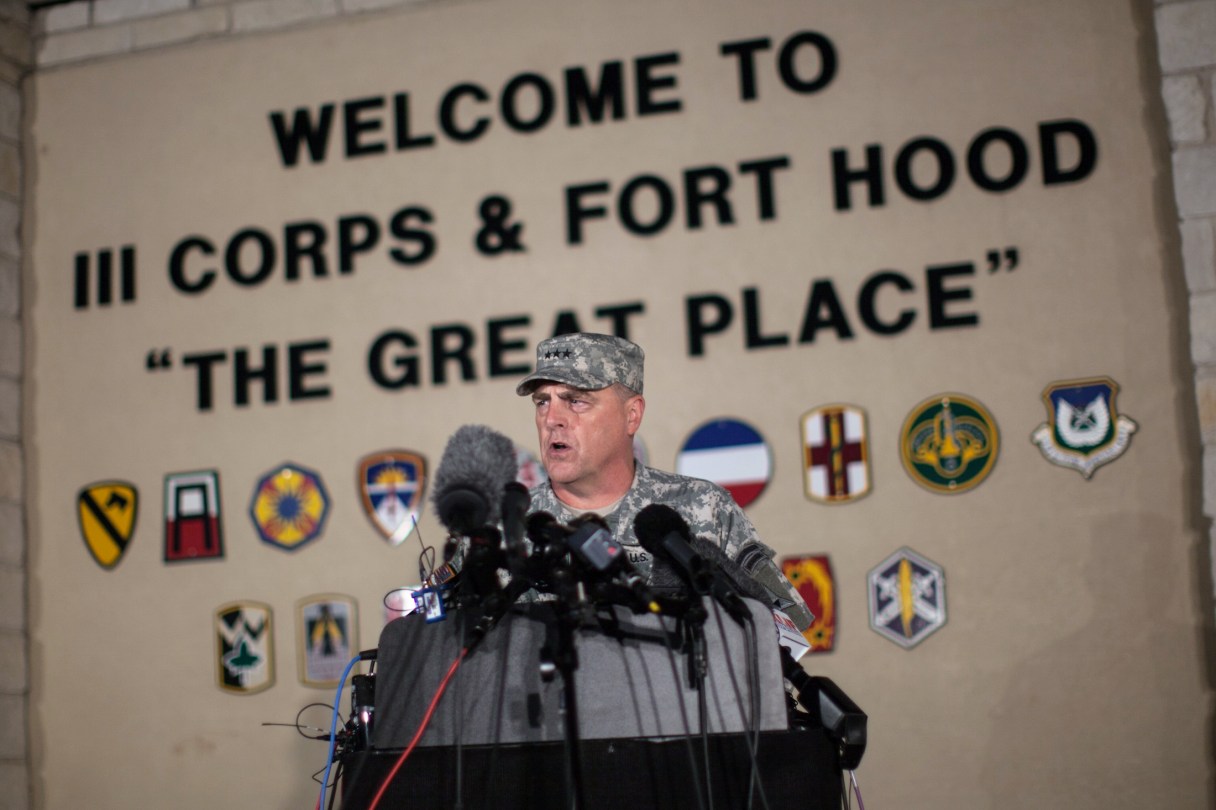
FILE  - In this April 2, 2014 file photo, Lt. Gen. Mark Milley, commanding general of III Corps and Fort Hood, speaks with the media outside of an entrance to the Fort Hood military base following a shooting that occurred inside, in Fort Hood, Texas. Fort Hood did not have a system in place that could have anticipated a deadly rampage last April that left four soldiers dead and 16 wounded, according to a U.S. Army report released Friday, Jan. 23, 2015. (AP Photo/Tamir Kalifa, File)
FILE - In this April 2, 2014 file photo, Lt. Gen. Mark Milley, commanding general of III Corps and Fort Hood, speaks with the media outside of an entrance to the Fort Hood military base following a shooting that occurred inside, in Fort Hood, Texas. Fort Hood did not have a system in place that could have anticipated a deadly rampage last April that left four soldiers dead and 16 wounded, according to a U.S. Army report released Friday, Jan. 23, 2015. (AP Photo/Tamir Kalifa, File) FILE - In this April 2, 2014 file photo, Lt. Gen. Mark Milley, commanding general of III Corps and Fort Hood, speaks with the media outside of an entrance to the Fort Hood military base following a shooting that occurred inside, in Fort Hood, Texas. Fort Hood did not have a system in place that could have anticipated a deadly rampage last April that left four soldiers dead and 16 wounded, according to a U.S. Army report released Friday, Jan. 23, 2015. (AP Photo/Tamir Kalifa, File)

FORT WORTH, Texas (AP) – Fort Hood officials say there were no clear warning signs before a soldier went on a rampage last April that left four dead and 16 wounded, according to a U.S. Army report released Friday.

There was no indication that Spc. Ivan Lopez would go on a two-block shooting spree before killing himself on April 2, the report concluded. It also said the chain of command would have had difficulty recognizing any personal problems leading up to the attack, because risk assessment relies on self-reporting and Lopez had been dishonest with his supervisors.

“In the absence of a system capable of identifying (Lopez) as a threat, and because the unit was unaware and unable to address the variety of stressors in (Lopez’s) life, Fort Hood was not able to prevent the shooting,” lead investigator Lt. Gen. Joseph E. Martz said in the report.

No single factor prompted the incident, the report said, despite Army investigators’ previous findings that Lopez had been in an argument over a leave request.

Investigators have said the 34-year-old Iraq War veteran was undergoing treatment for depression and anxiety while being evaluated for post-traumatic stress disorder, but was not considered “likely” to commit violence.