
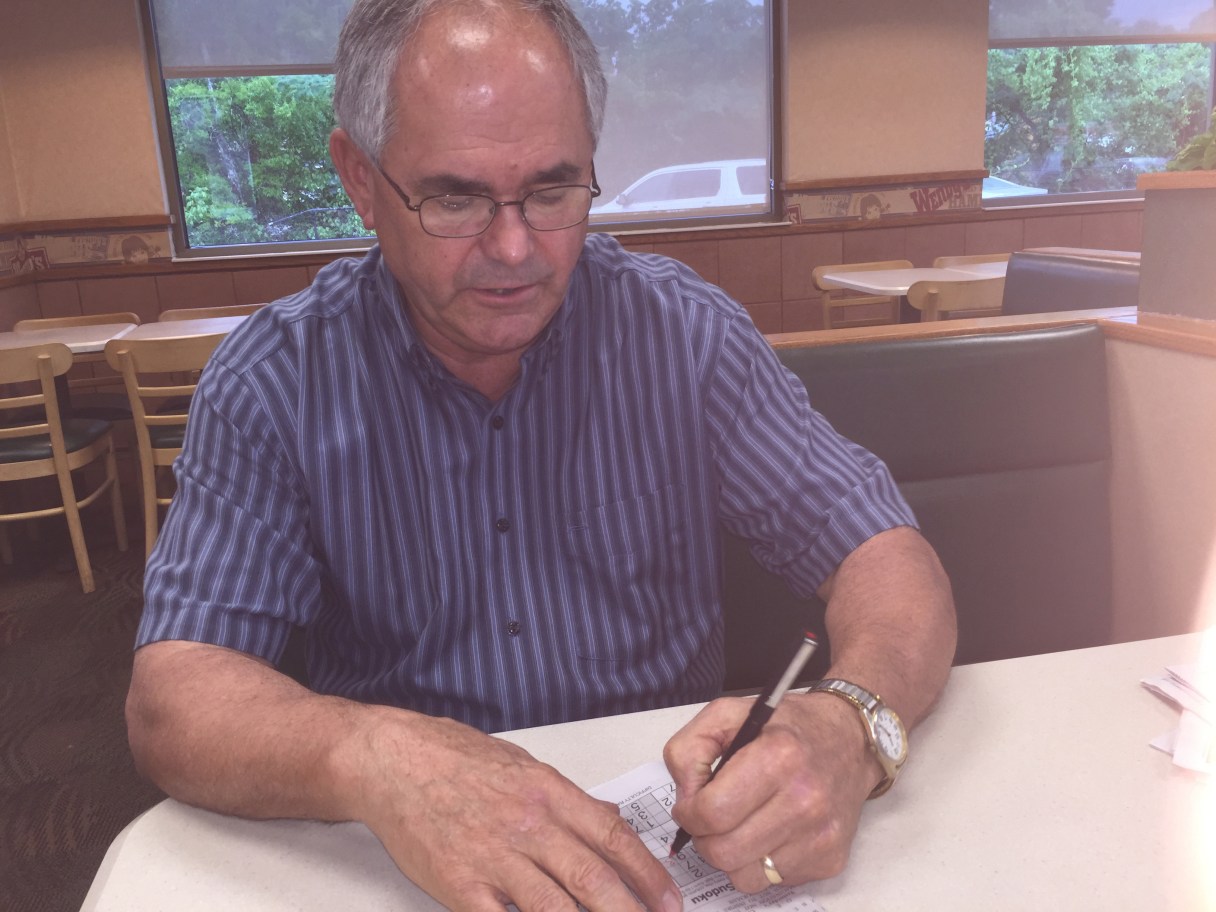
Gene Bennett, a 68-year-old former Pepsi truck driver, is a creature of habit. Every morning, Bennett pours himself a cup of coffee, grabs his morning newspaper and fires up his brain.
Bennett’s passion is Sudoku, those little number puzzles in the Life section of the Times Free Press that are a cross between arithmetic and a Rubik’s Cube.
He works the puzzles religiously, and successfully completed his 2,000th consecutive Sudoku grid last week – a streak that stretches back six and a half years.
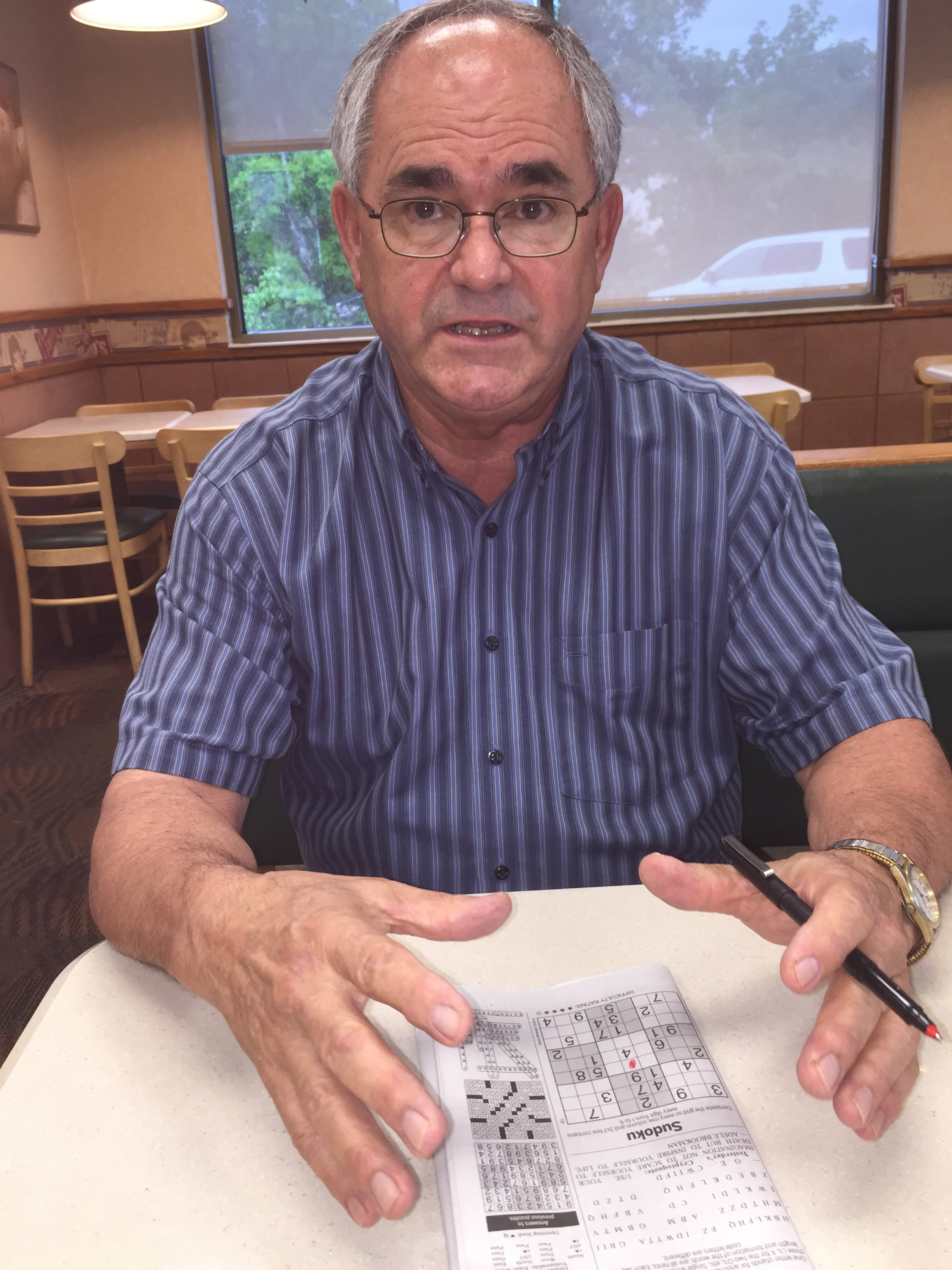 Gene Bennett, of East Brainerd, has worked the Sudoku puzzle for more than 2,000 days in a row.
 Mark Kennedy
Bennett is the Cal Ripken Jr. of Sudoku, the iron man of paper puzzles.
He documents his daily victories on a little yellow legal pad, registering each successful effort every Monday through Saturday – there is no Sudoku puzzle in the Sunday Times Free Press.
“I was never expecting to get to 1,000,” said Bennett one day last week, while methodically working a Sudoku puzzle at a Wendy’s restaurant on East Brainerd Road. “It’s like they say: A thousand-mile journey begins with a single step.”
Sudoku is a relatively new phenomenon. The modern Sudoku-style puzzle is believed to have been invented by a retired Indiana architect in 1979 and called “Number Place.” A Japanese game company later adopted the formula and renamed it Sudoku – Japanese for “the digits are limited to one occurrence.” By the late 2000s, the puzzles had begun popping up in many American newspapers.
If you’re not familiar with Sudoku, each puzzle is a grid 9 spaces by 9. Each row of spaces, horizontally and vertically, must be filled in to contain the numerals
1 through 9 without any repeats. Each puzzle also has a set of embedded 3-by-3 squares that must also contain all nine digits.
To seasoned Sudoku enthusiasts, the numbers simply buzz around in their heads until they line up in the proper order and march themselves down to the page. The puzzles start out easy on Mondays and get progressively harder as the days roll by. The difficulty level can be easily manipulated by how many numerals the puzzle-maker chooses to give away at the start.
Bennett says he can work the Monday-though-Wednesday puzzles in the Times Free Press in about five minutes each – with an ink pen. Later in the week, he said, the puzzles take him 10 minutes or more to complete. Sometimes he makes several copies of the puzzle to help him experiment with different number combinations. The puzzle-makers use a star system to telegraph a puzzle’s difficulty, three stars for easy and five or six stars for puzzles designed to make your brain bleed.
One day, Bennett said, he had to make 14 copies before solving the puzzle correctly. He walked away from it several times, he said, before finally solving it the next day.
“That’s as close as I ever came to quitting,” he admits.
Bennett says he was introduced to the game by a church friend. Over time, people have given him Sudoku books and even a computerized version of the game, but he still prefers paper and pen.
“It teaches you to think logically,” he said of the game. “It keeps my mind sharp – what little mind I have left.”
Contact Mark Kennedy at mkennedy@timesfreepress.com or 423-757-6645.
Follow him on Twitter @TFPCOLUMNIST. Subscribe to his Facebook updates at www.face book.com/mkennedy columnist.