
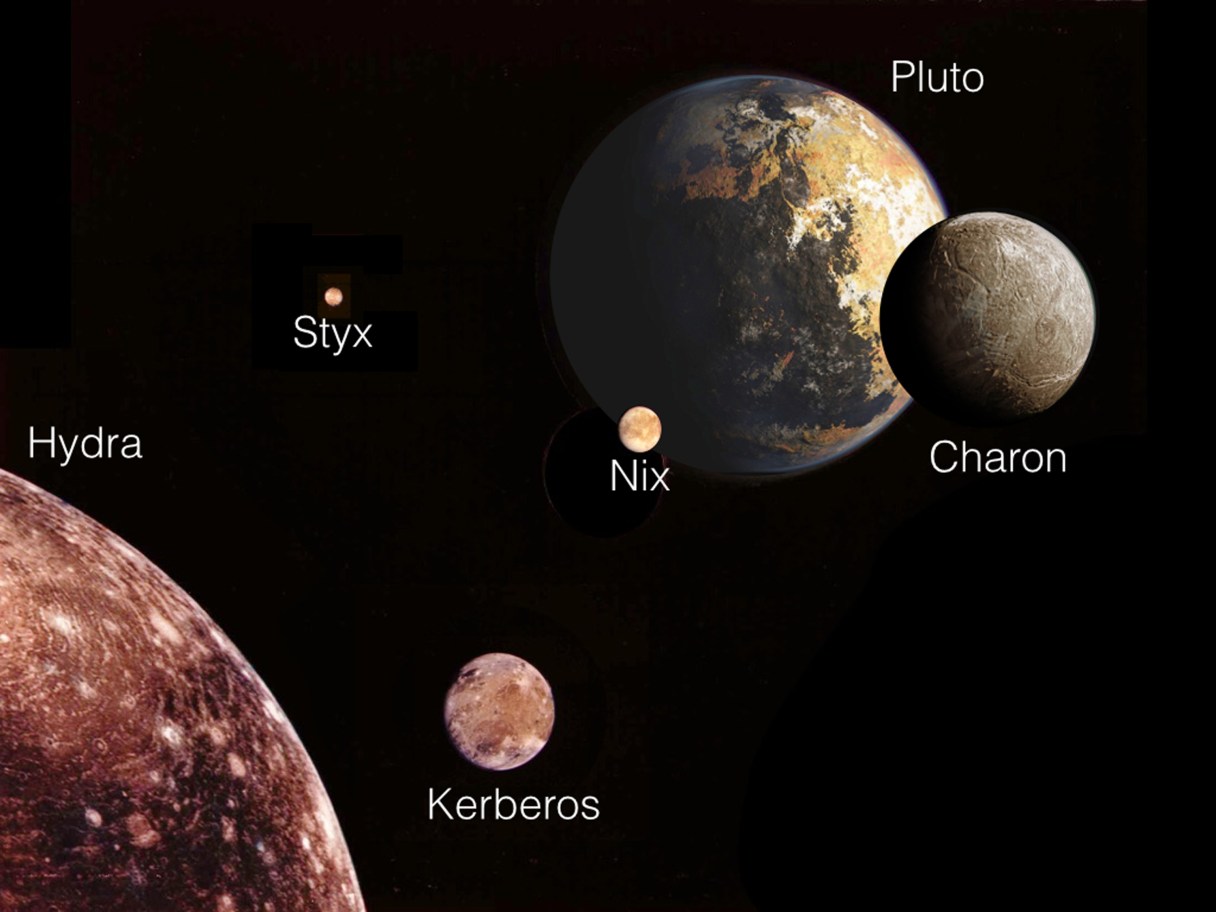
 An artist’s concept of Pluto. In a few days, NASA’s New Horizons spacecraft will zip past the former ninth planet, the first up-close look of the icy world in the outer solar system. (Johns Hopkins University Applied Physics Laboratory/Southwest Research Institute/NASA via The New York Times) —FOR EDITORIAL USE ONLY
Read more
Krauthammer: Pluto and us
Come Tuesday morning, after nine and a half years of flying through the solar system at 31,000 miles per hour, NASA’s New Horizons spacecraft will pass Pluto.
The flying science lab will transmit photos and scientific readings that will tell us for the first time things we have and have not even begun to imagine about the dwarf planet once thought to be the farthest outpost of our galaxy. The information won’t rewrite textbooks about Pluto and distant space. It in fact will write those textbooks for the first time, according to Dr. Alan Stern, the principal investigator in the New Horizons space program, who talked recently with reporters at The New York Times.
Pluto was demoted by astronomers from “planet” to “dwarf planet” about a decade ago because, according to the International Astronomical Union, “A true planet must be able to clear its orbital path of other objects.” Say, what?
Whatever. For most of us Pluto, with its mercurial name, remains the mystery of our galactic rural suburbs. It is so far away – about 3 billion miles away – that the speed of light from there is really not speedy. It takes almost five hours for a glimmer of light from Pluto’s surface to reach our eyes. Two-way radio communication between the spacecraft and its operators requires a nine- to 10-hour round trip. Even with the Hubble Space Telescope, the best pictures we’ve ever seen of this distant orbiter that is about two-thirds the size of our moon appeared merely as tiny, pixelated blobs.