
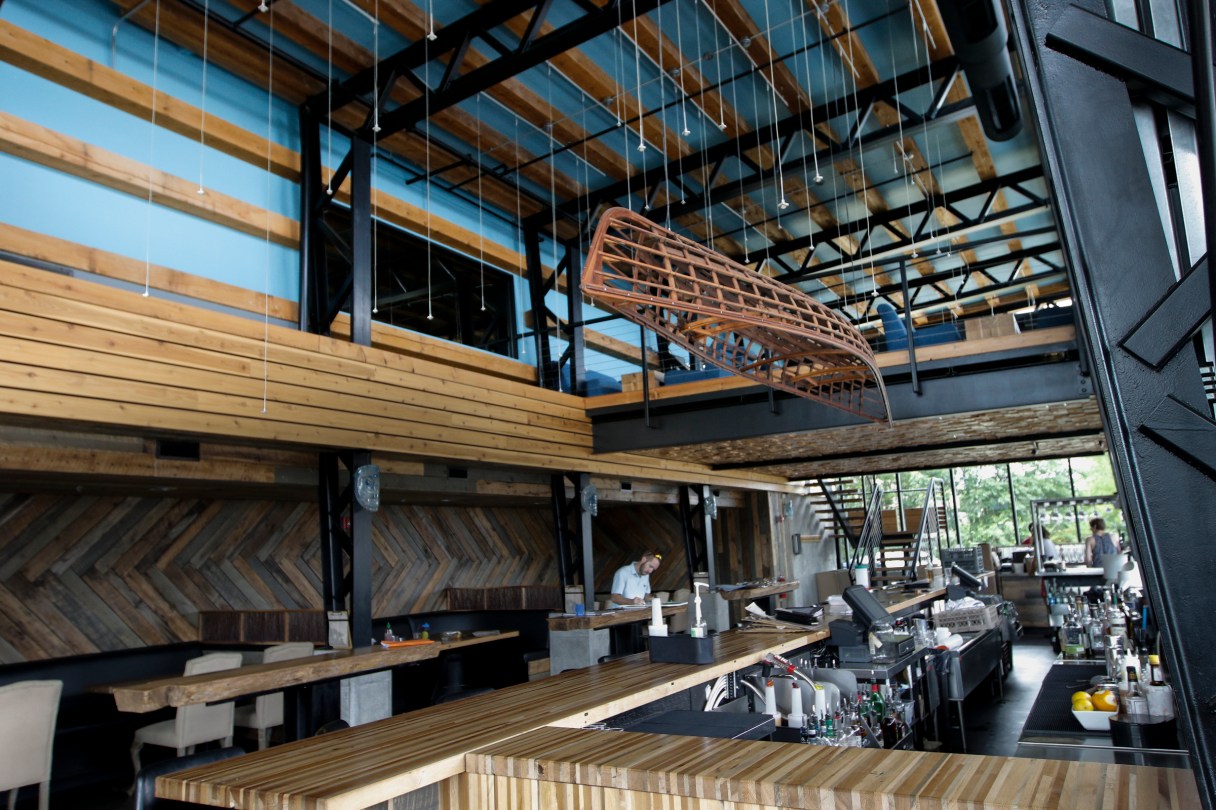
A Chattanooga eatery whose layout blends the city’s industrial legacy and its expansive mountain-rimmed landscape captured the public vote in an annual design contest.
The Flying Squirrel last weekend won the “People’s Choice” category for best-designed café and bar in the Restaurant Design Awards, sponsored by the Los Angeles chapter of the American Institute of Architects.
Palmer Built Environments and Haskel Sears Design were the creative masters of the Southside building. The Chattanooga firms’ chief priorities included embracing the spirit of what Flying Squirrel owners Max Poppel and Dan Rose already had next door, the LEED-certified Crash Pad hostel, which caters to outdoor athletes and creates a sense of community among them and the city.
“We wanted it to be very connected to the outdoors and the landscape,” said architect Thomas Palmer, founder and owner of Palmer Built Environments, which merged with Cogent Studios in February. “And really connected to the street and being able to generate sidewalk traffic and bicycles and walking, and to make it very accessible.”
To that end, one side of the bar is outdoors, its other sides claiming views of the outdoors. Total outdoor seating is 70, the same number of seats there are indoors. Glass walls encase three sides of the building, and a glass entry reaches eight feet high and five feet wide, pivoting at its center as the building’s gateway.
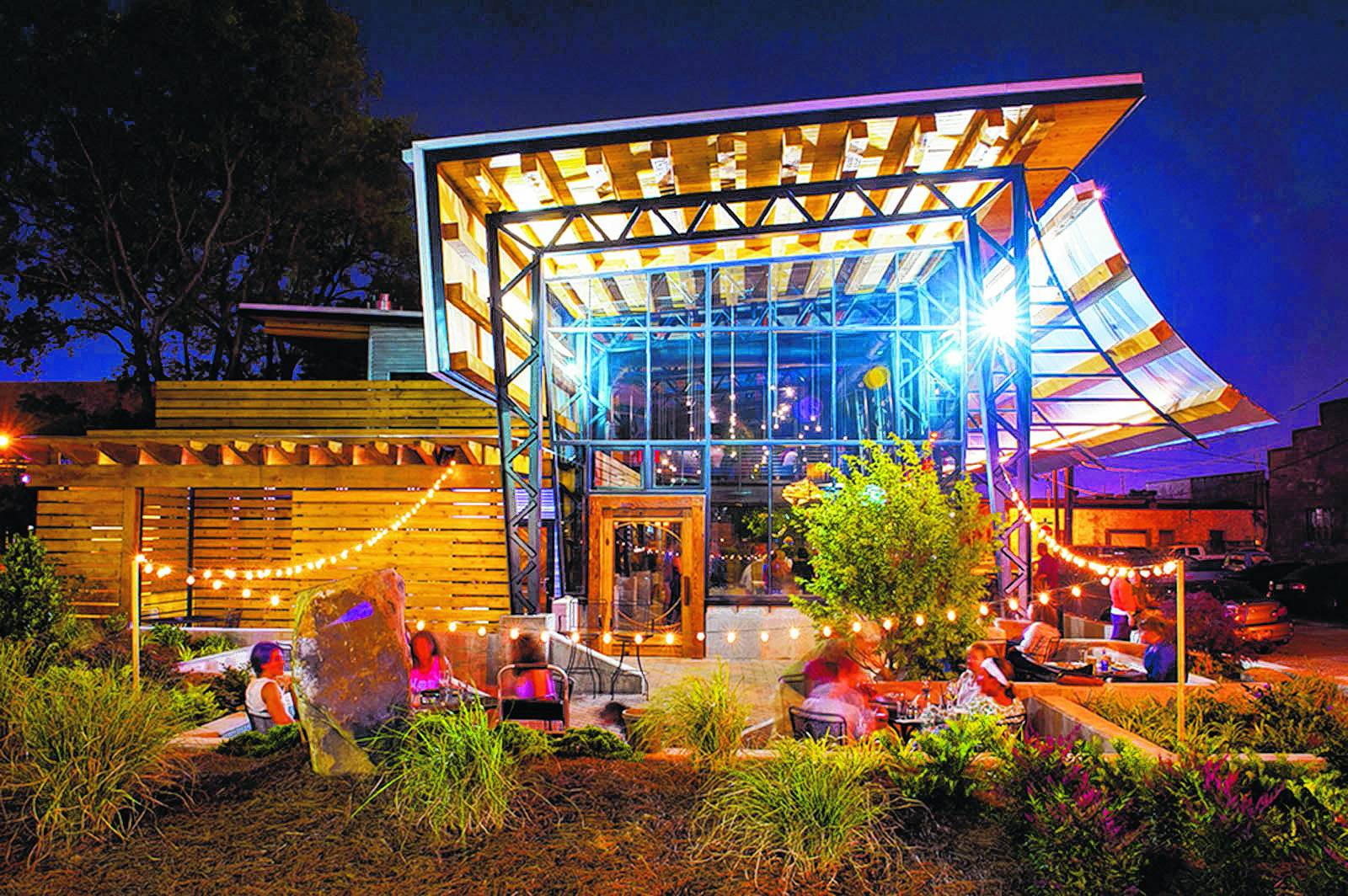 The Flying Squirrel restaurant on Chattanooga’s Southside. The owners of the $1.5 million eatery, which opened in 2013, say it is a work of art with its exposed trusses and giant cedar beams that make up the backbone of the building, to the locally crafted fixtures and furnishing.
“It’s your first encounter with the interior,” said Matt Haskel Sears, whose namesake firm handled all the interior finishes. “It opens effortlessly, you pass through, and you have this long visual shot of the space.” A frame of timber more than a century old, from a local mill or factory surrounds it.
The space intentionally has no televisions. “I tried to build an interior that was timeless and would be interesting enough for people to not get bored with it,” Sears said. “To have a space people could enjoy over and over again, not just a one-time wow factor.”
Poppel and Rose gave Sears and Palmer great freedom “to build something that was not just functionally useful, but aesthetically pleasing too,” Sears said. “A highly functional piece of art that’s a building.”
Almost every element inside is custom made, Sears said. “There’s really nothing that’s conventional or off the shelf.”
Ancient wood wraps the interior, and a canoe that Sears built — not intending it for the Squirrel — is a light fixture. Reclaimed steel beams serve as bases for tables, whose surface is reclaimed wood slabs, in keeping with Sears’ professional (and personal) philosophy. Haskel Sears Design has, in part, built its reputation by choosing what it will make and how it will make it based upon green principles, progressive design and sustainable development.
Palmer, who moved to Chattanooga in 2007 and opened his architecture firm the same year, also designed Clyde’s and Green|Spaces in the Southside.
“I’ve been very inspired by Chattanooga’s industrial past, and a lot of architecture that’s utilitarian I find very beautiful,” he said.
The Flying Squirrel’s steel trusses demonstrate his sentiment in three dimensions.
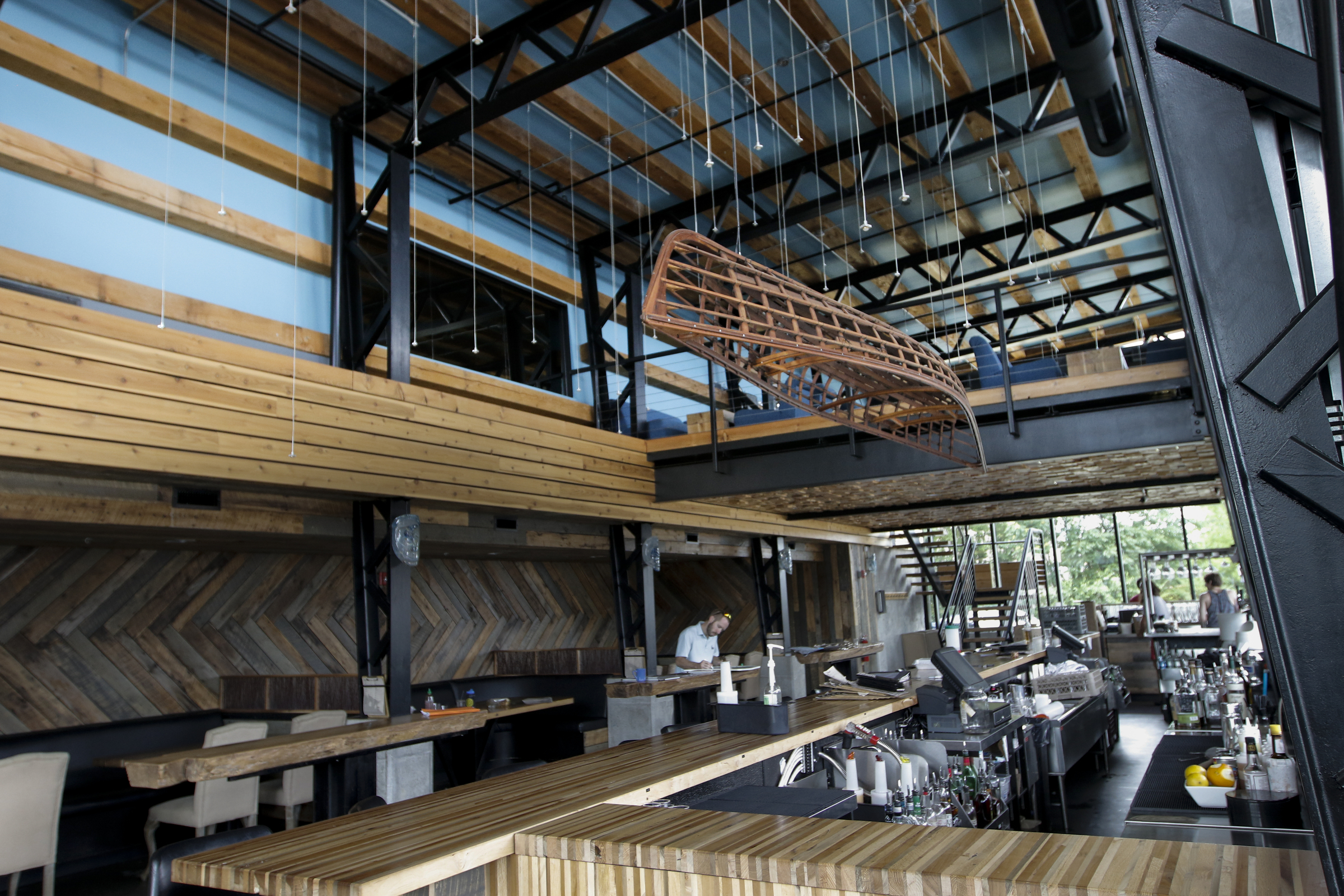 A decorative canoe hangs above the bar of the Flying Squirrel on Tuesday, June 2, 2015, in Chattanooga. The Flying Squirrel was recently voted the best-designed cafe and bar in the Restaurant Design Awards.
“Thomas did a great job of taking structural elements, and instead of trying to hide them he actually accentuated them,” Sears said.
A total of 27 eateries entered the Restaurant Design Awards’ café and bar category. Last year’s winner was Café Saul. E Mendez in Guatemala City, Guatemala.
“This just shows us once again that Chattanooga can rally behind its own better than cities 20 times our size,” Poppel said Tuesday. “We’re incredibly appreciative of everyone who voted for us.”
The Flying Squirrel opened in May 2013. It cost about $1.5 million to build, Poppel said.
Contact staff writer Mitra Malek at mmalek@timesfreepress.com or 423-757-6406. Follow her on Twitter @MitraMalek.