
The story lines for this week’s U.S. Open are familiar.
And different.
It’s the golf tournament that has survived as much as it has won. It’s the event that can haunt men’s dreams – ask Phil – and the one that puts a premium on accuracy as much as everything else.
The Open will test players’ patience as well as their power. It will be a challenge for the nerves and the knack of every golfer in contention.
But the usual suspects step to the forefront. Again.
 Jay Greeson
We know Tiger Woods will be a story, but that story will be one of wonder and fear. For the first time, he is an underdog to make the cut. Yes, Tiger Woods, in the all-knowing eyes of Vegas, is picked to fail.
We know Phil Mickelson will be a story. Lefty, who turned 45 Tuesday, has six career runner-up finishes at our national golf championship. With a win at Chambers Bay, he would complete the career Grand Slam.
We know the two young studs – Rory McIlroy and Jordan Spieth – will be a story. Their future – and the game’s future in a lot of ways – is an interesting subplot at every major. The difference moving forward, though, is how they handle the pressure of being favored every week.
We know the winner, whomever it may be – our two picks are Jason Day and Jimmie Walker – will be a story. That said, we think there will a first-time major champion crowned Sunday night.
We know the course will be a story. It always is when the United States Golf Association tries its best to reinstate par as a good score for the game’s best players.
But this may be the biggest difference of them all this week.
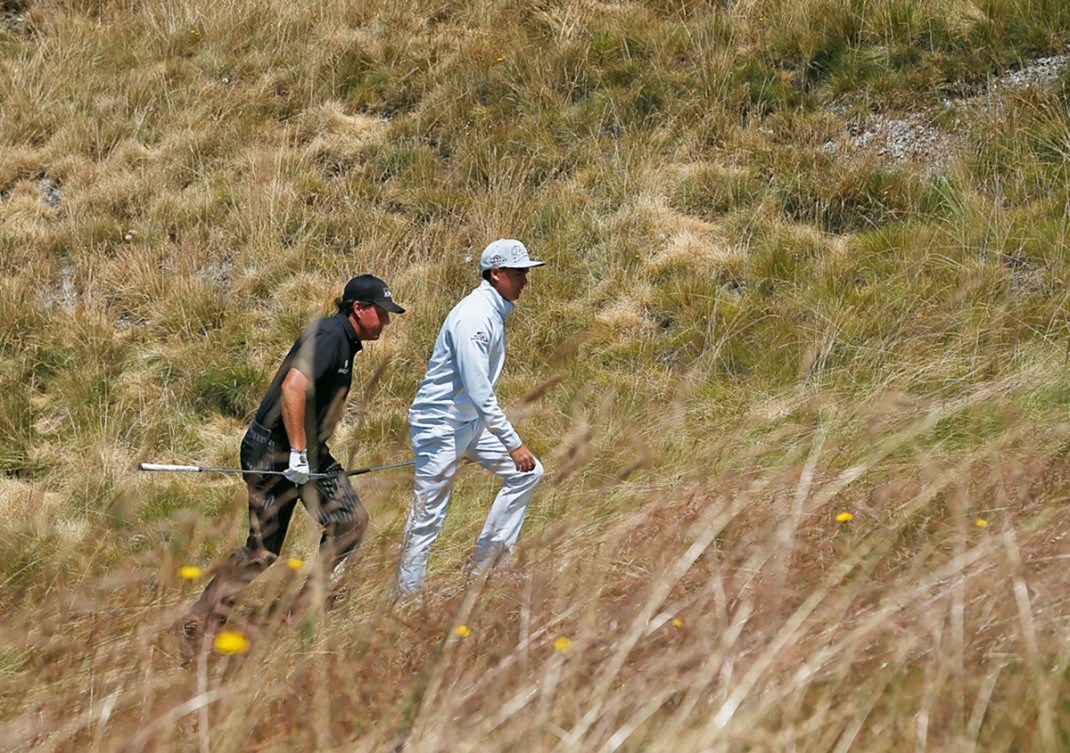
Chambers Bay is nuts. The twists and turns – never mind the fescue grass – will make this unlike any U.S. Open in recent memory and more like every British Open we can recall.
“The first time you play it, it’s like St. Andrews,” Mickelson told reporters this week. “You don’t know where to go.
The course is just 8 years old, a veritable pup by comparison to the other tracks we see most years.
Like those familiar, famous courses, it will set up impossibly long. There will be four of the five longest par 4s in U.S. Open history on the back nine at Chambers Bay. That does not include the first hole, which – like the 18th – may play as a par 5 or a par 4, depending on the day and the mood of the USGA.
We are all for mixing the venues, but this seems a little like Sir Goony’s. It’s one thing to move the pins or tees, but to alter the score of par on a daily basis seems more than unorthodox. It seems simply uncool. Players want to have a firm idea what they are going to do as soon as possible, and not knowing whether the first hole is a scoring hole or a surviving hole is beneath our expectation of major championship golf.
Ask yourself this: Do you see Augusta National or the R&A trying some poppycock idea like that? Exactly.
The craziness – or the unknowns – do not end there, but the rest are part of the struggle that have become synonymous with the U.S. Open.
Players must be creative, using a variety of shots around monster greens to try to get up and down in a tournament that is defined by saving par. Players must be steely and resilient. Players must handle the pressure, especially on the weekend, that comes when major championships are on the line.
Granted, all of this comes on a course that has all of one tree, and that will take some time to get used to, but those nuances are exciting.
So the June of champions – Triple Crown winner, Stanley Cup, NBA Finals and now this – will continue on a track that will give us a U.S. Open unlike one we have ever seen.
While the players may be bemoaning that fact – and the unknown unfairness of the starting and finishing holes deserves the complaints – there is something to be said for new and different for a sporting public intrigued by that.
The longstanding love affair based as much in beauty as familiarity between the public and Augusta National can never be replicated at the other majors, so trotting out an overarching surprise offers excitement.
And we all can agree that’s something golf needs more than ever.
Contact Jay Greeson at jgreeson@timesfreepress.com and follow him on Twitter @jgreesontfp. You can read his online column, “The 5-at-10,” Monday through Friday at timesfreepress.com after 10 a.m.