
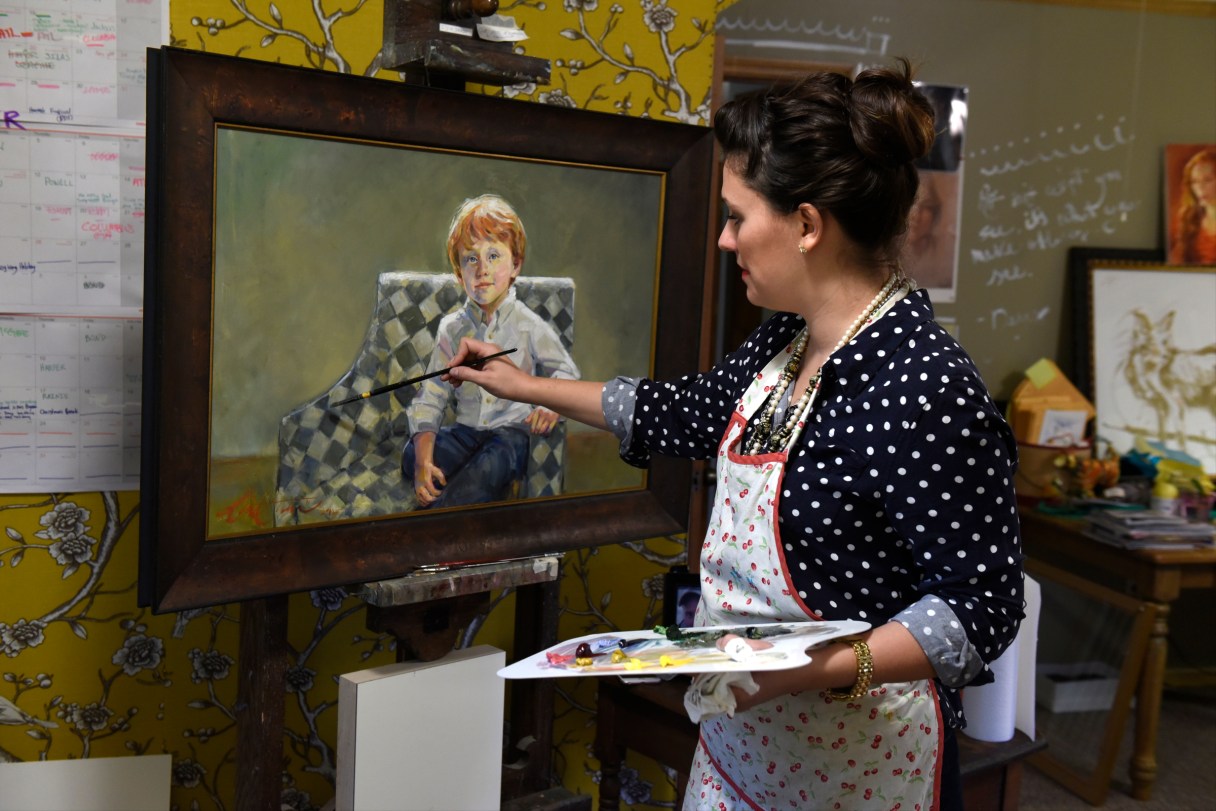
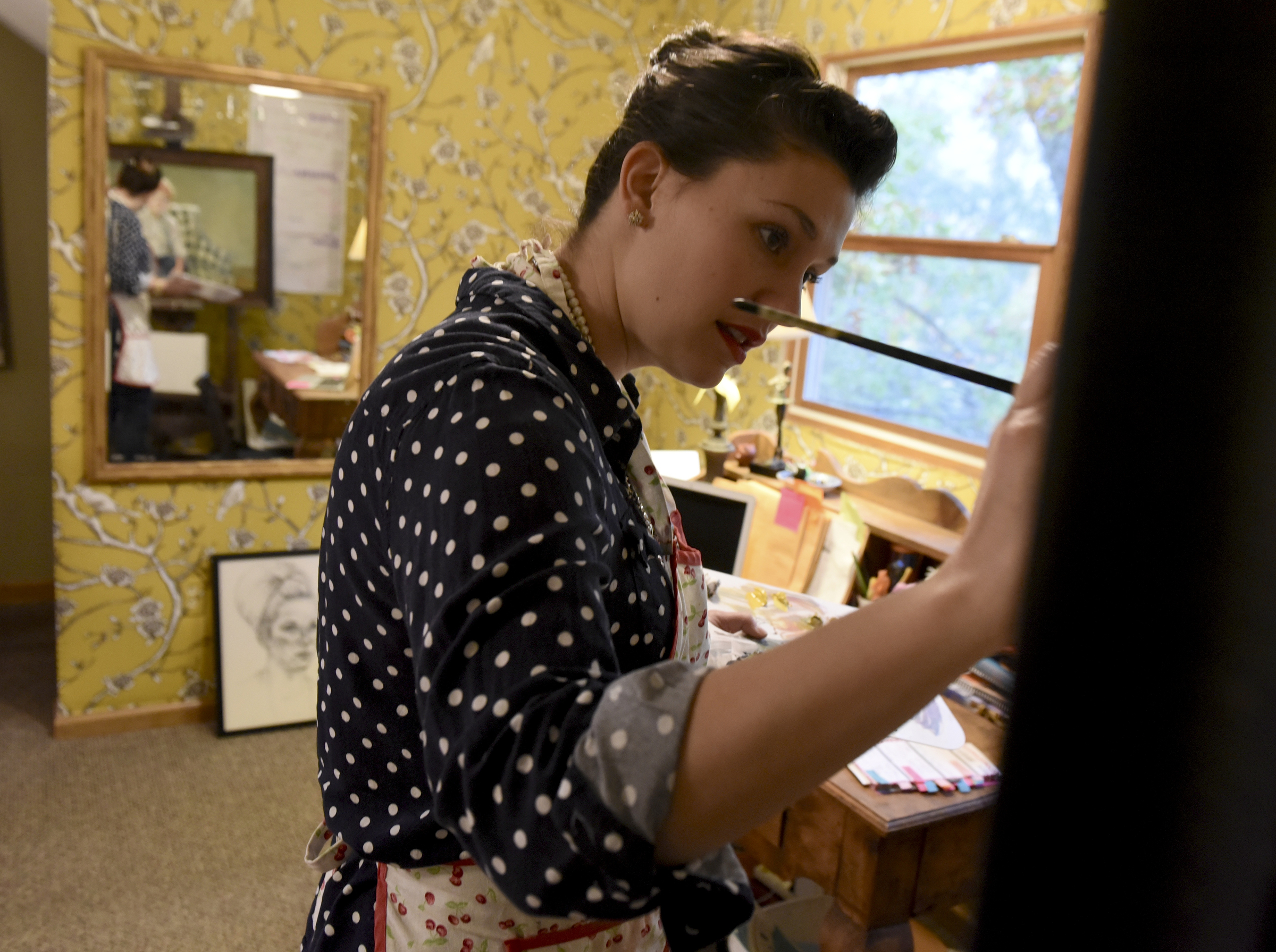
 Portrait artist Liz Lindstrom works on a painting in the studio in her home on Tuesday, Oct. 28, 2015, in the town of Signal Mountain, Tenn. She uses a mirror across the room from her easel to give herself a different perspective as she works.
Liz Lindstrom paints portraits for a living – children, adults, some pets with the family.
When the company she works for, Portraits Inc., held a competition in New York, Lindstrom knew whom she wanted to paint – Autumn Graves, headmaster at Girls Preparatory School.
Though she was home-schooled and has no affiliation with Girls Preparatory School, Lindstrom was impressed to hear that Graves had challenged the GPS students to be “Mad, Bad and Dangerous,” encouraging them to “ditch expectations” and “start something” in their lives. But there was even more.
“Her career is just so interesting,” say Lindstrom, the daughter of local painter Bart Lindstrom.
The portrait that Lindstrom painted of Graves, a career educator who came to GPS from Sidwell Friends School in Washington, D.C., took third place in a juried competition called “The Modern Portrait, Recent Additions to Portrait Inc. Collection.” The portrait, along with the other winners in the contest, is part of a nationwide traveling exhibit at Portraits Inc. locations and is currently at the company’s store in Birmingham, Ala.
Lindstrom, 33, paints her portraits from photographs she takes during usually one, but sometimes several, sessions with the client. She spent several hours with Graves, not only taking pictures but also getting to know her.
“I asked about her career and what inspires her,” Lindstrom says.
Graves says she’d only sat for her wedding portrait prior to this experience and appreciated how comfortable Lindstrom made her feel.
“I’m not part of the selfie generation,” she says. “I don’t take a lot of pictures of myself.”
In the portrait, Graves is shown with her hands in front of her, fingertips touching as if she is about to say something important. Lindstrom added a colored pattern to the flat gray dress Graves wore to the sitting.
Graves says the painting captures both her soft and tough sides.
“I’m kind of a big softie,” she says. “I can watch a 30-second commercial and cry, but I can also make really tough decisions that impact people’s lives. I feel like she captured that a lot.”
Lindstrom says Graves has a big personality that she wanted to showcase.
“I felt she just so fills a space, so I painted her with little space above her head in the painting. She also talks with her hands to make a point.
“She [Graves] was happy with it,” Lindstrom says. “I wanted it to be busier to reflect her personality. She did giggle about those hands.”
Such changes are normal for Lindstrom in her work. On the day she and Graves met in her studio, Lindstrom was working on a portrait of a young boy, darkening the blue squares on a chair on which he was sitting; the original chair was solid white.
She makes such changes either to showcase a trait, such as whimsy or a busy personality, that she’s noticed in her subject, but sometimes the changes are to complement the frame or the room where the portrait will hang. She says her finished works showcase “how the person feels to me.”
Lindstrom took no formal painting lessons, but learned to paint from her father and other local painters such as Gordon Wetmore and Jim Aplin. Her subjects come from all over the country, with most from the Southeast, in particular Atlanta. Some are done in a watercolor wash or in charcoal and conté, a type of crayon made of graphite and clay, or in oils.
She paints in her home studio on a large easel that once belonged to her father. Behind her is a large mirror and, when painting, she constantly looks at the piece over her shoulder in the mirror.
“It gives me a reverse image and a farther-away perspective that is usually more accurate,” she says.
It’s a trick she learned from her father. She also tries to remember an oft-quoted saying of his: “It takes to people to paint – one to paint and one to shoot him before he ruins it.”
Contact Barry Courter at bcourter@timesfreepress.com or 423-757-6354.