
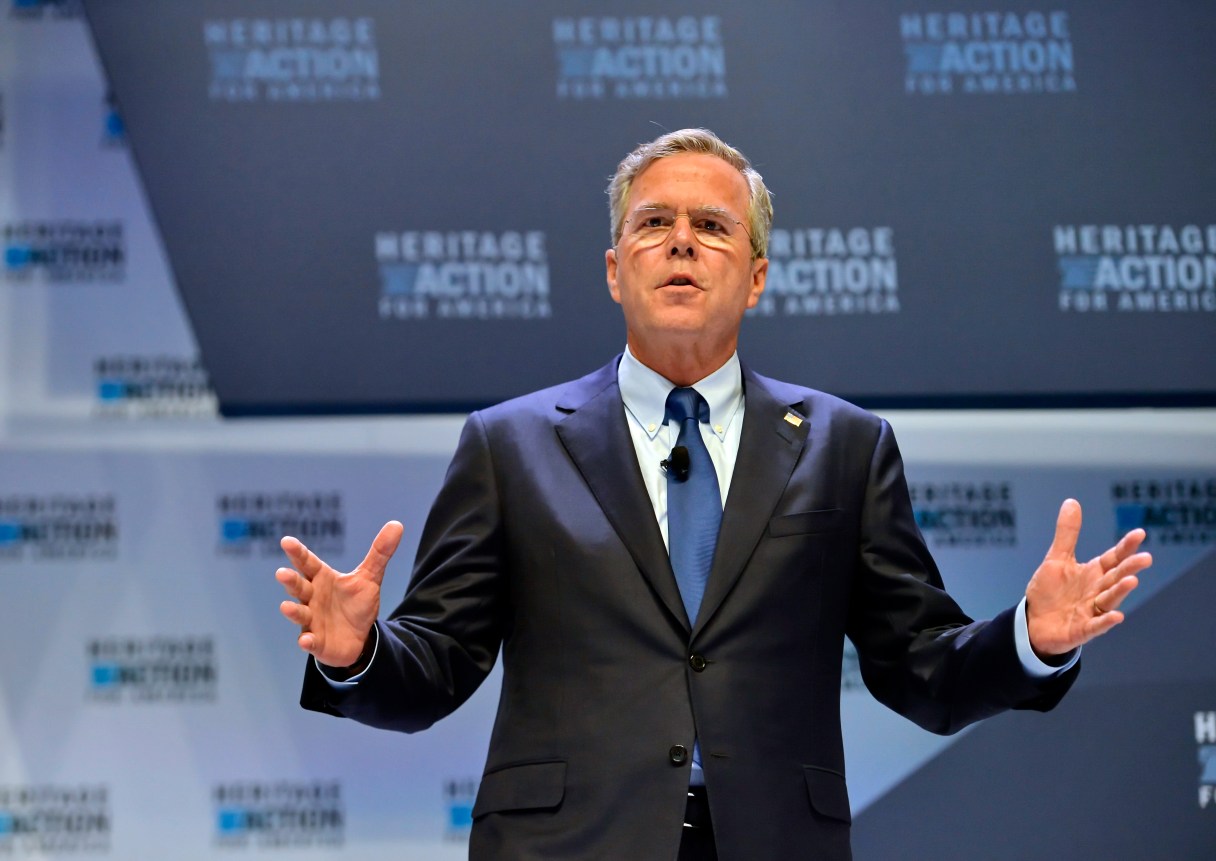
GREENVILLE, S.C. (AP) – Setting aside personality clashes for a night, the Republican Party’s 2016 contest shifted to substance Friday as a slate of White House hopefuls professed their devotion to conservative values in battleground South Carolina.
They vowed to eliminate federal departments that regulate education and environmental protection, called on congressional leaders to block federal funding from Planned Parenthood even if it triggers a government shutdown, and promised to adopt policies that reduce the number of unwed mothers.
“Just once, Republicans should nominate someone who is as committed to conservative principles as Barack Obama is committed to liberal principles,” Texas Sen. Ted Cruz told a crowd of thousands gathered in a South Carolina arena.
But even among a friendly crowd, there were tense moments.
Former Florida Gov. Jeb Bush triggered boos when he defended his early support for the Common Core education standards, a policy developed by state leaders in both parties that has become a target of tea party ire.
“I’m for higher standards, and Common Core standards are higher than the standards that exist,” Bush said before being interrupted by boos. “If South Carolina wants to be without Common Core standards, great, just make sure the standards that you apply are higher than the ones before you had Common Core. Standards matter. Accountability matters.”
Friday’s forum comes two days after the GOP’s 2016 class met for its second debate, a California faceoff that exposed deep rifts between the candidates on immigration, foreign policy and the Supreme Court’s ruling on same-sex marriage. The debate, like much of the early 2016 primary season, has been dominated by strong personalities – brash billionaire Donald Trump, in particular.
Trump was a late scratch for Friday’s presidential forum, hosted by Heritage Action for America, the political arm of a Washington-based conservative think. The event also featured retired neurosurgeon Ben Carson, Florida Sen. Marco Rubio, former technology executive Carly Fiorina, Wisconsin Gov. Scott Walker, New Jersey Gov. Chris Christie, Kentucky Sen. Rand Paul, former Pennsylvania Sen. Rick Santorum and Louisiana Gov. Bobby Jindal.
Walker, facing a sharp decline in the polls, charged that he’d “take all the education money out of Washington” and send it to individual states. In addition to closing the federal education department, he called for the same shifts in federal funding for transportation, the environment, workforce development and Medicaid, the health-care program for the poor.
He also called for congressional Republicans to strip federal funding from Planned Parenthood even if it causes a government shutdown. He suggested that Senate Republicans use the so-called “nuclear option” to bypass filibuster rules that often require 60 votes to proceed on contentious issues.
“We don’t have to play by those rules,” Walker said.
Beyond Common Core, the party’s more conservative wing has criticized Bush for his support for an immigration overhaul that includes a pathway to legal status for immigrants in the country illegally.
“He could perform like Superman in the debates, but he’s dead in the water with the tea party and the base generally,” said tea party movement co-founder Mark Meckler. “He’s the only candidate they absolutely loathe.”
Other Republican governors, including Walker, previously supported Common Core, and candidates such as Carson have supported a pathway to legal status for immigrants in the country illegally.
Carson cited his recent proposal for a guest worker program for such immigrants to perform “work that Americans won’t do.” He mentioned agricultural workers.
But he avoided a question about whether those workers would have permanent legal status and be eligible for various federal benefits. “Guest workers are not eligible for anything unless we, the American people, decide” they are, he said.
South Carolina’s Feb. 20 primary shapes up as a critical bridge between the traditional opening states of Iowa and New Hampshire and a March 1 “Super Tuesday” that features a gaggle of Southern states, from Virginia to Texas. South Carolina GOP leaders expect as many as 600,000 voters to cast primary ballots, dwarfing turnout in Iowa, New Hampshire and Nevada, the other three states that hold primary contests in February. Republicans here pride themselves on having sided with the eventual nominee in every election from 1980 until 2012, when Newt Gingrich won a surprise victory over Mitt Romney, Rick Santorum and others.
Former South Carolina Sen. Jim DeMint now runs the Heritage Foundation.
Notably absent from Friday’s affair was the state’s senior senator and presidential hopeful Lindsey Graham, who finds himself languishing at the bottom of the polls nationally. Graham is a strong figure politically in South Carolina, but the most conservative activists in the Republican Party view him as too moderate and too willing to negotiate with Democrats.