
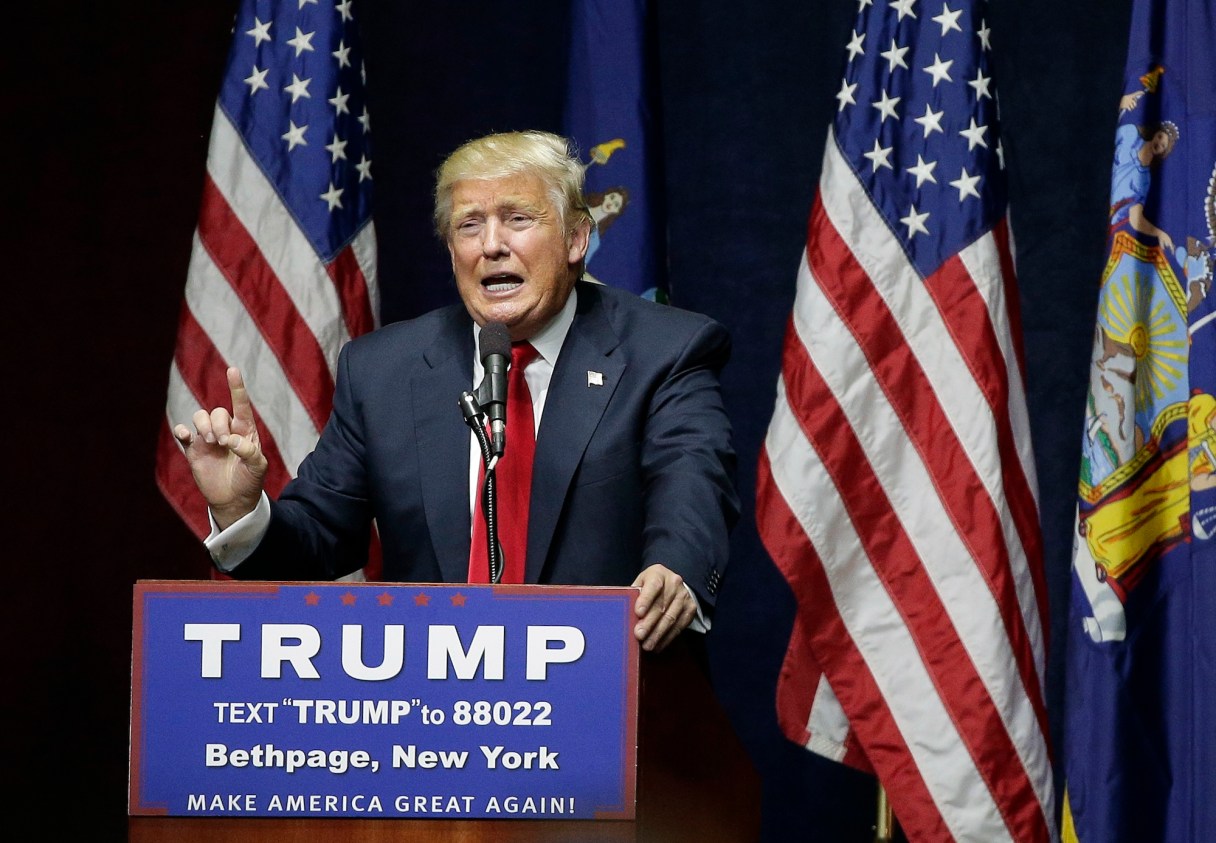
Enough already with the references to Donald Trump, the deal-making whiz-bang businessman.
You know, the ones that tout his “huge” biz brain? Shouldn’t he therefore be expected to know to read those tiny little letters clarifying the rules of every contract – like delegate and convention specifics?
So when the Donald doth protest too much about the Grand Ole’ Party’s delegate rules, doesn’t it just make your eyes cross?
It reddened the eyes of RNC Chairman Reince Priebus, who shot back with a tweet: “Nomination process known for a year + beyond. It’s the responsibility of the campaigns to understand it. Complaints now? Give us all a break.”
Obviously it has dawned on Trump that he may well arrive at the Republican National Convention this summer with the most popular votes, the most state victories and the most pledged delegates and still lose the nomination.
Not because the system is “stacked against him,” as he claims, but because he and his campaign didn’t do the reading, scouting and homework to actually check the “win” box. Kind of like when his kids didn’t think to find out the date by which they had to register to vote in New York in order to mark the ballot by their father’s name in the upcoming primary in their home state later this week. Have they never voted before?
But Trump, rather than acknowledge any failure on his part, has instead turned up rhetoric and continued to lash out at a process he (and most voting Americans) have never taken the time to study.
Voting Americans can be forgiven for not knowing all of the rules. After all, we love watching football, but until we play it we don’t immerse ourselves in the minutia of how to obey every new rule change – like the new ones about no forcible hits in the head or neck area.
But aside from failing miserably to understand the system and organize his campaign accordingly, Trump has clearly benefited from those same GOP rules, according to an analysis last week by NBC. In fact, Trump has benefited far more than any other GOP candidate under the party’s arcane rules for allocating delegates.
Trump now leads the Republican field with 756 delegates – or 45 percent of all delegates awarded to date. Yet he has won only about 37 percent of all votes in the primaries, according to the NBC analysis, meaning Trump’s delegate support is greater than his actual support from voters. In other words, by Republican Party math, Trump has been awarded a delegate bonus of 22 percent above his raw support from voters.
By contrast, the smarmy Ted Cruz – a Harvard lawyer who clearly has read the fine print – has handily organized his campaign to corral adrift delegates. Cruz’s 545 delegates comprise 32 percent of all delegates awarded to date, while he has won about 28 percent of all votes in the primaries, according to the NBC analysis. GOP math gives him a delegate bonus of 14 percent above his raw support. Further, he has fashioned a ground game to grab up still more delegates at the convention after the first round of votes.
Most Americans believe the nomination should go to whatever candidate has the most votes, according to polls. But votes are different from delegates, and a strong finish by Cruz could chip away at the idea that the nomination is automatically Trump’s to lose, according to NBC analysts. If there is an open convention, the will of those 20 million-plus voters will be channeled into a final decision by 2,472 delegates.
Unlike Trump – the deal-making, fine-print illiterate – Cruz not only knows how to read the rules, he knows how to use them. He finished second in the 2012 Senate primary in Texas, down 10 percentage points, only to win the runoff by 13 points. NBC analysts suggest that Cruz’s entire campaign now rests on pulling off that feat on a national scale – and convincing Republican activists that it’s legitimate.
Cruz to Trump: You very well may be fired.
The big question is how that will play with the American people – especially the Republican base that now will be slapped in the face with the fact that it has never fully understood the tricks Republican politicians play with voting rights, gerrymandering – and yes, delegate math.
Perhaps this year’s elections will wake up Americans to the reality that one person, one vote and majority rule don’t really mean what our civics classes once taught us.