
Thursday, October 29, 2026Oct 29

This story is free to read.

Just a burp: Intriguing hints of physics particle evaporate

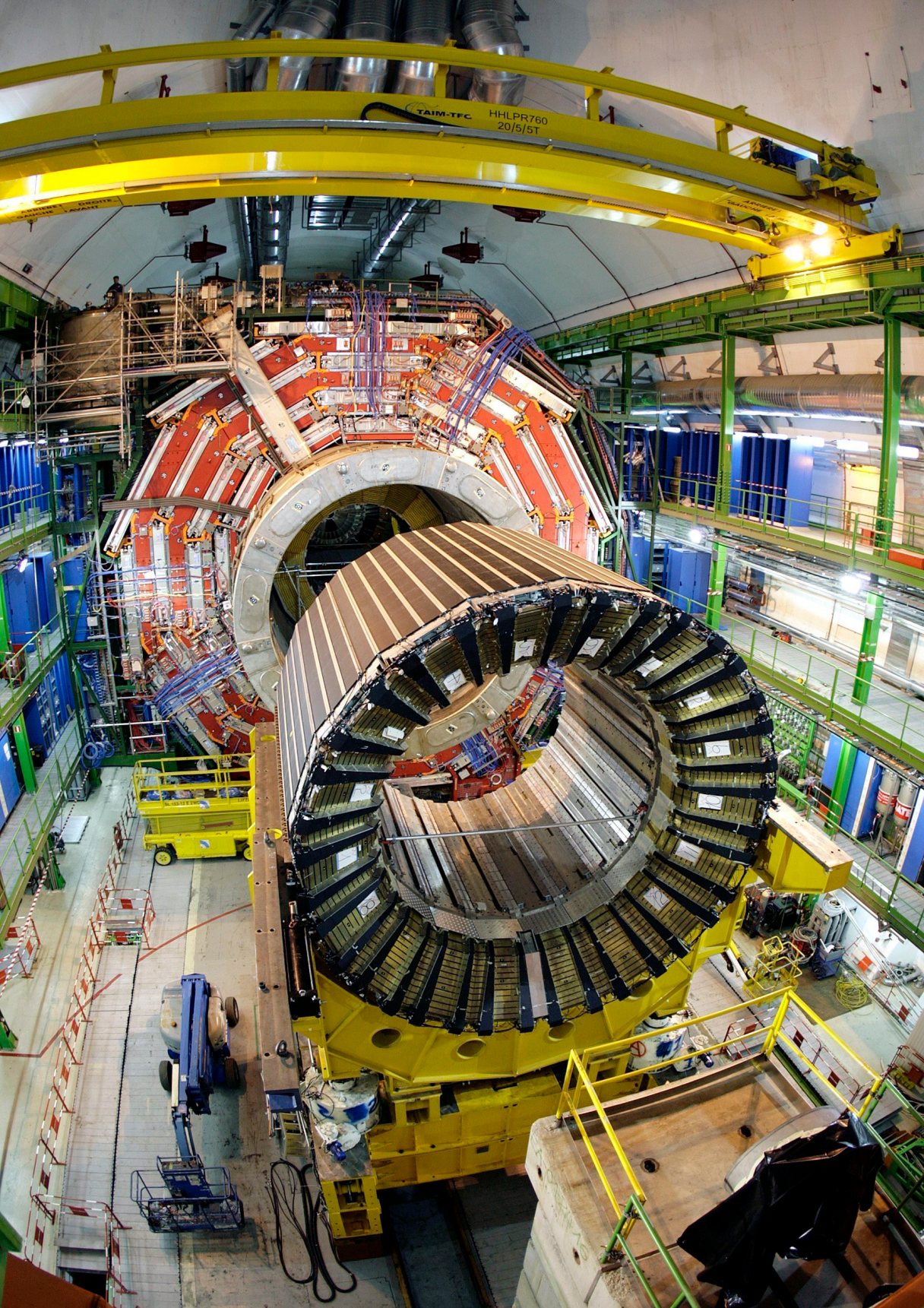
FILE -In this March 22, 2007 file photo, the magnet core of the world's largest superconducting solenoid magnet (CMS, Compact Muon Solenoid) at the European Organization for Nuclear Research (CERN)'s Large Hadron Collider (LHC) particle accelerator, in Geneva, Switzerland. Disappointed physicists from the Large Hadron Collider report that what initially could have been an intriguing new particle turned out just to a statistical burp. Last December, researchers at the European Center for Nuclear Research saw two readings of what could have been a new particle that would not have fit with the existing main physics theory. The same center in 2012 discovered the Higgs boson or “God particle.”  (AP Photo/Keystone, Martial Trezzini, File)
FILE -In this March 22, 2007 file photo, the magnet core of the world's largest superconducting solenoid magnet (CMS, Compact Muon Solenoid) at the European Organization for Nuclear Research (CERN)'s Large Hadron Collider (LHC) particle accelerator, in Geneva, Switzerland. Disappointed physicists from the Large Hadron Collider report that what initially could have been an intriguing new particle turned out just to a statistical burp. Last December, researchers at the European Center for Nuclear Research saw two readings of what could have been a new particle that would not have fit with the existing main physics theory. The same center in 2012 discovered the Higgs boson or “God particle.” (AP Photo/Keystone, Martial Trezzini, File) FILE -In this March 22, 2007 file photo, the magnet core of the world's largest superconducting solenoid magnet (CMS, Compact Muon Solenoid) at the European Organization for Nuclear Research (CERN)'s Large Hadron Collider (LHC) particle accelerator, in Geneva, Switzerland. Disappointed physicists from the Large Hadron Collider report that what initially could have been an intriguing new particle turned out just to a statistical burp. Last December, researchers at the European Center for Nuclear Research saw two readings of what could have been a new particle that would not have fit with the existing main physics theory. The same center in 2012 discovered the Higgs boson or “God particle.” (AP Photo/Keystone, Martial Trezzini, File)

WASHINGTON (AP) – Eight months after raising hopes that they may have found an intriguing new particle that cannot be explained by the existing main physics theory, disappointed scientists are saying: Never mind.

It was just a statistical burp, not a breakthrough, researchers reported Friday.

“Basically we see nothing,” said Tiziano Camporesi, a chief scientific spokesman at the European Center for Nuclear Research .

Early unconfirmed readings of a new particle in December by physicists at the center, called CERN, set the physics world abuzz. Scientists there had discovered the Higgs boson or “God particle” in 2012, and two new readings from the Large Hadron Collider made it seem like they may had found a revolutionary new particle.

In the months that followed, scientists poured over more data from high-speed atom crashes while theorists tried to figure out what it all means. But the new data ruled out any particle existing at the energy level they had been looking at.