
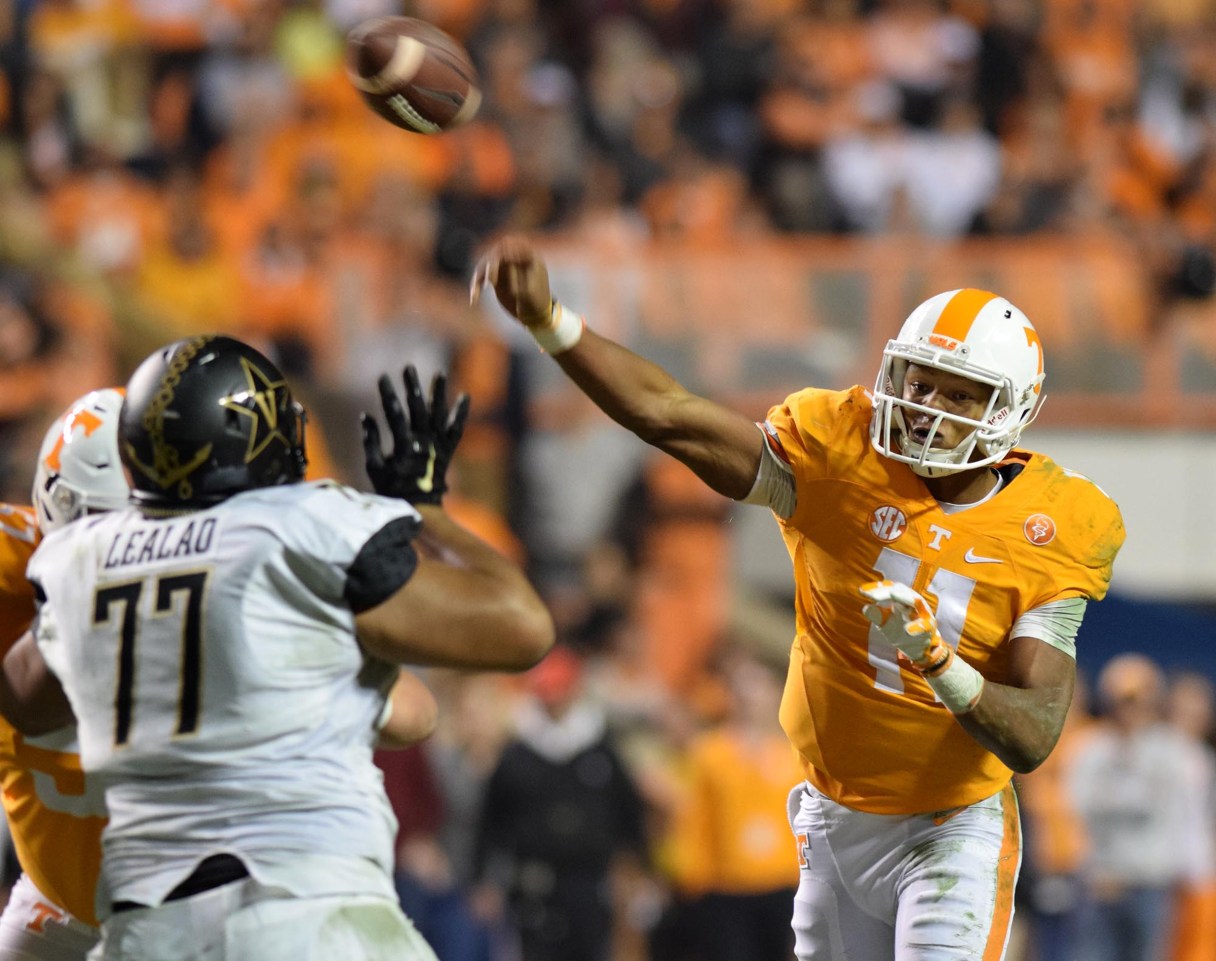
KNOXVILLE – Josh Dobbs is one of the best running quarterbacks in college football.
The question the Tennessee senior has had to answer the most since the end of last season centers on the aspect of his game he doesn’t do so well.
His accuracy throwing the football has been an area for improvement for Dobbs throughout his career, and given the talent around him and what should be one of the Southeastern Conference’s most productive rushing attacks, marginal progress from Dobbs as a passer this season might be enough to make the Volunteers unstoppable on offense.
“I want to complete every ball I throw,” Dobbs said Thursday. “You look at statistics and everything, and a great completion percentage in the SEC is 65 percent and an extraordinary one is 70 percent. That’s what we’re aiming for. Every ball you throw, you throw with a purpose.
“At the end of the day you want to take care of the football and get the ball in our playmakers’ hands, and that’s what we’re seeking this camp and pushing for this season.”
Only 19 qualifying quarterbacks in college football surpassed the 65 percent mark in 2015, and Western Kentucky’s Brandon Doughty, at nearly 72 percent, was the only one to complete higher than 70 percent.
Nearly a third of those quarterbacks were taken in April’s NFL draft, and the group also includes some of college football’s top returning quarterbacks in Clemson’s Deshaun Watson (67.8 percent), Oklahoma’s Baker Mayfield (68.1), Washington State’s Luke Falk (69.4) and Houston’s Greg Ward Jr. (67.2).
Jake Coker (Alabama), Chad Kelly (Ole Miss), Brandon Allen (Arkansas) and Dak Prescott (Mississippi State) were the four SEC quarterbacks to complete better than 65 percent of their passes.
In a turbulent year for SEC quarterbacks, Dobbs ranked sixth at 59.6 percent on 344 attempts, and he topped the 65 percent mark only against Bowling Green, Western Carolina, North Texas and Missouri.
Dobbs has shown he’s capable of winning games with his arm, most notably the Georgia game last season and the past two contests against South Carolina, but both he and offensive coordinator Mike DeBord have indicated he’s made some mechanical tweaks, mainly with his footwork, to make him more accurate more consistently.
“In today’s football you don’t see a lot guys just drop back and throw the ball right away, because of the superior talent on defense and the rush and all the blitzing and things like that,” DeBord said. “A quarterback has to learn to step up, side-step, scramble – all those things. Therefore, every throw is different.
“One time he might be here, and the next time he might be over there. All that goes into it. He’s obviously improved.”
Tennessee needs to increase its batting average on downfield throws – better play at wide receiver and better protection by the offensive line would help there – and Dobbs said he wants to do a better job of using running backs Jalen Hurd and Alvin Kamara when nothing is open downfield and making “the simple completions.”
Dobbs also wants to continue to avoid throwing interceptions, and though he threw only five in 2015, the number easily could have been higher.
“You have to take care of the football at the end of the day,” he said, “so if no one’s open and you can’t really make a play with your legs and you want to play the field-position game, you want to throw the ball in the stands and live to play another down. We talk about it every day. Field position is crucial, especially at the SEC level.
“Throwing away the ball and punting, rather than taking a sack or just throwing it up and having a 50-50 ball, you just want to take care of the football at the end of the day. Turnover margin’s really the key margin that defines winning and losing in this league. If we can take away the ball more than we turn it over, then we’ll be in good shape this season.”
The Vols will be in better shape if their passing game doesn’t slow what could be an explosive offense.
“We’ve installed a lot more in the first (week of practice) as we really ever have,” Dobbs said. “Guys are understanding the playbook even more, understanding it more in depth, understanding coverages and understanding what looks we want to run plays into. It allows us to go faster and move quicker when we get on the field, and we’ve seen great progress from that.”
Contact Patrick Brown at pbrown@timesfreepress.com.