

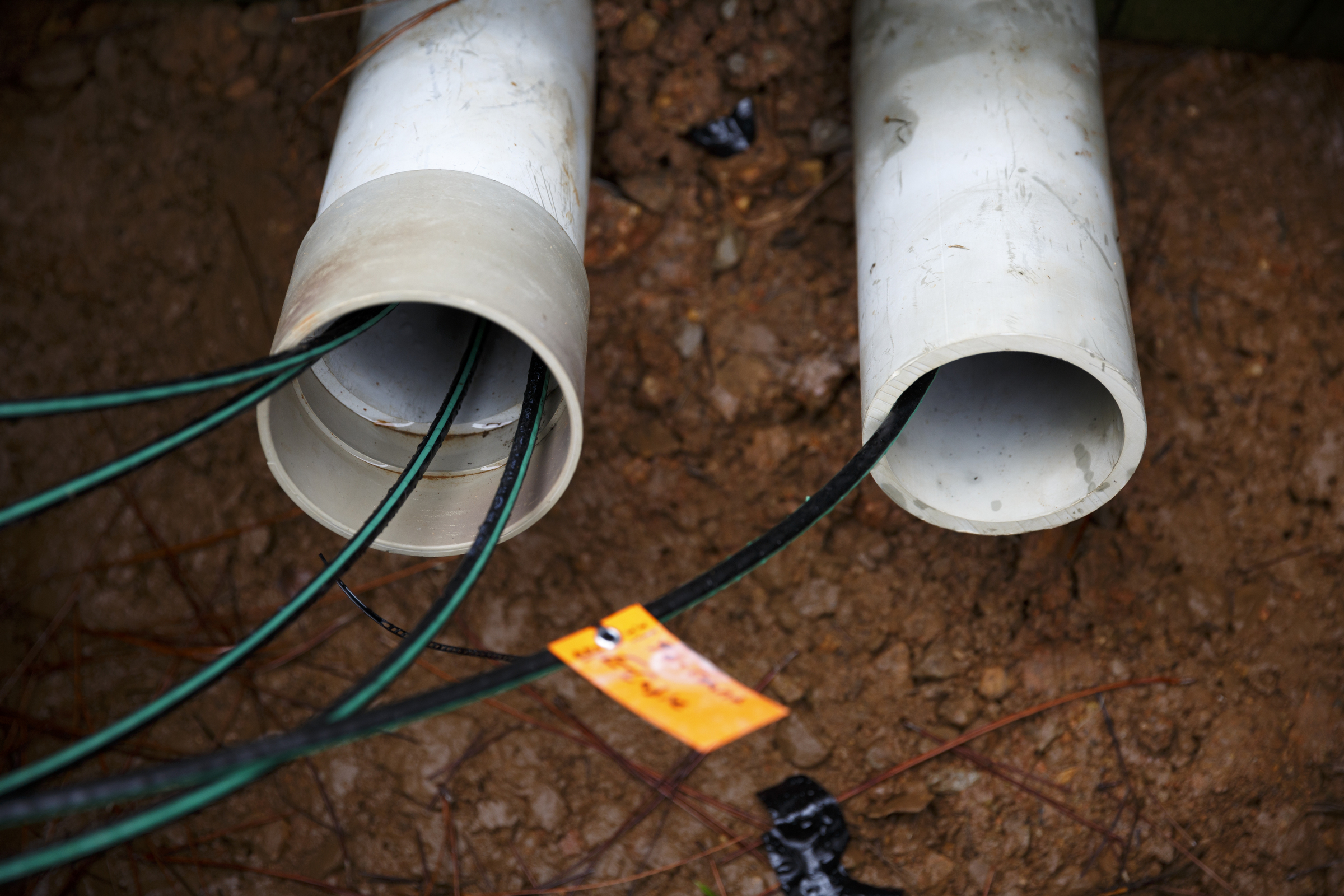
 Fiber optic cables run into pipes during an EPB installation at CityGreen Apartments on Friday, Jan. 15, 2016, in Chattanooga, Tenn.
A federal appeals court decision limiting EPB’s planned expansion of high-speed broadband to under-served areas outside EPB’s Chattanooga service area puts a spotlight on the next session of the Tennessee General Assembly.
Legally, the argument is about the so-called unfair advantage of government services in the private-sector market as well as about the tired thinking of “state’s rights” since this ruling said the FCC overstepped its authority when it overturned Tennessee restrictions on the planned expansion.
But practically speaking, the argument is about you – the public – and your geography vs. a corporation’s profit margin as a determinant for whether you can get high-speed internet – or even internet at all.
In today’s world, internet service is tantamount to a necessary utility service – as access to the internet now is almost as essential and vital to our lives as running water, electricity and phone service.
But old-fashioned cable services such as Comcast and AT&T say they can’t expand broadband service into more rural areas until the customer base is dense enough to ensure a profit or at least a break-even bottom line. They also argue that EPB, with its fiber optics telecom service and it willingness to build on its 600-square mile territory in the Chattanooga area to expand into areas such as Bradley County, would create an unlevel playing field for them.
The appeals court agreed Wednesday, upholding the Tennessee restrictions law passed years ago by our General Assembly after it was heavily wined, dined and lobbied by cable companies such as Comcast and AT&T. Those restrictions limit attempts by EPB and other publicly owned utilities to expand high-speed broadband into under-served areas outside their region.
Meanwhile, nearly one of every eight residents in the state cannot get high-speed broadband service – this in a state where employers say they can’t find enough qualified workers because our education is not up to par.
Studies by both the state Department of Economic and Community Development and the Tennessee Advisory Commission on Intergovernmental Relations this spring underscored the need to expand high-speed broadband across Tennessee. Both studies suggested municipalities and nonprofit co-ops could play a key role in expanding fiber optic services in rural areas.
And Tennessee Sen. Janice Bowling, R-Tullahoma, who plans to reintroduce legislation next year to remove state limits on municipalities and power co-ops offering broadband, summed up the problem quite succinctly: “Is the state going to continue to block its citizens from having access to 21st century technology so key to our economic future?”
She and Tennessee Rep. Kevin Brooks, R-Cleveland, said AT&T, Charter Cable and other investor-owned utilities have had years to extend high-speed broadband into more rural areas of the state but have yet to do so.
Brooks said getting to Gov. Bill Haslam’s “Drive to 55” goal of having 55 percent of adults with college degrees or certificates “will be very hard, if not impossible, if we have the equivalent of a 35 mph speed limit on our broadband speed” for distance learning.
What we don’t understand is how the majority of Tennessee lawmakers have agreed with investor-owned utilities that EPB’s expansion plan represents “the unfair advantage” of government services but don’t think that the lobbying of private utilities represents an unfair corporate advantage and influence.
Common Cause Adviser Michael Copps referenced well-financed campaigns by private utilities fearing more competition in this way: “Industry-backed state laws to block municipal broadband exist only because pliant legislators are listening to their Big Cable and Big Telecom paymasters. These corporate providers invest in campaign contributions rather than in deploying high-quality broadband.”
Our lawmakers are charged with thinking about the public good, not the corporate favor.
As citizens, we should be constantly reminding them of that.