
Sunday, November 1, 2026Nov 1

This story is free to read.

Rosetta space probe sees bright flares, landslide on comet

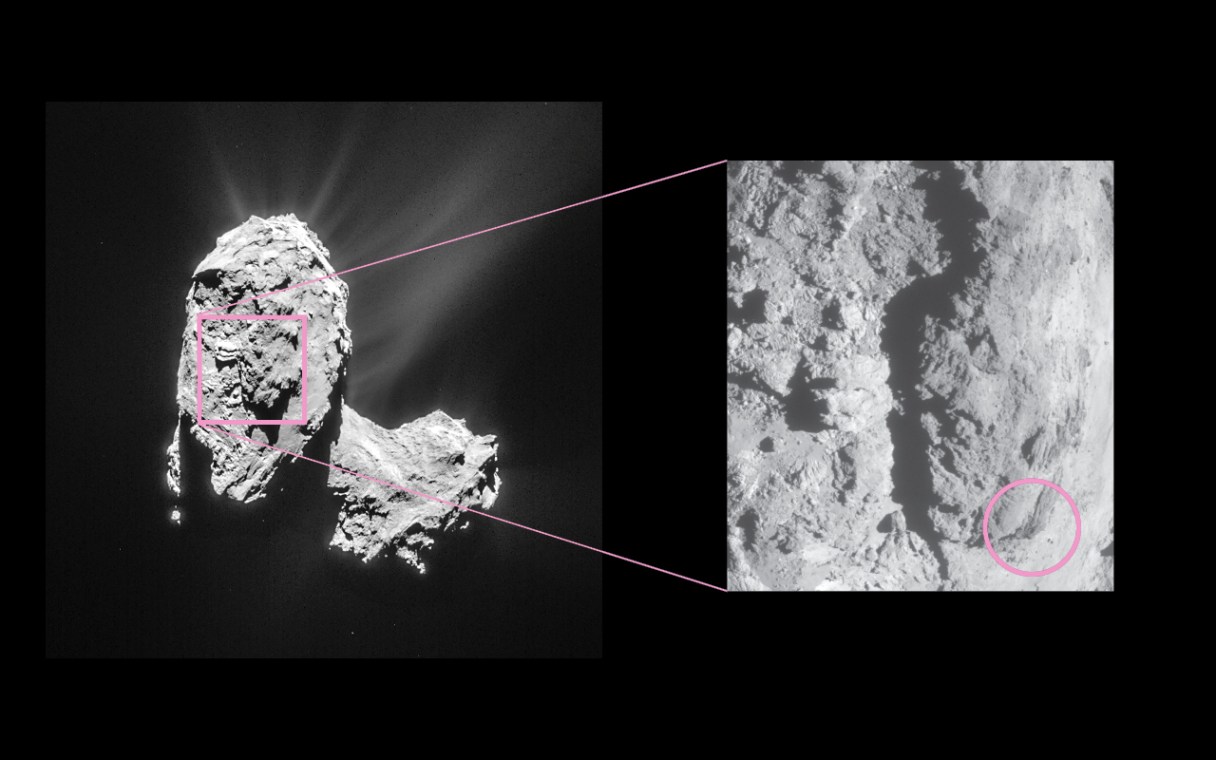
This is an  image  publicly released by the European Space Agency, ESA, on Thursday Aug. 25, 2016.   Rosetta’s instruments detected an outburst event from Comet 67P/Churyumov–Gerasimenko on Feb. 19, 2016. The source was traced back to a location in the Atum region, on the comet’s large lobe, as indicated in this image. The inset image was taken a few hours after the outburst by Rosetta’s NavCam and shows the approximate source location. The image at left was taken on March 21, 2015 and is shown for context, and so there are some differences in shadowing/illumination as a result of the images being acquired at very different times. (Rosetta NavCam/ESA via AP)
This is an image publicly released by the European Space Agency, ESA, on Thursday Aug. 25, 2016. Rosetta’s instruments detected an outburst event from Comet 67P/Churyumov–Gerasimenko on Feb. 19, 2016. The source was traced back to a location in the Atum region, on the comet’s large lobe, as indicated in this image. The inset image was taken a few hours after the outburst by Rosetta’s NavCam and shows the approximate source location. The image at left was taken on March 21, 2015 and is shown for context, and so there are some differences in shadowing/illumination as a result of the images being acquired at very different times. (Rosetta NavCam/ESA via AP) This is an image publicly released by the European Space Agency, ESA, on Thursday Aug. 25, 2016. Rosetta’s instruments detected an outburst event from Comet 67P/Churyumov–Gerasimenko on Feb. 19, 2016. The source was traced back to a location in the Atum region, on the comet’s large lobe, as indicated in this image. The inset image was taken a few hours after the outburst by Rosetta’s NavCam and shows the approximate source location. The image at left was taken on March 21, 2015 and is shown for context, and so there are some differences in shadowing/illumination as a result of the images being acquired at very different times. (Rosetta NavCam/ESA via AP)

BERLIN (AP) – The European Space Agency’s Rosetta space probe has captured images of a bright burst of light on the comet it is orbiting, apparently caused by a landslide.

The dramatic light flashes were recorded Feb. 19 and accompanied by rising temperatures and sharp increases in dust, gas and plasma released from comet 67P/Churyumov-Gerasimenko.

Eberhard Gruen of the Max-Planck-Institute for Nuclear Physics in Heidelberg, Germany, said Thursday a landslide on the comet’s surface was most likely responsible.

The flashes would have been generated by light reflecting from dust particles kicked up by the landslide.

The European Space Agency plans to crash-land Rosetta on the comet’s surface Sept. 30, more than two years after it started orbiting the comet.

Data collected by Rosetta and its lander, Philae, have improved scientists’ understanding of comets.