Any parent can imagine the fear you might experience if your child needs an operation. There are so many questions and concerns, worries and fears. For children and families in the Chattanooga area, a team of some of the most highly trained and experienced pediatric surgeons in the country is prepared to provide safe and effective surgical care. What’s more, they can perform many procedures using minimally invasive techniques – even on the tiniest newborn babies.
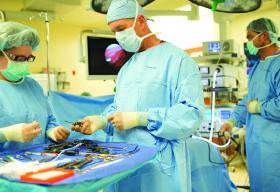
 USA pediatric surgeon Dr. Koontz (right) performs a minimally-invasive surgery
“Our first priority is to assess the child and decide exactly what needs to be done to correct the problem, then we think about the family. It’s so important for the family to have every question answered and to have an understanding about rather complex surgical procedures we’re going to do. We work hard to establish that relationship of trust,” says Dave Bhattacharya, M.D., pediatric surgeon with University Surgical Associates. “Then we work together with the larger pediatric team – whether that’s the intensive care unit, cardiology, pulmonology and others – to develop a plan for the best possible outcome.”
Advantages of Minimally Invasive Surgery
Adults have had the benefit of minimally invasive surgery for many years, but only recently have these techniques been adapted for children. Curt Koontz, M.D., fellowship trained pediatric surgeon with University Surgical Associates, is one of the nation’s most experienced pediatric surgeons who uses these minimally invasive techniques to reduce surgical trauma, reduce incision size, and help speed healing. He’s also pioneered the use of these methods and was the first in the region to perform many procedures laparoscopically including hernia repair, extravascular cardiac operations, resection of the esophagus, and single site gallbladder and colon procedures among others.
“There are several benefits to using minimally invasive techniques whenever possible. The first benefit is cosmetic. Instead of one larger incision on the belly, you have several smaller incisions that heal very quickly,” says Dr. Koontz.”But there’s also a lesser chance of a hernia developing because of surgery and less pain after the procedure. Less pain often translates to a shorter hospital stay – something every parent hopes for, and is an added advantage.”