
Thursday, October 29, 2026Oct 29

This story is free to read.

Professor designs explosives detector to rival a dog’s nose

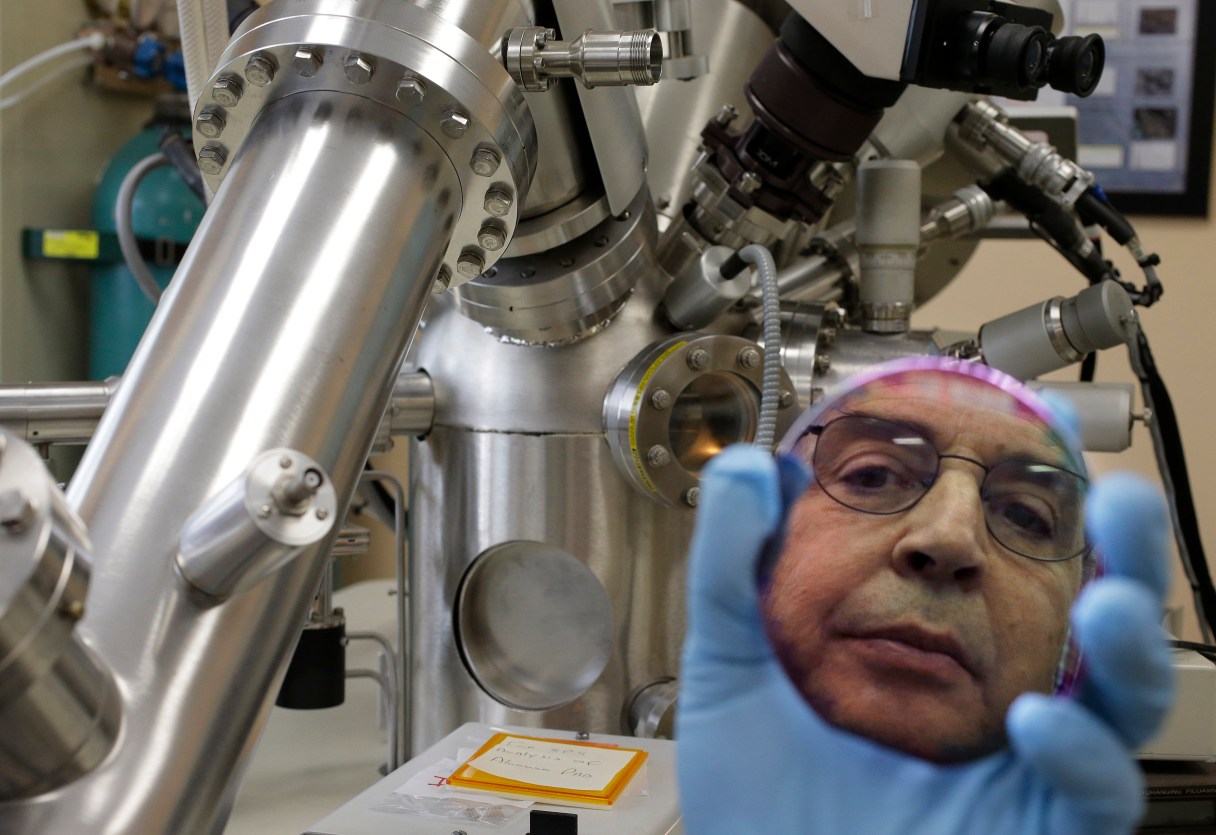
In this Tuesday, Jan. 26, 2016 photo University of Rhode Island engineering professor Otto Gregory is reflected in a silicon wafer, that contains sensors to detect explosives, in front of a thin film surface analyzer, behind, in a laboratory on the school's campus, in North Kingstown, R.I. He has developed a sensor that detects the explosive used in the Paris bombings, to try to stop future attacks. Gregory compares his sensor to a dog’s nose, the gold standard in explosives detection. It “sniffs” the air for vapors emitted from explosives. (AP Photo/Steven Senne)
In this Tuesday, Jan. 26, 2016 photo University of Rhode Island engineering professor Otto Gregory is reflected in a silicon wafer, that contains sensors to detect explosives, in front of a thin film surface analyzer, behind, in a laboratory on the school's campus, in North Kingstown, R.I. He has developed a sensor that detects the explosive used in the Paris bombings, to try to stop future attacks. Gregory compares his sensor to a dog’s nose, the gold standard in explosives detection. It “sniffs” the air for vapors emitted from explosives. (AP Photo/Steven Senne) In this Tuesday, Jan. 26, 2016 photo University of Rhode Island engineering professor Otto Gregory is reflected in a silicon wafer, that contains sensors to detect explosives, in front of a thin film surface analyzer, behind, in a laboratory on the school's campus, in North Kingstown, R.I. He has developed a sensor that detects the explosive used in the Paris bombings, to try to stop future attacks. Gregory compares his sensor to a dog’s nose, the gold standard in explosives detection. It “sniffs” the air for vapors emitted from explosives. (AP Photo/Steven Senne)

SOUTH KINGSTOWN, R.I. (AP) – A University of Rhode Island professor has developed a sensor that detects the kind of explosive used in the Paris bombings, to try to stop future attacks.

Professor Otto Gregory compares his sensor to a dog’s nose, the “gold standard” in explosives detection. It “sniffs” the air for vapors emitted from explosives.

Gregory is evaluating how well his sensor detects triacetone triperoxide (try-AS’-uh-tohn try-pur-AHX’-iyd).

The Paris attackers packed TATP into their suicide vests and wielded assault rifles, killing 130 people in November.

The U.S. Department of Homeland Security began funding Gregory’s work through an explosives research center in 2008.