
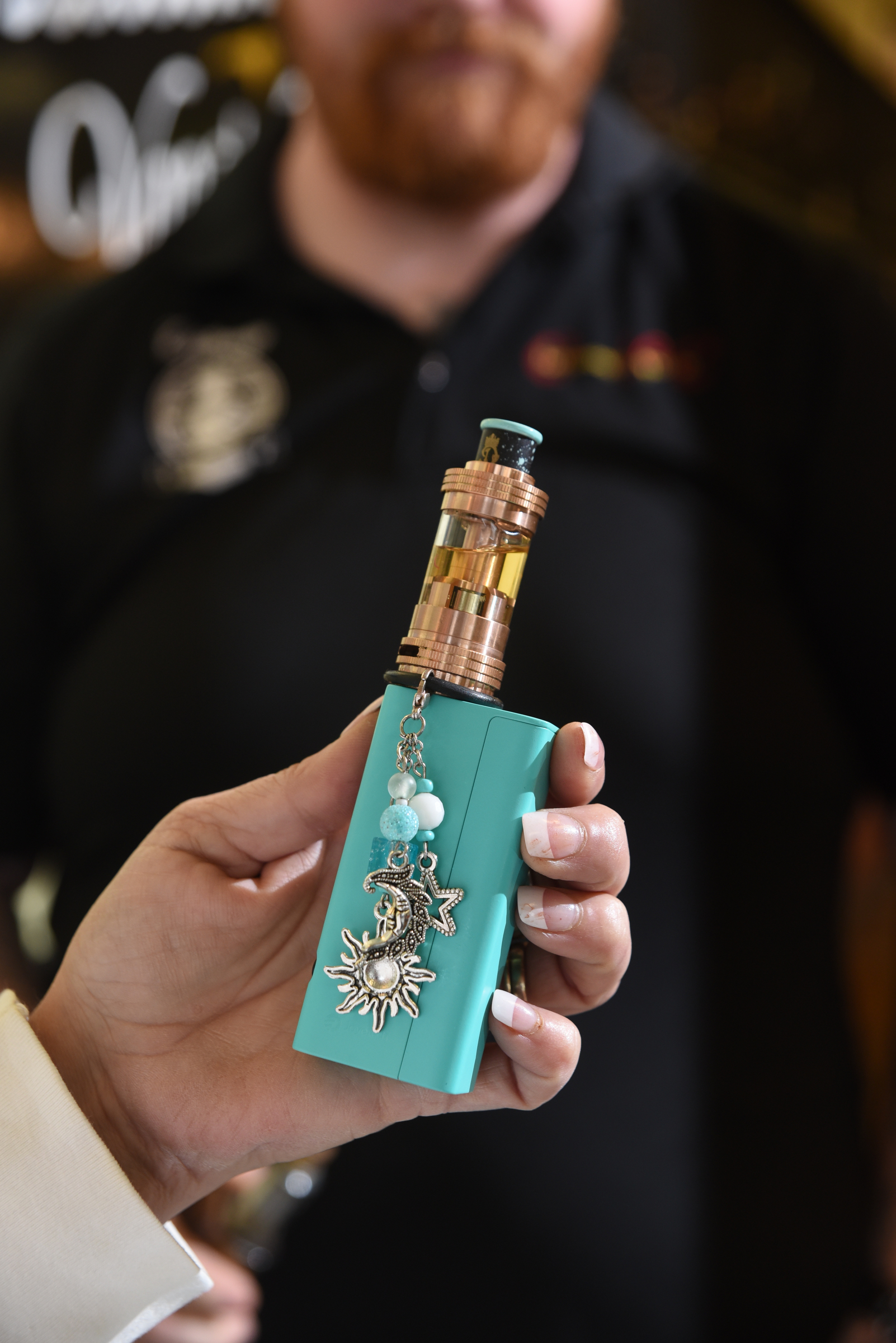
 Kristi Holcomb holds her new EVIC VT e- cigarette unit at Chattanooga Vapor Co. in East Brainerd. The unit, minus the bling, costs between $80 and $90, according to Holcomb.
The electronic-cigarette store on East Brainerd Road that Payton Mayes manages for the Chattanooga Vapor Co. resembles a jewelry store more than the convenience stores where most tobacco smokers buy their products.
Rows of gleaming e-cigarettes and vaporizers, in varying colors and shapes, line a long, glass display case. On the wall behind him, a large rack holds hundreds of vials of the liquid, or “juice,” used in an e-cigarette. As customers wander in, he offers several the opportunity to sample one of the countless flavor options.
The vibe is somewhere between a high-tech cigar bar with premium selections, and a candy store, offering something for every taste.
But Mayes wants to emphasize what he sees as another aspect of e-cigarettes – they helped him quit smoking.
“I was a fireman in Fort Oglethorpe and was smoking two packs a day,” Mayes said. Switching to e-cigarettes allowed him to stop, he said, and his doctor confirmed that within weeks his lungs had improved.
With five local stores, Chattanooga Vapor Co. is the largest e-cigarette vendor in town, Mayes said, and he believes its products are saving lives by helping smokers quit.
This is the time of year when thousands of smokers resolve to give up tobacco products. So are e-cigs the answer?
Public health officials say it is too soon to say, given that e-cigarettes were only invented in 2006.
“You can get into arguments about their safety,” said Janie Burley, who coordinates the anti-smoking programs at the Chattanooga-Hamilton County Health Department. “We just don’t know at this point.”
Burley concedes that by eliminating tar and other combustion byproducts cigarette smokers inhale, e-cigs seem to be a step in the right direction.
But health officials worry about the lack of regulation.
“Currently there are not adequate safeguards or regulations regarding those producing electronic cigarette components, including what chemicals can be used,” Tennessee Health Commissioner Dr. John Dreyzehner said in an advisory message, “and no clear requirements to warn consumers of potential risks and hazards of inhaling these varied emissions deeply into the lungs.”
That may change soon. The U.S. Food and Drug Administration has sent proposed regulations to the White House for review that would allow it to regulate e-cigs in much the same way it regulates cigarettes.
What has many public health officials on the defensive is how fast e-cigs caught on.
Introduced in the U.S. in 2009, they quickly achieved broad use, particularly among younger adults. An October study said 22 percent of people aged 18 to 24 have tried e-cigs and 5 percent are regular users. Another recent study concluded that e-cigs are more popular than conventional smokes among high school students.
Users are known as “vapers” because what is inhaled is not smoke from a cigarette, but rather vapor from the e-cigarette.
But many non-users are not familiar with how e-cigarettes work.
The device consists of two main parts: the heating element and a liquid that is vaporized by the heat. The liquid normally contains flavoring – more than 7,000 flavors are reported – and anywhere from zero to 36 grams of nicotine. That is a concern because nicotine has been shown to affect brain development, and the flavoring makes e-cigs attractive to younger kids.
“Nicotine is dangerous for kids at any age, whether it’s an e-cigarette, hookah, cigarette or cigar,” U.S. Centers for Disease Control and Prevention Director Tom Frieden said in a statement earlier this year.
To date, medical studies on the health effects of vaping are inconclusive, Burley said, in large part because the devices have been in use such a short time. She listed several chemicals that have been found in e-cigs’ vapor, including formaldehyde and acetaldehyde from the vapor, and nickel and lead from the vaporizers themselves.
These are not present at the same level as for tobacco cigarettes, she said, “but the point is, there is something in the emission. It is not just water vapor and it is not 100-percent safe.”
While e-cigs may help smokers give up tobacco, none of the manufacturers advertise that aspect of their product, Burley said.
“‘Take back your freedom.’ That’s been the marketing campaign,” she said. “Not to switch to e-cigs from cigarettes to eventually put them down – they want you to switch [to e-cigs] to continue using them.”
She also noted the big tobacco companies are increasingly major players in the e-cig market, owning several of the best-selling brands.
“Thirteen hundred people per day die in the U.S. from smoking-related diseases,” she said. “Tobacco companies lose that many people per day who are using their products. They need to replace that number.”
Health officials also worry that vaping inevitably will lead some people to cigarette smoking.
“With tobacco smoking, 90 percent of all smokers have their first cigarette before the age of 18,” Burley said. “If you can get people to a certain age and not experiment [with smoking], then they are more likely not to.”
So if health officials could wave a magic wand and convert all smokers to vapers, would the health benefits justify doing it?
“We don’t know the long-term effect, because we can’t determine their safety,” Burley said.
Her fear is it may take 10 to 15 years before researchers learn for certain if there are hazards with e-cigarettes, and by that time, she said, “for a lot of users, that would be too late.”
Contact staff writer Steve Johnson at sjohnson@timesfreepress.com, 423-757-6673, on Twitter @stevejohnsonTFP or on Facebook, at facebook.com/noogahealth.