
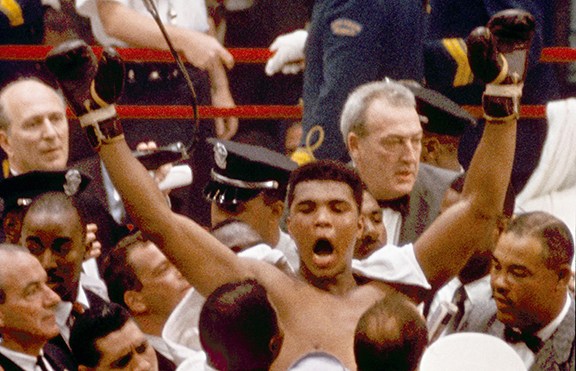
 Mark Wiedmer
A stolen red Schwinn bicycle. That’s what started the career path of the self-described “Greatest of All Time.”
Maybe Muhammad Ali – who was 12-year-old Cassius Clay of Louisville, Ky., at the time of that theft – might have become the three-time heavyweight boxing champion of the world even without that misfortune. You’d like to hope so. The world’s a far better place today for Ali having lived in it for 74 years before his death Friday night due to complications from Parkinson’s disease.
In fact, to recount his accomplishments in life beyond boxing, “the greatest of all time” barely does justice to Ali the human being as opposed to Ali the athlete.
But that pilfered bicycle is why he first embraced the sport instead of football or basketball. He wanted to be able to pummel anyone brazen enough to attempt to steal his or his family’s property.
And for anyone old enough to remember Ali in his boxing prime, our emotions have taken a beating the past couple of days.
There are the touching moments we all remember, such as July 19, 1996, in Atlanta, when he both shocked and touched the heart of the whole world by lighting the Olympic cauldron, Parkinson’s clearly gripping him as his right arm trembled and the flame shook a bit, but the spark still defiantly danced in his eyes, as it had since birth.
The brilliant writer Dave Kindred closed his obit of Ali with a recollection of that night in the Big Peach, of then-President Bill Clinton coming to speak to Ali after the ceremony.
Said Clinton to Ali: “They didn’t tell me who would light the flame. But when I saw it was you, I cried.”
There are the humorous moments befitting someone labeled “The Louisville Lip,” most coming through his rhyming poetry, often at the expense of opponents about to be done in by both his wicked words and wily deeds.
The most famous is assuredly his mocking of Sonny Liston, just before a 22-year-old Ali dethroned Liston as heavyweight champ in 1964, when Ali bellowed: “Float like a butterfly, sting like a bee. Your hands can’t hit what your eyes can’t see.”
There was the surprising Ali, the one who said on the day after that fight, when asked about becoming a Muslim: “I don’t have to be what you want me to be. I’m free to be who I want.”
There was soon the defiant Ali, the one who threw away three years of his boxing prime to fight the military draft.
Said Ali at the height of that drama, the U.S. government threatening to send him to jail: “I’m proud to say that I am the first man in the history of all America, athlete and entertainer-wise, who gave up all the white man’s money, looked the white man in the eye and told him the truth. I’m just so happy. I go to bed happy, I wake up happy, and I’ll go to jail for 10 years happy. And it’ll always be said, ‘There’s one that didn’t compromise.'”
Now counter that with Michael Jordan’s comment concerning why he wouldn’t back black Democratic candidate Harvey Gantt in a 1990 U.S. Senate race in North Carolina against Republican behemoth Jesse Helms: “Republicans buy (Nike) shoes, too.”
To refresh memories, Ali’s fight with the government during an escalating Vietnam War grew so contentious – “I ain’t got no quarrel with them Viet Cong,” the boxer proclaimed – that it took an 8-0 Supreme Court ruling in his favor on June 28, 1971, to return him to the ring.
And, oh, were those of us of a certain age blessed to see him fight, though it’s always fair to ask if we as a society should condone boxing, given its savagery. Yet it didn’t seem like that with Ali in the ring, dancing his “Ali Shuffle,” throwing punches the eyes strained to see, poetry in motion – a sweet science, indeed.
That was mostly pre-Supreme Court, of course. The later Ali, his skills no longer untouchable, became as tough of mind and spirit as athletic ability. He beat the powerful George Foreman in the “Rumble in the Jungle” in Zaire with his “rope-a-dope” strategy, allowing Foreman to punch himself out while Ali rested on the ropes, then pummeled him in later rounds.
Then there was the “Thrilla in Manila,” his third and final fight against nemesis Joe Frazier.
His wonderful wit on display before the bout, Ali told Philippines president Ferdinand Marcos, “I saw your wife. You’re not as dumb as you look.”
Following the most brutal fight of his career, Ali sagely said: “We went to Manila as champions, Joe and me, and we came back as old men.”
Though he would go on to reclaim the heavyweight championship a third time after losing it to Leon Spinks, Ali was never the same after that final Frazier fight.
Yet the hope and joy Ali brought to the world after his fighting days were behind him and Parkinson’s betrayed him should be his enduring legacy.
Or as he wrote in his 2004 memoir: “I would like to be remembered as a man who won the heavyweight championship three times, who was humorous, and who treated everyone right.”
He added he’d like to be recalled as “a man who tried to unite all humankind through faith and love, (but) I guess I’d settle for being remembered only as a great boxer who became a leader and champion for his people. And I wouldn’t even mind if folks forgot how pretty I was.”
A friend of mine was privileged to see Ali treating people right in February of 1995 at a Kentucky basketball game. Having come to Lexington to help quell racial tensions after a black youth was killed by a white policeman, Ali spied a heavyset young woman in the bowels of Rupp Arena who had struggled most of her life with weight issues.
Approaching her with a smile on his face, Ali cupped his hands against her face and said, “Hello, pretty.”
When it came to Ali, many, many more times than not, pretty was as pretty did.
Contact Mark Wiedmer at mwiedmer@timesfreepress.com.