
Monday, November 9, 2026Nov 9

Justice quest goes on after ‘Freedom Summer’ court cases end

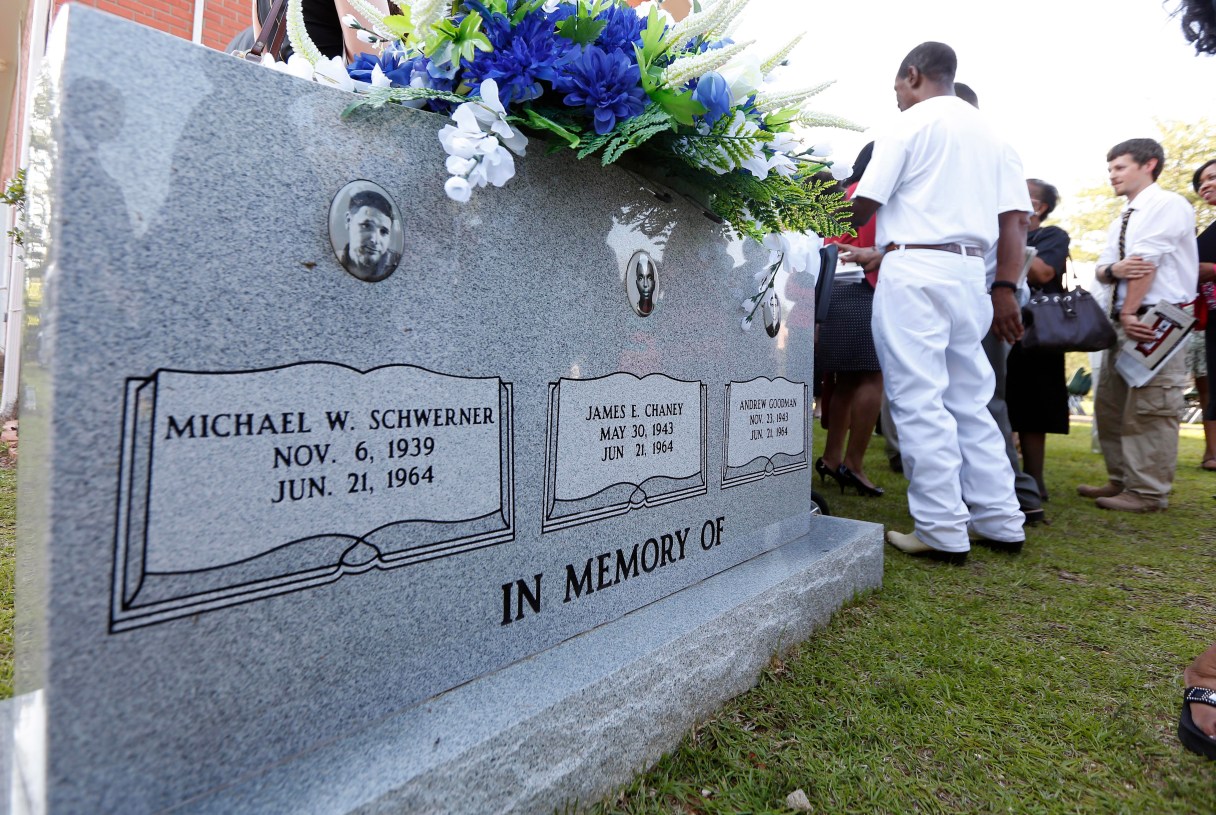
FILE - In this June 15, 2014 file photograph, flowers top the memorial marker for Michael Schwerner, James Chaney and Andrew Goodman, civil rights workers who were killed in the "Mississippi Burning" case of 1964, outside the Mt. Zion United Methodist Church in Philadelphia, Miss., following a commemorative service in their honor. With additional criminal charges ruled out in the 1964 killings of the three civil rights workers, the community and state are left with harder ways to pursue justice in the case. Relatives of Chaney, Goodman and Schwerner said their deaths should prompt reflection about racism across Mississippi and the United States. (AP Photo/Rogelio V. Solis, File)
FILE - In this June 15, 2014 file photograph, flowers top the memorial marker for Michael Schwerner, James Chaney and Andrew Goodman, civil rights workers who were killed in the "Mississippi Burning" case of 1964, outside the Mt. Zion United Methodist Church in Philadelphia, Miss., following a commemorative service in their honor. With additional criminal charges ruled out in the 1964 killings of the three civil rights workers, the community and state are left with harder ways to pursue justice in the case. Relatives of Chaney, Goodman and Schwerner said their deaths should prompt reflection about racism across Mississippi and the United States. (AP Photo/Rogelio V. Solis, File) FILE - In this June 15, 2014 file photograph, flowers top the memorial marker for Michael Schwerner, James Chaney and Andrew Goodman, civil rights workers who were killed in the "Mississippi Burning" case of 1964, outside the Mt. Zion United Methodist Church in Philadelphia, Miss., following a commemorative service in their honor. With additional criminal charges ruled out in the 1964 killings of the three civil rights workers, the community and state are left with harder ways to pursue justice in the case. Relatives of Chaney, Goodman and Schwerner said their deaths should prompt reflection about racism across Mississippi and the United States. (AP Photo/Rogelio V. Solis, File)

JACKSON, Miss. (AP) – The search for courtroom justice in the 1964 killings of three civil rights workers in Mississippi’s Neshoba County has ended, but some say the search for another kind of justice is still ongoing.

Mississippi’s attorney general announced last week there’s no longer any way to gather enough evidence to charge the remaining living suspects in the slayings of James Chaney, Andrew Goodman and Michael Schwerner.

Relatives of the three say their deaths should prompt reflection about racism across Mississippi and the United States.

Eight people were convicted of federal civil rights violations related to the killings in 1967. And in 2005, Edgar Ray Killen was convicted of manslaughter. He remains in prison.

Leroy Clemons, who runs the Neshoba Youth Coalition, says ongoing racial reconciliation work has borne fruit in Philadelphia.