
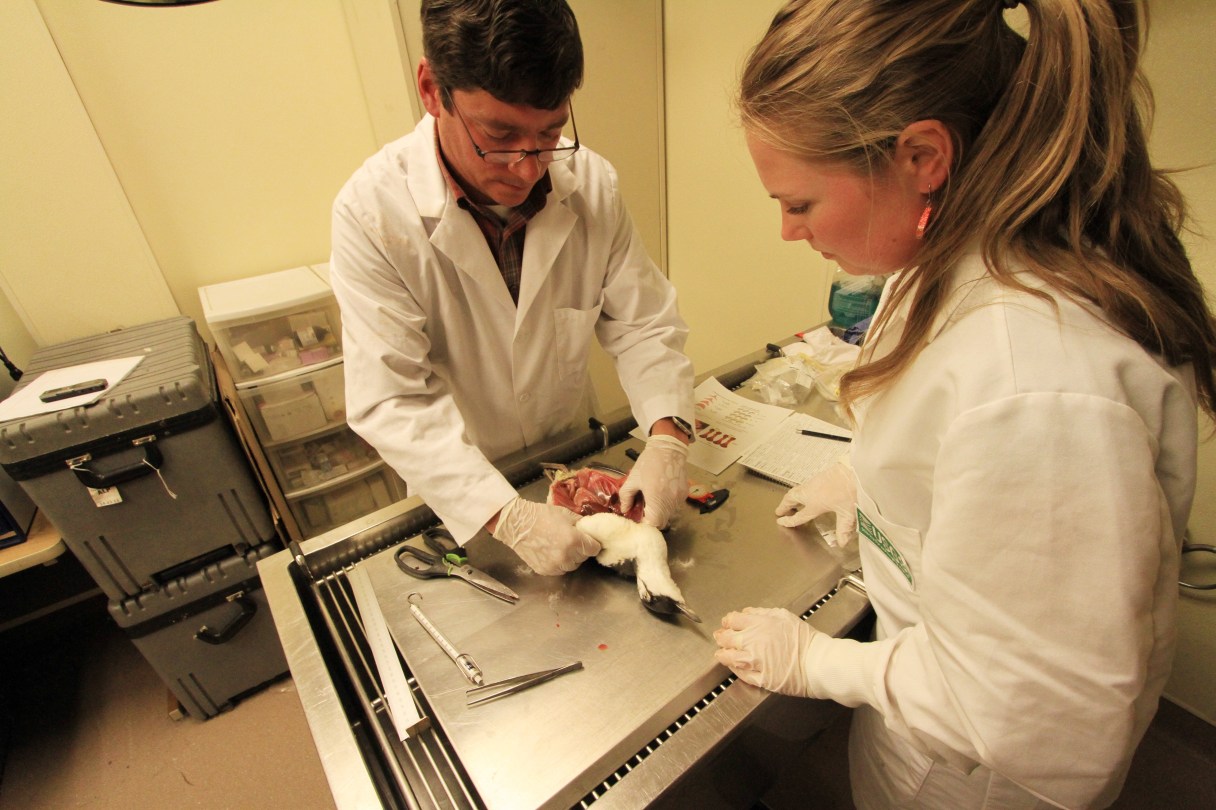
ANCHORAGE, Alaska (AP) – The common murre on Sarah Schoen’s examination table lived a short, hungry life.
Measurements of its beak and leg indicated it hatched in June. Its stomach and breast showed how it died. The 3-inch-long stomach was empty, and the pectoral muscles that powered its wings, allowing it to “fly” underwater after forage fish, were emaciated.
“As the bird starves, the body eats the muscle for energy,” Schoen said. “The muscle becomes more and more concave.”
Schoen, a wildlife biologist for the U.S. Geological Survey, and Rob Kaler, a biologist for the U.S. Fish and Wildlife Service, on Friday performed necropsies on common murres, part of an effort by dozens of scientists to explain the massive die-off of common murres that began one year ago.
Common murres are one of the northern hemisphere’s most common seabirds. The Alaska population is estimated at 2.8 million out of a world population of 13 to 20.7 million birds. Awkward on land, common murres can dive to 600 feet hunting fish or krill.