
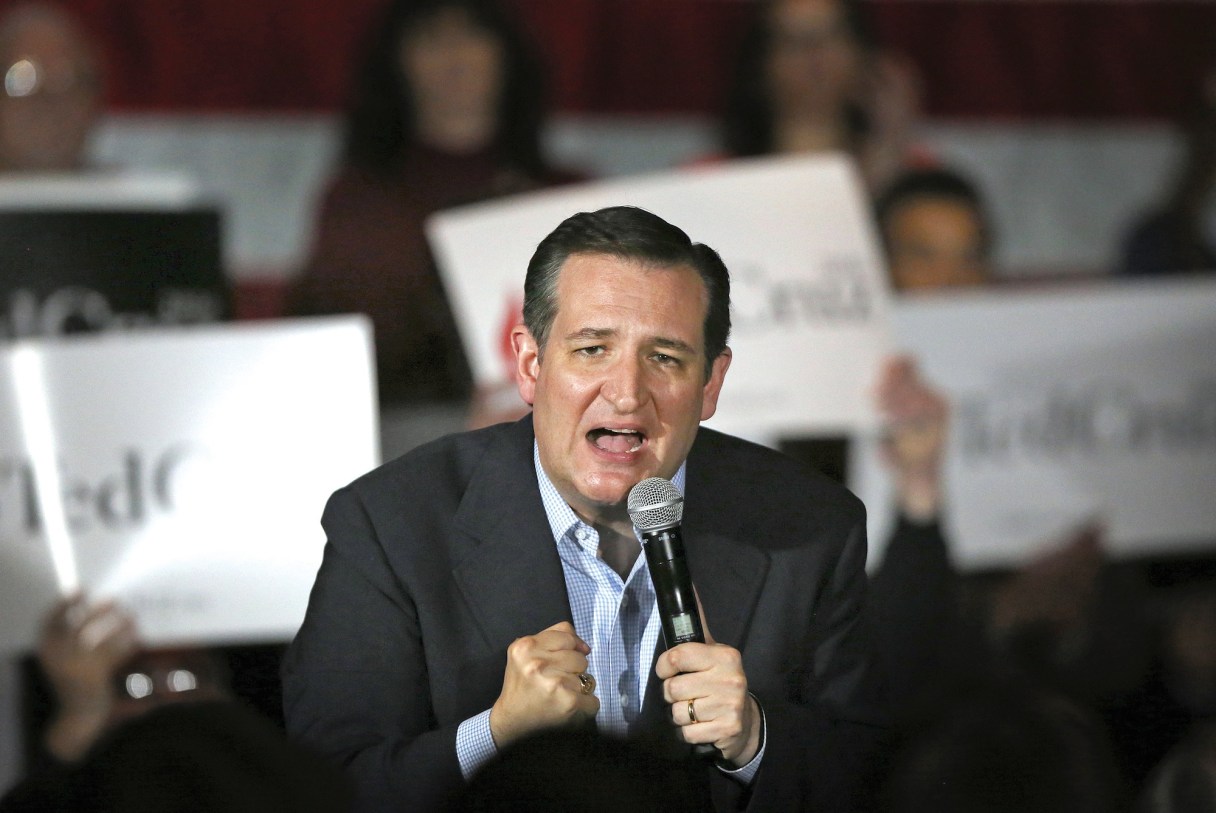
Enough, for one week at least, about the strange victories of Donald Trump. Let’s talk about the mysteries of his last real competitor, Ted Cruz.
On the surface, Cruz is a straightforward figure: The ideological zealot, the politician-as-activist, the unbending embodiment of True Conservatism. He’s the scourge of Obamacare, the bane of the GOP establishment, the evangelical moralist with a flat-tax plan and a Reagan quote for every occasion.
In this framing, Cruz is basically Barry Goldwater come again, an ideological crusader who might still grab his party’s nomination but whose general election prospects are limited by his own extremism.
I’ve used this framing myself, and it might be the best way to approach a Hillary-Cruz race. But it also seems inadequate.
Start at the intuitive level. Despite what you may have heard, true belief is pretty common among politicians. Listen to Rand Paul talk about liberty or Marco Rubio dilate on the promise of America; watch Bernie Sanders rail against inequality or President Barack Obama defend technocratic liberalism. They all radiate sincerity.
With Cruz, though, even the most fervent peroration always feels like a debater’s patter, an advocate’s brief, more of a command performance than a window into deep conviction.
This doesn’t mean that Cruz’s conservatism isn’t sincere. But the fact that he seems so much like an actor hitting his marks fits with the story of how he became Mr. True Conservative Outsider in the first place. Basically, he spent years trying to make it in Washington on the insider’s track and hit a wall because too many of the insiders didn’t like him. So he deliberately switched factions, turning the establishment’s personal disdain into a political asset.
His push for the Obamacare shutdown, and the bill of goods he sold the party’s base, was a particularly remarkably exercise in self-serving political cynicism. But on many fronts – Edward Snowden, trade policy, immigration, the fate of Middle Eastern Christians – Cruz has proceeded with several fingers in the wind.
The same pattern has prevailed in the presidential campaign, in his complicated relationship to Trump – obsequious at first, cynically imitative on issues where Trump’s demagogy has worked, and finally self-righteous and dudgeon-filled now that the name-calling and scandal-mongering have been turned against his reputation and his family.
Throughout this rise, Cruz has often seemed less like Goldwater than like American conservatism’s own Kenneth Widmerpool, the most memorable character in the English novelist Anthony Powell’s series, “A Dance to the Music of Time.”
This is not exactly a flattering comparison. But the American reader may find aspects of Widmerpool’s character curiously sympathetic. And some of that strange sympathy could be extended to Cruz.
Unloved, unattractive, a Simpsons-quoting nerd still chasing the teenage dream of world domination, the Texas senator has outworked, out-organized and outlasted the candidates who were supposed to beat him.
His cynicism can be repellent, his message discipline exhausting, and his Reagan-vintage policy proposals induce a mild despair. But in the drama of this insane campaign, he has actually earned his position, and if his doggedness wins the Republican nomination on the second ballot it will be one of the most fascinating triumphs in recent political history.
The New York Times