
Fun Fact.
Red-bellied woodpeckers have a barbed tongue with which they use to impale insect larvae.
Woodpecker’s staccato drumming echoes prehistory. For tens of millions of years, these birds have frequented forests worldwide. Over 20 species are native to North America alone with six common in Tennessee.
A flash of red here; black and white speckles there – many of these animals bare close resemblance to one another, and as you will see, their names can be misleading.
Here are some tips on distinguishing between some of the region’s most notable lookalikes.
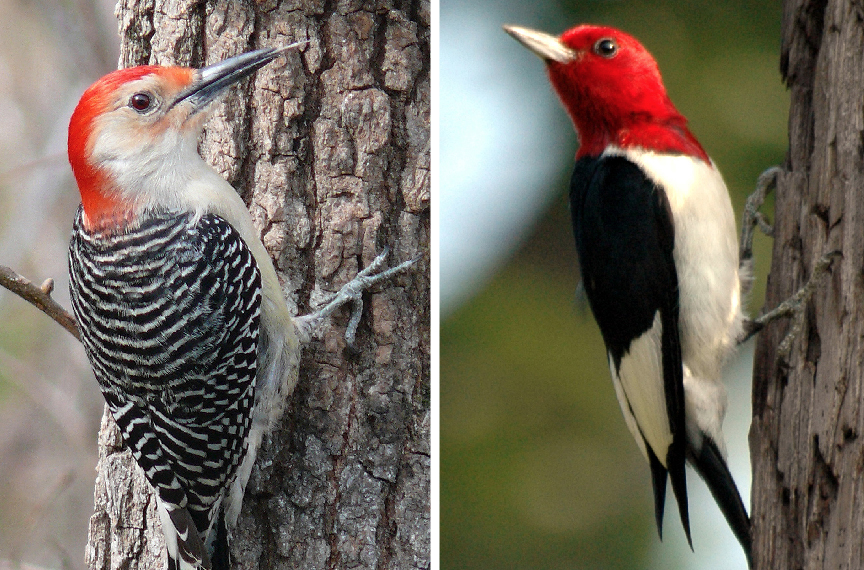
Left: Red-bellied woodpecker (Melanerpes carolinus)
– Bright red nape
– Black-and-white barred back
– Wash of red on belly; rarely visible
vs.
Right: Red-headed woodpecker (Melanerpes erythrocephalus)
– Bright red head (adults only)
– Solid white underparts
– Solid black back and primaries (primary feathers are the longest flight feathers and are located farthest from the body)
– White rump and secondaries (secondary feathers are shorter and are located on the wing close to the body)
_____
The following two woodpeckers might be the trickiest to tell apart. They both have white patches on their back, white underparts, black-and-white checkered wings and males have a red mark on the backs of their heads. However, the downy, known to frequent backyard feeders, is more common than the hairy, which forages almost exclusively in mature woods.
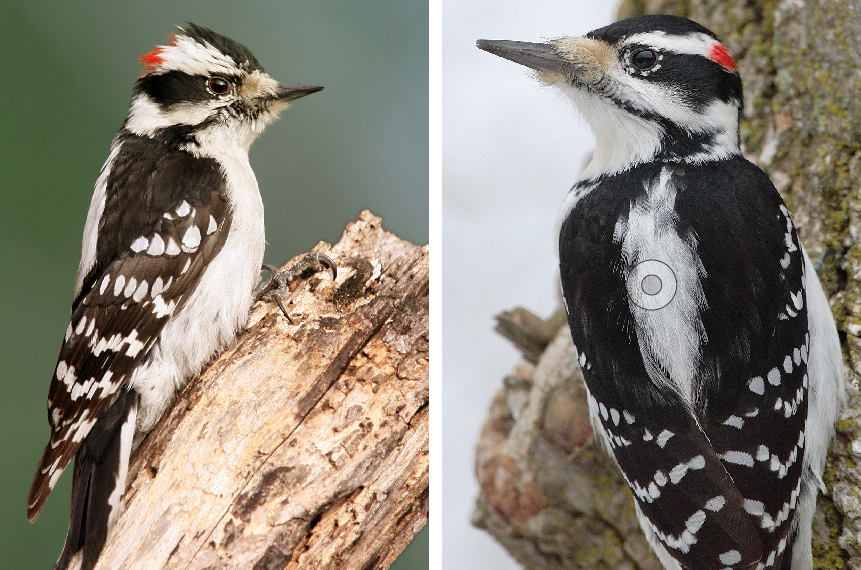
Left: Downy woodpecker (Picoides pubescens)
– Smallest woodpecker in North America, only 6 1/2 inches long
– Small bill
– Tuft of nasal bristles
vs.
Right: Hairy woodpecker (Leuconotopicus villosus)
– Larger than the downy, about 9 1/4 inches long
– Large bill
______
Differentiating between these two is easy. The answer is always pileated. That’s because the ivory-bill disappeared around 1935 – though some birders believe the lost species still exists.
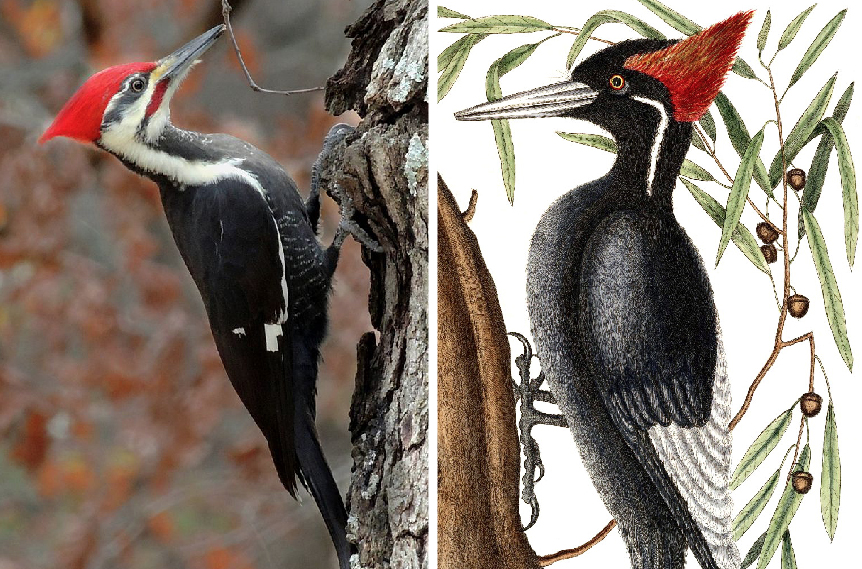
Left: Pileated woodpecker (Hylatomus pileatus)
– Crow-sized bird
– Dark-colored bill
– White chin
– White stripes on side of the face touch the bill
vs.
Right: Ivory-billed woodpecker (Campephilus principalis)
– Larger than the pileated, about 19 1/2 inches long
– Ivory-white bill
– Dark chin
– White stripes on side of face do no touch the bill