
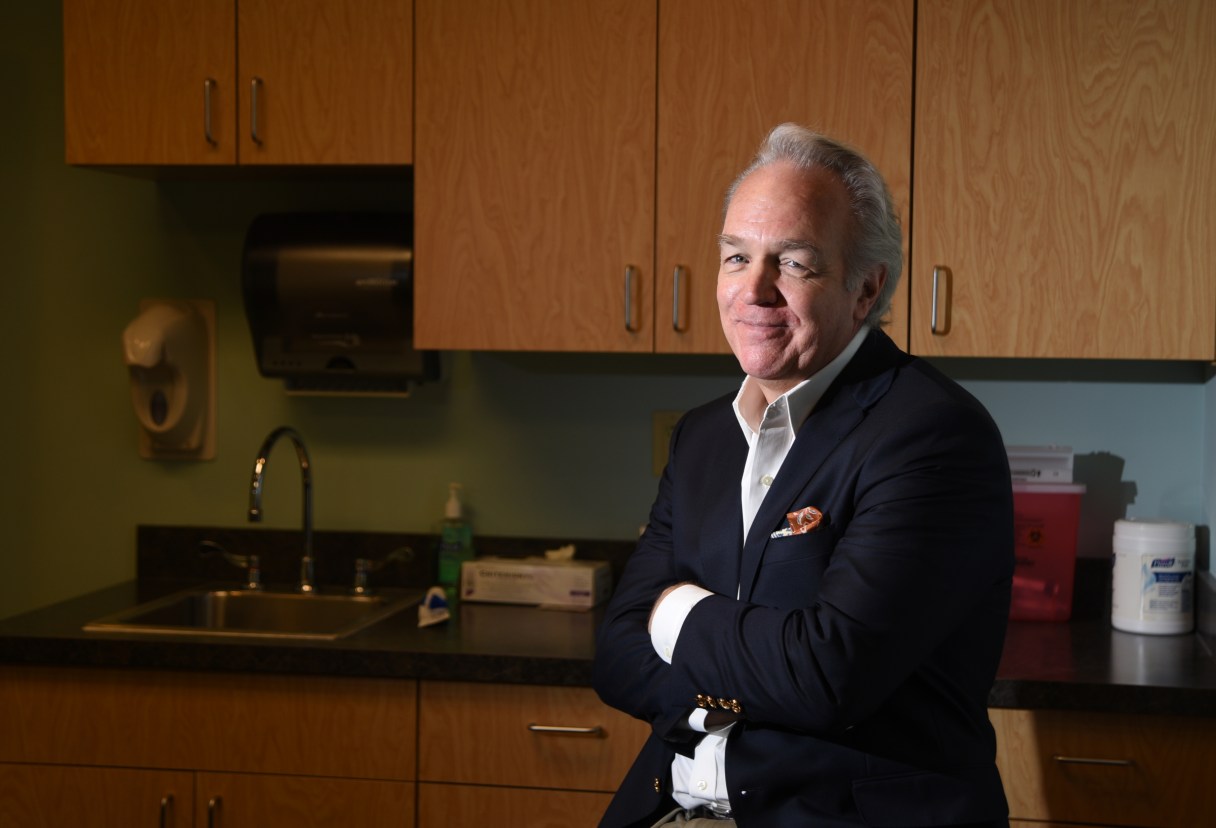
 Dan Potter, left, and Keith Hall stand Friday, Sept. 23, 2016 in CHI Memorial’s Missionary Ridge Building.
Dan Potter thought he just had a low testosterone level.
Doctors checked his pituitary gland and even tried testosterone replacement therapy, but then a test showed that his prostate gland was enlarged.
He was referred to CHI Memorial prostate specialist Dr. Lee Jackson, who did a blood test and noticed that his PSA level was unusually high for a guy who was only 42 years old.
PSA stands for prostate specific antigens, a substance produced normally by the prostate gland. As a man ages, the level increases, but Potter’s PSA was way out of line. “My levels were that of a 75-year-old,” said Potter, who works in the environmental services department at CHI Memorial.
Keith Hall, 56, a radiation detection specialist at TVA’s Sequoyah Nuclear Plant, had checked his PSAs every year since he was 40, and they were always below a level of 4.0, what most doctors thought was normal. But then he skipped a checkup for a year because he was building a new home. When he went back to his doctor two years later, his level had skyrocketed from 2.4 to 10.