
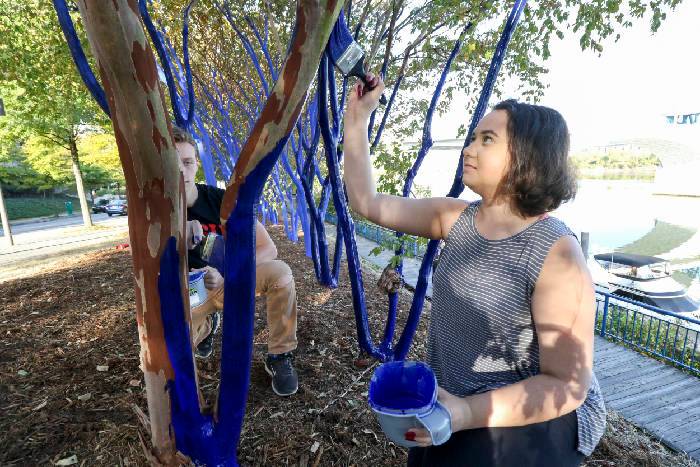
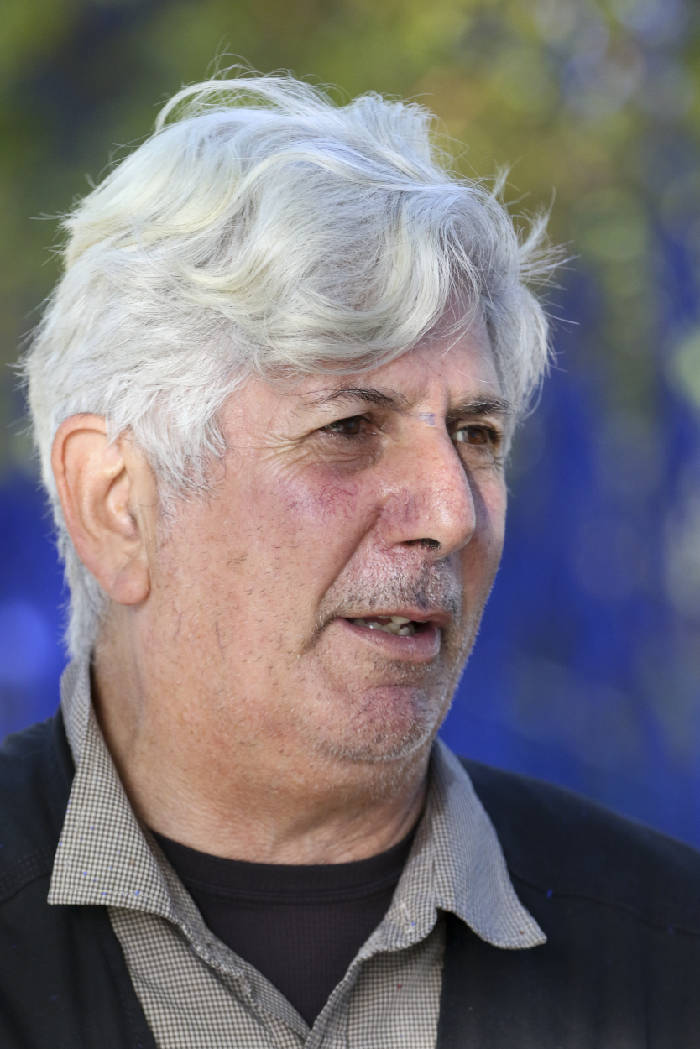
 Konstantin “Kon” Dimopoulos speaks about his art movement that started in 2000 where he visits different cities and paints area trees blue.
Perhaps you’ve noticed some blue trees dotting the city’s landscape as of late. Konstantin Dimopoulos, the New Zealand-born artist heading up the project titled “The Blue Trees,” says he’s trying to bring attention to the plight of old-growth forests around the world.
About 18 million acres – roughly the size of Panama – are destroyed each year, according to the National Geographic Society. About 36 football fields’ worth of trees are lost every minute, the World Wildlife Fund estimates. Such damage leads to soil erosion, eradicates animal and plant habitats, ejects more carbon dioxide into the atmosphere and reduces the number of trees to pull pollution from the air.
After hearing these stats from the Australian chapter of Friends of the Earth, Dimopoulos, who lives in Melbourne, wanted to spread the word.
“As an artist, I thought, ‘What can I do to make people more aware of this?” he said. “I thought, ‘I wish we could do something that would make people in the cities aware of this because it’s happening thousands of miles away and is invisible.”
Along came the idea of painting trees blue, something far from invisible, although the paint will wash off in three to four months, he said.
“Blue, I think, talks about serenity. It’s almost like the cathedral windows, the stained glass,” said the 60-year-old artist. But, he added, vibrant blue “also grabs attention and that’s what we’re here for. If I colored them brown, nobody would care, and part of it is to create something that is the apotheosis of what a tree is.”
Blue trees sounded like an interesting idea to Rachel Frizzell and Caleb Mathias, two friends who were painting the trees with Dimopoulos last week.
“I thought it looked like a lot of fun because I have a passion about bringing art to the public and the community. I think it’s a great way to get the community involved,” said 19-year-old Frizzell, a student at the University of Tennessee at Chattanooga who’s majoring in communications and French.
Mathias, 19 and a geology major at UTC, was attracted to the idea that tree painting could “spread knowledge about the environmental problems right now.”
A sculptor by trade, Dimopoulos has carried the tree-painting project to 20 cities so far, including London, Toronto, Atlanta and Melbourne; in Chattanooga, its money comes from the Benwood Foundation, the Lyndhurst Foundation and the Footprint Foundation.
The project runs until Nov. 15 and, while here, he’ll also paint trees at the Bessie Smith Cultural Center and visit schools to spread his message to kids.
“I take take this to schools to say to kids: ‘Look, you can change your world just as an artist changes a canvas,'” he said. “Just because you’re in Chattanooga doesn’t mean you can’t change the world.
“Part of my thing is to just start the conversation.”
Dimopoulos asks that, if you walk by the blue trees and wonder what’s going on, to stop and ask.
“I like when people stop and say, ‘What are you doing to our trees?'” he said. “I don’t like people to just go past and don’t say anything.”