
Thursday, October 29, 2026Oct 29

This story is free to read.

Future climate change field test doesn’t make Earth greener

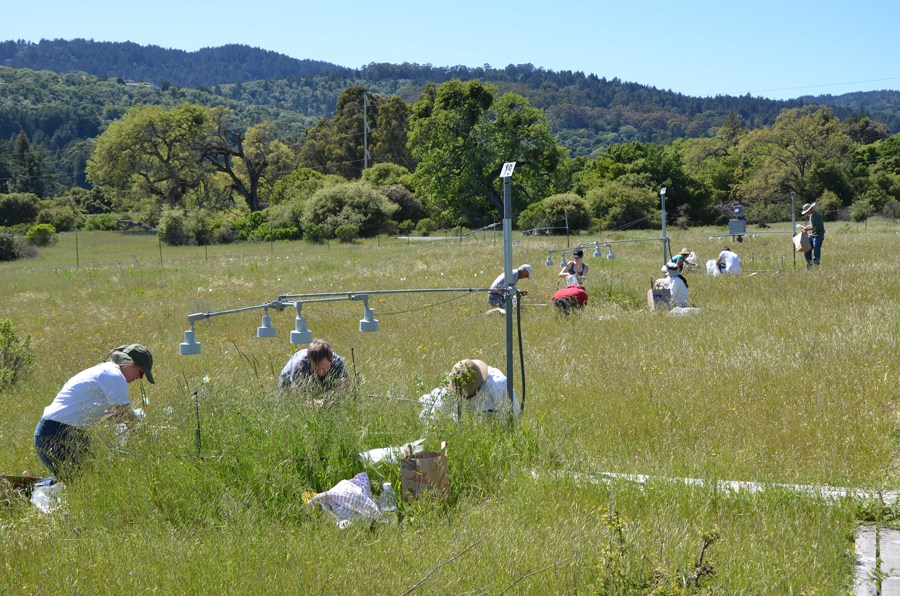
In this photo provided by Stanford University, participants in the Jasper Ridge Global Change Experiment sampled plots of the grassland ecosystem for 17 years. For 17 years with experiments on more than one million plants, scientists put future global warming to a real world test, growing California flowers and grasslands with extra heat, carbon dioxide and nitrogen to simulate a not-so-distant future. The results contradict a common talking point by people who downplay the threat of global warming and reject the science.    (Nona Chiariello/Stanford University via AP)
In this photo provided by Stanford University, participants in the Jasper Ridge Global Change Experiment sampled plots of the grassland ecosystem for 17 years. For 17 years with experiments on more than one million plants, scientists put future global warming to a real world test, growing California flowers and grasslands with extra heat, carbon dioxide and nitrogen to simulate a not-so-distant future. The results contradict a common talking point by people who downplay the threat of global warming and reject the science. (Nona Chiariello/Stanford University via AP) In this photo provided by Stanford University, participants in the Jasper Ridge Global Change Experiment sampled plots of the grassland ecosystem for 17 years. For 17 years with experiments on more than one million plants, scientists put future global warming to a real world test, growing California flowers and grasslands with extra heat, carbon dioxide and nitrogen to simulate a not-so-distant future. The results contradict a common talking point by people who downplay the threat of global warming and reject the science. (Nona Chiariello/Stanford University via AP)

LOS ANGELES (AP) – In the course of a 17-year experiment on more than 1 million plants, scientists put future global warming to a real world test – growing California flowers and grasslands with extra heat, carbon dioxide and nitrogen to mimic a not-so-distant, hotter future.

The results, simulating a post-2050 world, aren’t pretty. And they contradict those who insist that because plants like carbon dioxide – the main heat-trapping gas spewed by the burning of fossil fuels – climate change isn’t so bad, and will result in a greener Earth.

At least in the California ecosystem, the plants that received extra carbon dioxide, as well as those that got extra warmth, didn’t grow more or get greener. They also didn’t remove the pollution and store more of it in the soil, said study author Chris Field, director of the Stanford Woods Institute for the Environment. Plant growth tended to decline with rising temperatures.

“This experiment really puts to bed the idea of a greener hypothesis where ecosystems save us from the implications of human-induced climate change,” Field said.

Earlier this year, a team of international scientists released a study that looked at Earth from 1982 to 2009 and found it was greening, with a quarter to half the planet producing an increase in the growing season. Field said that earlier study is about trends the planet has already seen, but doesn’t say much about the future.