
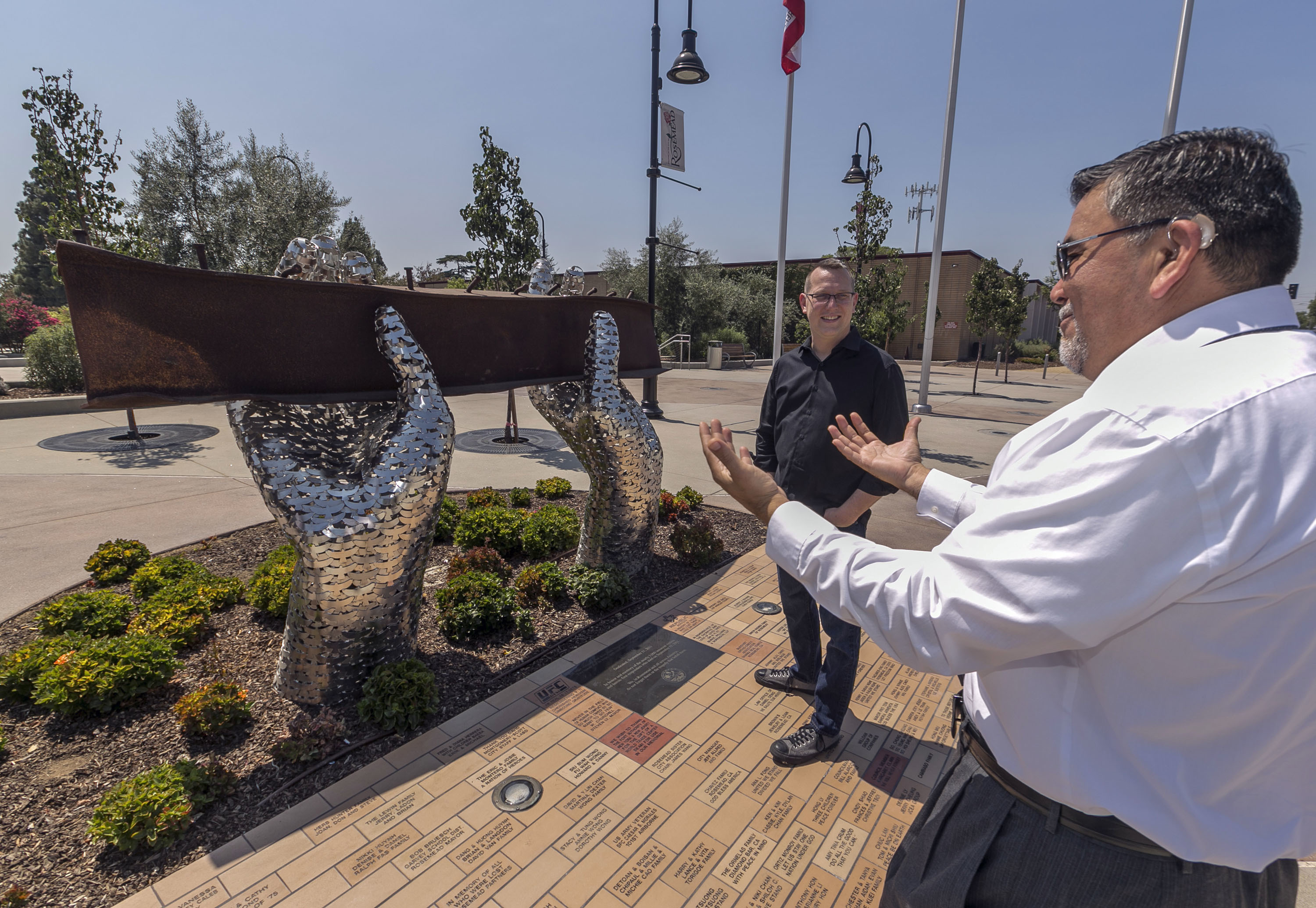
 In this Friday, Aug. 26, 2016 photo, California State EDD employee Juan Milan, right, talks with artist Heath Satow about his sculpture, “Reflect,” made with a damaged, rusted I-beam from the collapsed World Trade Center buildings, outside the Rosemead, Calif., city hall plaza. Satow said he purposely positioned the beam at about eye level, so people could see, touch and feel it. (AP Photo/Damian Dovarganes)
NEW YORK – Behind the barbed wire, the white minivan’s busted windows and crumpled roof hint at its story. But forklifted to this windblown spot on the John F. Kennedy International Airport tarmac, between a decommissioned 727 and an aircraft hangar, it’s doubtful passing drivers notice it at all.
In the long struggle with the searing memories of 9/11, though, the van’s solitary presence here marks a small but significant transition point.
Tons of wreckage – twisted steel beams weighing up to 40,000 pounds, chunks of concrete smelling of smoke, a crushed fire engine, a dust-covered airline slipper – were salvaged from the World Trade Center site for preservation in the weeks after the 2001 terrorist attacks. Now, 15 years later, this van, part of a government agency motor pool likely sheltered from the impact in the parking garage beneath the complex, is the very last artifact without a resting place.
When the van is claimed, as soon as a few weeks from now, it will fulfill a pledge that, to move beyond 9/11 without losing sight of it, New York would share relics of that terror, along with the tales of sacrifice and fear that come with them.
The decision by officials to give away pieces of Trade Center wreckage has been praised and criticized over the years. But its impact is undeniable.