
Tuesday, November 10, 2026Nov 10

Feds preview rules of the road for self-driving cars

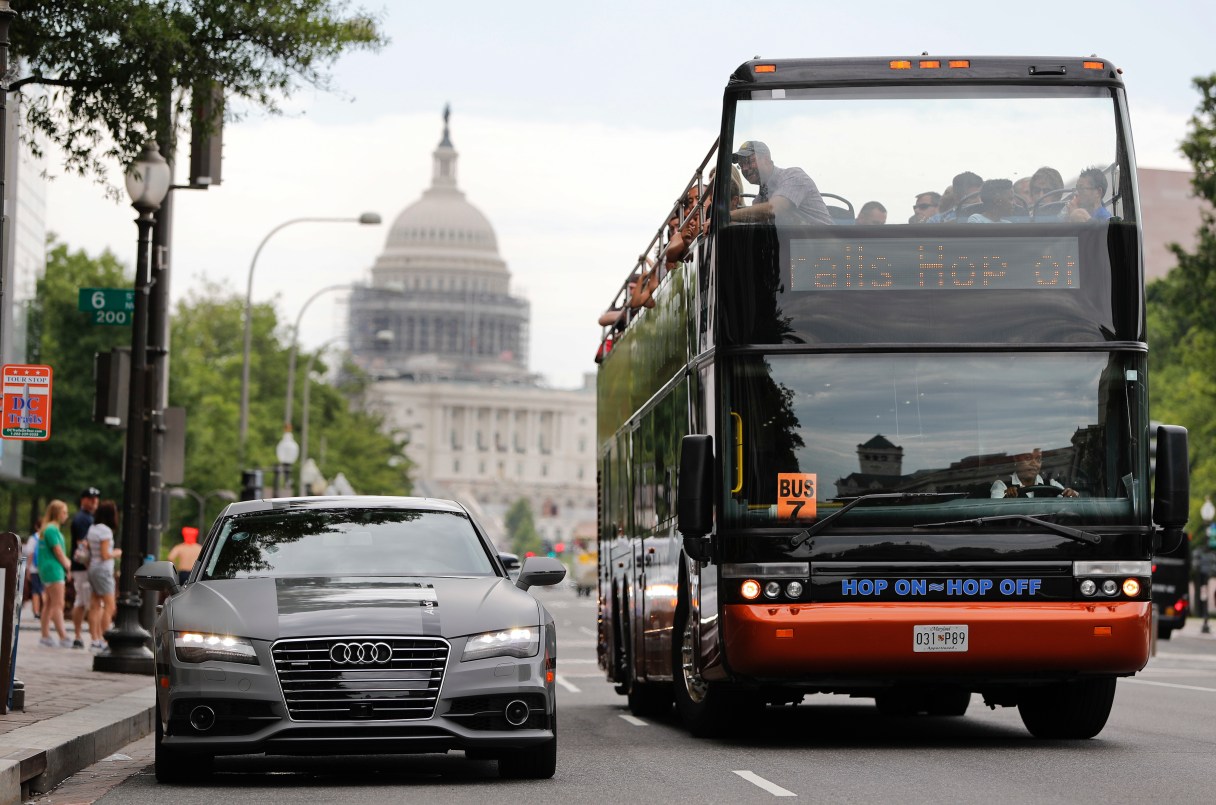
In this July 15, 2016, photo, a double decker tour bus drives by an Audi self driving vehicle parked on Pennsylvania Avenue, near the Capitol in Washington. The federal government should be in charge of regulating self-driving cars rather than states since the vehicles are essentially controlled by software, not people, Obama administration officials said Sept. 19 as they laid out the broad outlines of their plans to help get the transformational technology safely onto the nation’s roadways. (AP Photo/Pablo Martinez Monsivais)
In this July 15, 2016, photo, a double decker tour bus drives by an Audi self driving vehicle parked on Pennsylvania Avenue, near the Capitol in Washington. The federal government should be in charge of regulating self-driving cars rather than states since the vehicles are essentially controlled by software, not people, Obama administration officials said Sept. 19 as they laid out the broad outlines of their plans to help get the transformational technology safely onto the nation’s roadways. (AP Photo/Pablo Martinez Monsivais) In this July 15, 2016, photo, a double decker tour bus drives by an Audi self driving vehicle parked on Pennsylvania Avenue, near the Capitol in Washington. The federal government should be in charge of regulating self-driving cars rather than states since the vehicles are essentially controlled by software, not people, Obama administration officials said Sept. 19 as they laid out the broad outlines of their plans to help get the transformational technology safely onto the nation’s roadways. (AP Photo/Pablo Martinez Monsivais)

WASHINGTON (AP) – Obama administration officials previewed long-awaited guidance Monday that attempts to bring self-driving cars to the nation’s roadways safely – without creating so many roadblocks that the technology can’t make it to market quickly.

Traditional automakers and tech companies have been testing self-driving prototypes on public roads for several years, with a human in the driver’s seat just in case. The results suggest that what once seemed like a technology perpetually over the horizon appears to be fast approaching, especially with car companies announcing a string of investments and acquisitions in recent months.

Federal officials have been struggling with how to capitalize on the technology’s promised safety benefits – the cars can react faster than people, but don’t drink or get distracted – while making sure they are ready for widespread use. The new guidance represents their current thinking, which they hope will bring some order to what has been a chaotic rollout so far.

Self-driving cars have the potential to save thousands of lives lost on the nation’s roads each year and to change the lives of the elderly and the disabled, President Barack Obama said in an op-ed published Monday by the Pittsburgh Post-Gazette.

“Safer, more accessible driving. Less congested, less polluted roads. That’s what harnessing technology for good can look like,” Obama wrote. But he added: “We have to get it right. Americans deserve to know they’ll be safe today even as we develop and deploy the technologies of tomorrow.”