
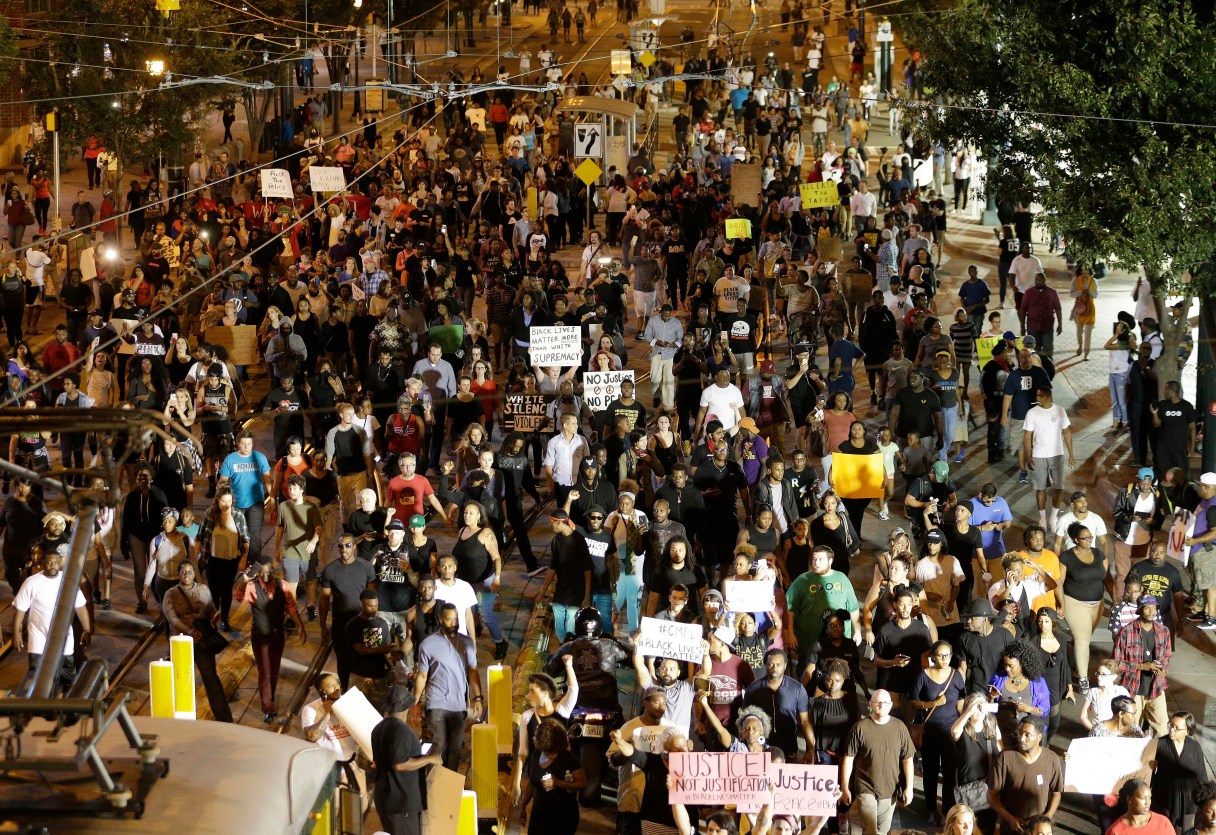
CHARLOTTE, N.C. (AP) – The killing of a black man by a Charlotte police officer, and the sometimes violent protests that followed, have intensified the political divide in a state crucial to deciding whether Hillary Clinton or Donald Trump wins the presidency.
Republicans and Democrats alike say the killing of Keith Lamont Scott will energize both parties’ strongest supporters in a presidential battleground state that also has competitive races for governor and the U.S. Senate. Both camps are citing the case as they push familiar arguments on race relations, law enforcement and social unrest.
“Both sides think they are right in this,” says Dee Stewart, a Republican consultant in North Carolina. “This all fits very well with Trump’s argument of ‘law and order’ and respecting our officers. It fits with the left’s narrative that anytime law enforcement acts with force in certain communities, it should be viewed with suspicion.”
It’s unclear if or how Scott’s killing and its aftermath will affect undecided voters, but even subtle shifts in support can be crucial. Polls show a tight race in a state that Barack Obama barely lost in 2012 after barely winning in 2008. In the state-by-state contest for the presidency, it’s difficult to see how Trump can win the presidency without capturing North Carolina.
Scott, 43, was shot Sept. 20 standing outside his vehicle. Police maintain he was armed. Video released by Charlotte-Mecklenburg authorities was inconclusive. The officer who shot Scott is also black.