
Wednesday, November 11, 2026Nov 11

Toyota shows robotic leg brace to help paralyzed people walk

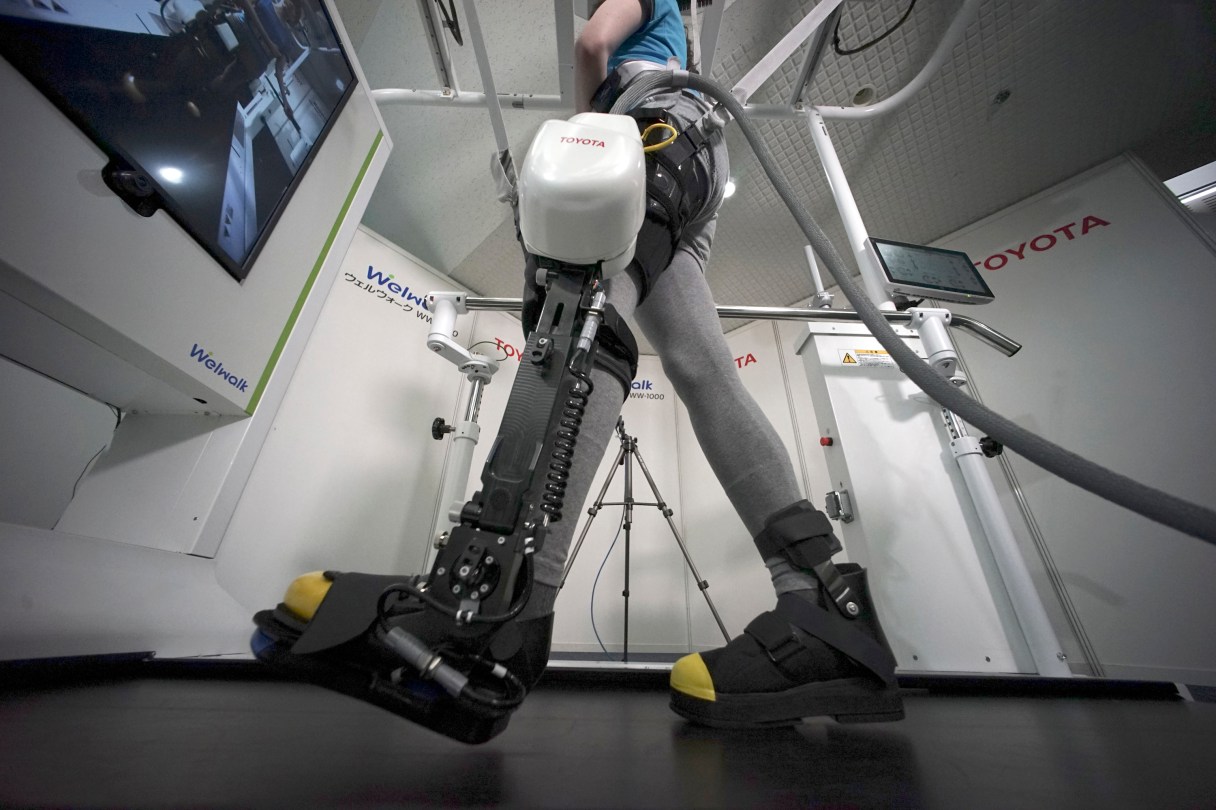
A model demonstrates the Welwalk WW-1000, a wearable robotic leg brace designed to help partially paralyzed people walk at the main system with treadmill and monitor,  at Toyota Motor Corp.'s head office in Tokyo, Wednesday, April 12, 2017. Toyota Motor Corp.'s Welwalk WW-1000 system is made up of a motorized mechanical frame that fits on a person’s leg from the knee down. (AP Photo/Eugene Hoshiko)
A model demonstrates the Welwalk WW-1000, a wearable robotic leg brace designed to help partially paralyzed people walk at the main system with treadmill and monitor, at Toyota Motor Corp.'s head office in Tokyo, Wednesday, April 12, 2017. Toyota Motor Corp.'s Welwalk WW-1000 system is made up of a motorized mechanical frame that fits on a person’s leg from the knee down. (AP Photo/Eugene Hoshiko) A model demonstrates the Welwalk WW-1000, a wearable robotic leg brace designed to help partially paralyzed people walk at the main system with treadmill and monitor, at Toyota Motor Corp.'s head office in Tokyo, Wednesday, April 12, 2017. Toyota Motor Corp.'s Welwalk WW-1000 system is made up of a motorized mechanical frame that fits on a person’s leg from the knee down. (AP Photo/Eugene Hoshiko)

TOKYO (AP) – Toyota is introducing a wearable robotic leg brace designed to help partially paralyzed people walk.

The Welwalk WW-1000 system is made up of a motorized mechanical frame that fits on a person’s leg from the knee down. The patients can practice walking wearing the robotic device on a special treadmill that can support their weight.

Toyota Motor Corp. demonstrated the equipment for reporters at its Tokyo headquarters on Wednesday.

One hundred such systems will be rented to medical facilities in Japan later this year, Toyota said. The service entails a one-time initial charge of 1 million yen ($9,000) and a 350,000 yen ($3,200) monthly fee.

The gadget is designed to be worn on one leg at a time for patients severely paralyzed on one side of the body due to a stroke or other ailments, Eiichi Saito, a medical doctor and executive vice president at Fujita Health University, explained.