
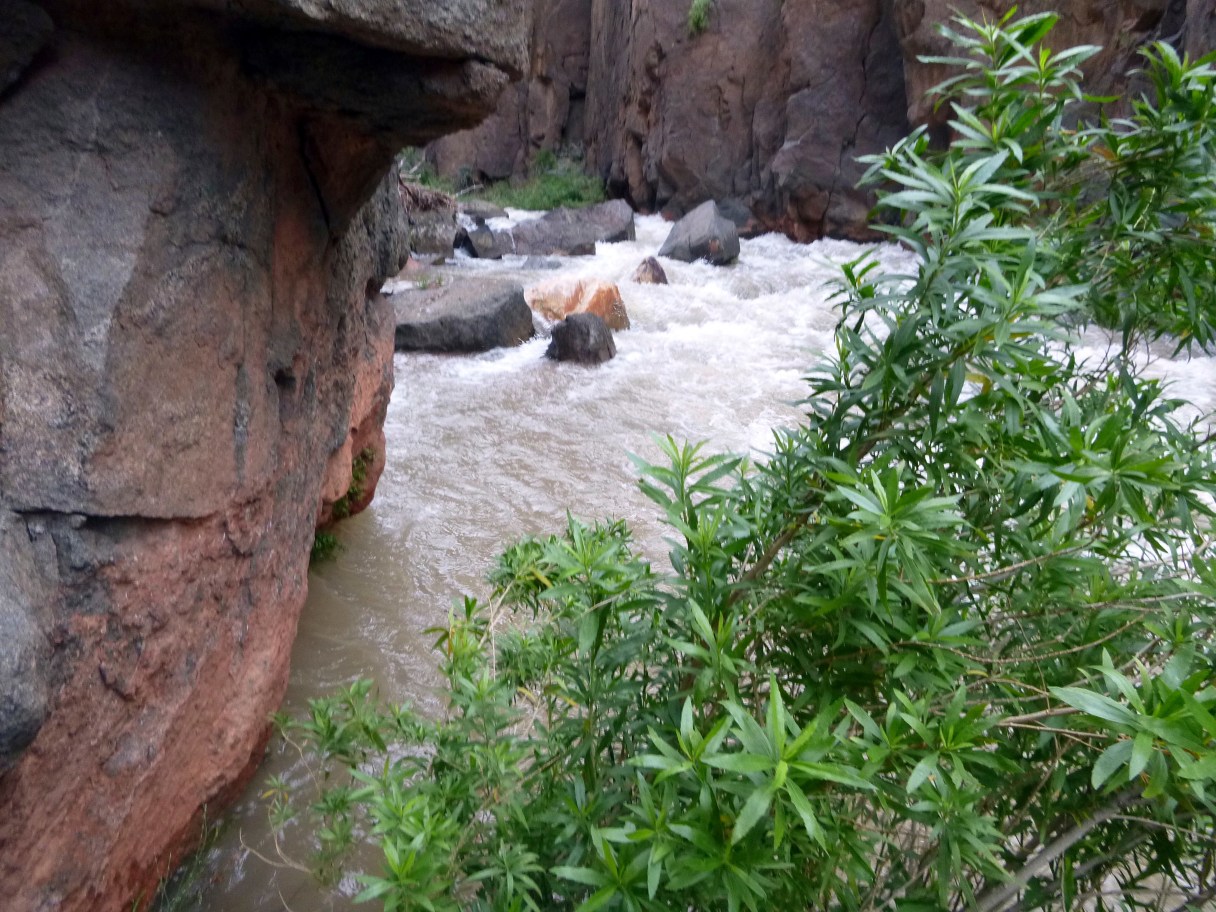
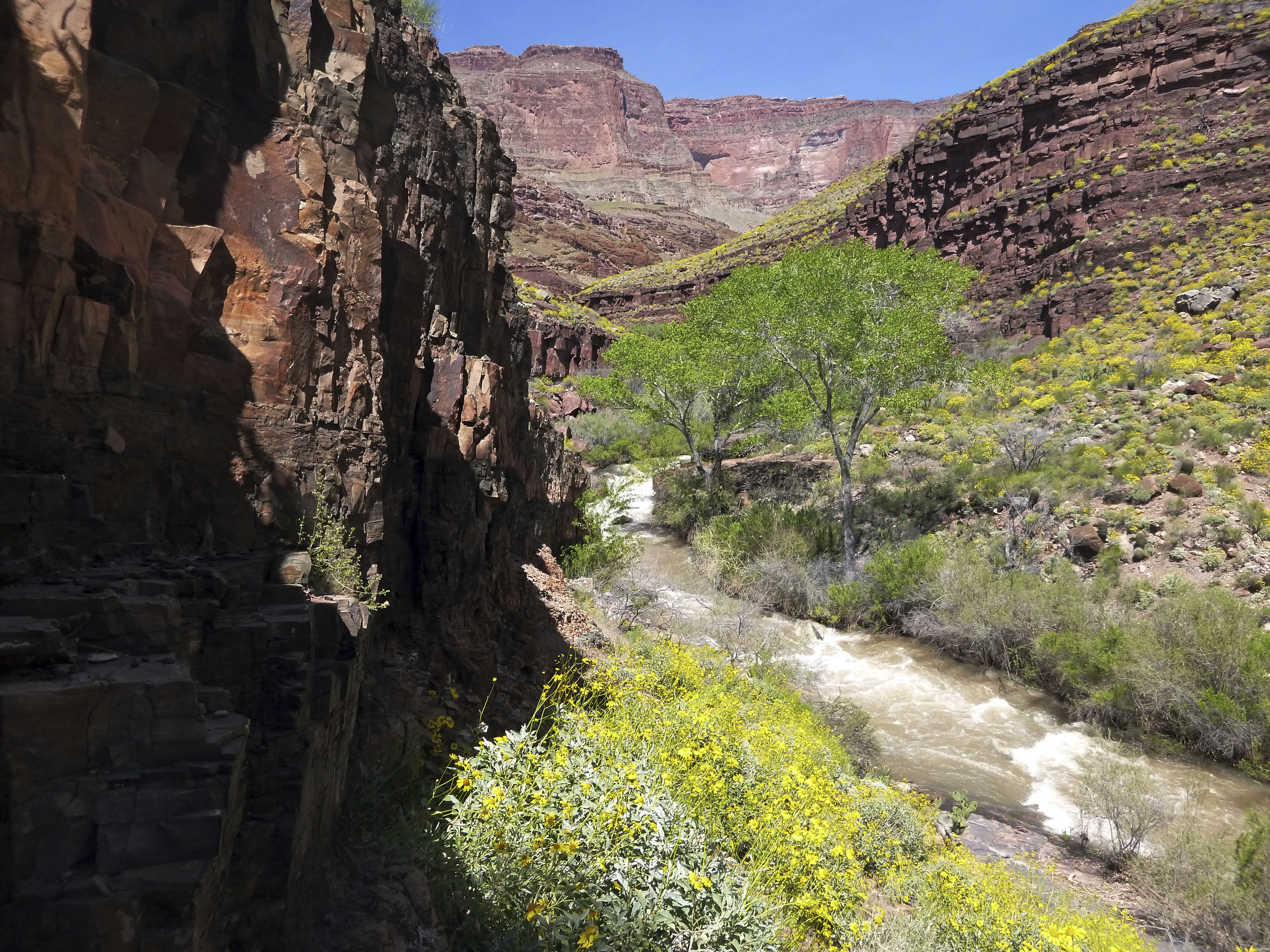
 This Sunday, April 16, 2017, photo provided by the National Park Service shows Tapeats Creek in Grand Canyon National Park in Arizona. Authorities are searching for Jackson Standefer, 14, and Lou-Ann Merrell, 62, after the pair lost their footing Saturday and fell into the water during a family trip in a remote area of the Arizona park. (National Park Service via AP)
PHOENIX – The desperate effort this week to find two hikers who disappeared at the bottom of the Grand Canyon represented the National Park Service’s most extensive use yet of drones in a search-and-rescue mission.
The Grand Canyon is the only national park with its own fleet of unmanned aircraft for reaching people who have gotten lost, stranded, injured or killed. Under a program that began last fall, it has five drones and four certified operators.
Jackson Standefer, 14, a McCallie School eighth-grader, and LouAnn Merrell, 62, lost their footing on April 15 while crossing a creek and were carried away by the current toward the Colorado River. They were on a hike with Merrell’s husband, Merrell Boot Co. co-founder Randy Merrell, and the boy’s mother, Julie Standefer-Merrell, of Chattanooga.
Ground teams consisting of about 20 people total, a National Park Service helicopter and an inflatable motor raft were flown into the canyon as part of the search this week. The Merrell Boot Co. also offered search resources, including a military-grade drone, climbers and rescuers.
The drones were used Monday through Wednesday in the search for Jackson and Merrell. And while the aerial search came up empty, it threw a spotlight on technology that can enter crevices and other spots unreachable by foot while sparing searchers the dangers of going up in a helicopter.
With its steep cliffs, nearly 2,000 square miles and mesmerizing views, the Grand Canyon can be as dangerous as it is captivating.
Rangers were confronted with 1,200 medical emergencies, 293 search-and-rescue missions and 17 deaths in 2016, a year in which it had nearly 6 million visitors. Last summer, a 35-year-old Yelp executive tripped while hiking, fell backward and was found dead 400 feet below.
“Our historic model was to take the helicopter to look and see,” said Grand Canyon Chief Ranger Matt Vandzura. But now, drones can offer “that same close look but without putting any people at risk. It has dramatically increased our ability to keep our people safe.”
The drones are about 18 inches across and 10 inches high, with a battery life of about 20 minutes. Drone operators watch the video in real time and then analyze it again at the end of the day.
The dangers of flying choppers in the canyon were illustrated in 2003, when a Park Service helicopter experienced a mechanical failure and crash-landed on the North Rim. Those aboard suffered only minor injuries; the helicopter was totaled.
Other national parks use drones, but for wildlife research. The use of private drones is prohibited in national parks.
James Doyle, a spokesman for the park service’s Intermountain region, said other national parks will probably seek their own drone fleets, too. He said the Grand Canyon’s extreme topography – it is a mile deep – makes it a perfect candidate.
“It’s a wonderful tool for the unfortunate situation we just found ourselves in at Grand Canyon,” Doyle said.
The park scaled back the operation and stopped using the drones but continued to search for the pair.
A memorial service will be held Sunday for LouAnn Merrell in her hometown of Vernal, Utah.