
Thursday, November 12, 2026Nov 12

Republicans in position to reshape federal bench

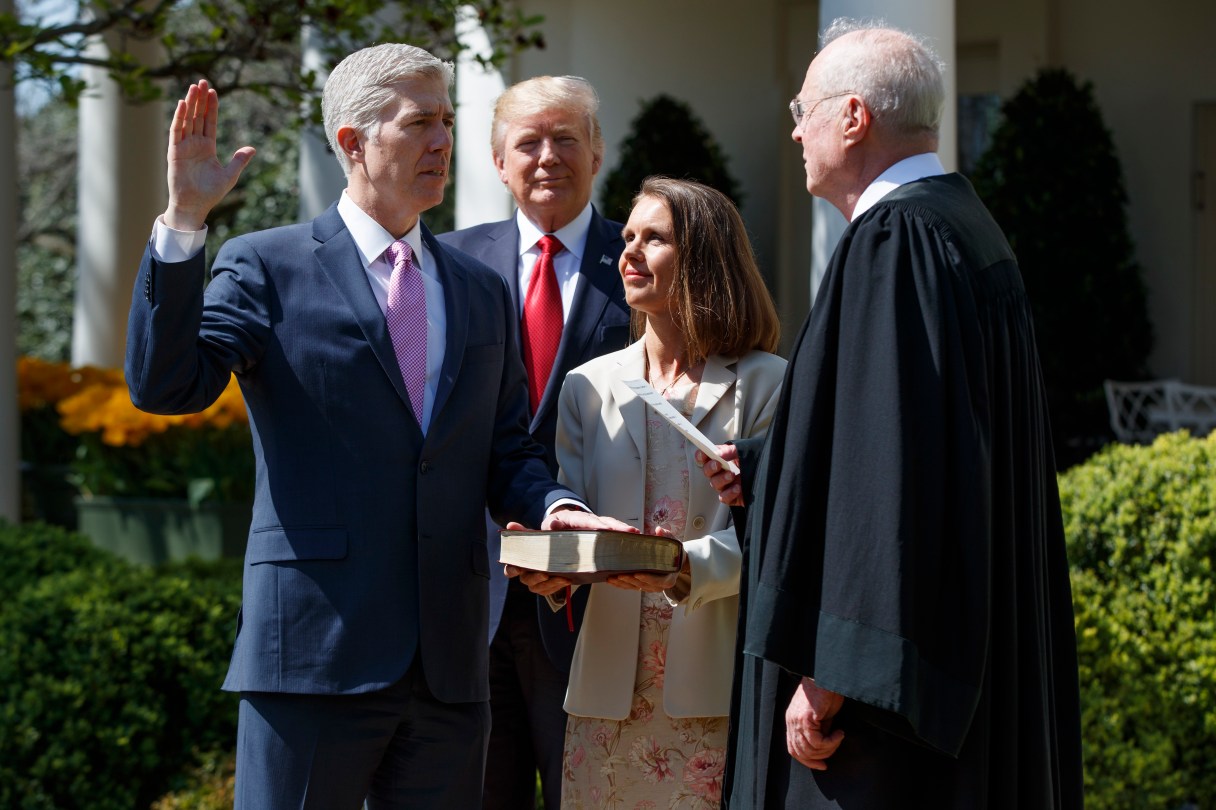
FILE - In this April 10, 2017, file photo, President Donald Trump watches as Supreme Court Justice Anthony Kennedy administers the judicial oath to Judge Neil Gorsuch during a re-enactment in the Rose Garden of the White House, in Washington. Gorsuch's wife Marie Louise Gorsuch hold a bible. Republicans have put President Donald Trump's Supreme Court nominee on the bench, and they’re now in a position to fill dozens more federal judgeships and reshape some of the nation's highest courts. (AP Photo/Evan Vucci, File)
FILE - In this April 10, 2017, file photo, President Donald Trump watches as Supreme Court Justice Anthony Kennedy administers the judicial oath to Judge Neil Gorsuch during a re-enactment in the Rose Garden of the White House, in Washington. Gorsuch's wife Marie Louise Gorsuch hold a bible. Republicans have put President Donald Trump's Supreme Court nominee on the bench, and they’re now in a position to fill dozens more federal judgeships and reshape some of the nation's highest courts. (AP Photo/Evan Vucci, File) FILE - In this April 10, 2017, file photo, President Donald Trump watches as Supreme Court Justice Anthony Kennedy administers the judicial oath to Judge Neil Gorsuch during a re-enactment in the Rose Garden of the White House, in Washington. Gorsuch's wife Marie Louise Gorsuch hold a bible. Republicans have put President Donald Trump's Supreme Court nominee on the bench, and they’re now in a position to fill dozens more federal judgeships and reshape some of the nation's highest courts. (AP Photo/Evan Vucci, File)

WASHINGTON (AP) – Republicans have put President Donald Trump’s Supreme Court nominee on the bench, and they’re now in a position to fill dozens more federal judgeships – and reshape some of the nation’s highest courts.

Democrats have few ways to stop them.

The Republican opportunity comes with the GOP in control of Congress and the White House, about 120 vacancies in federal district and appeals courts to be filled and after years of partisan fights over judicial nominations.

Frustrated by Republican obstruction in 2013, then-majority Democrats changed Senate rules so judicial nominations for those trial and appeals courts are filibuster-proof, meaning it takes only 51 votes, a simple majority in the 100-member Senate, for confirmation.

Today, Senate Republicans hold 52 seats.