
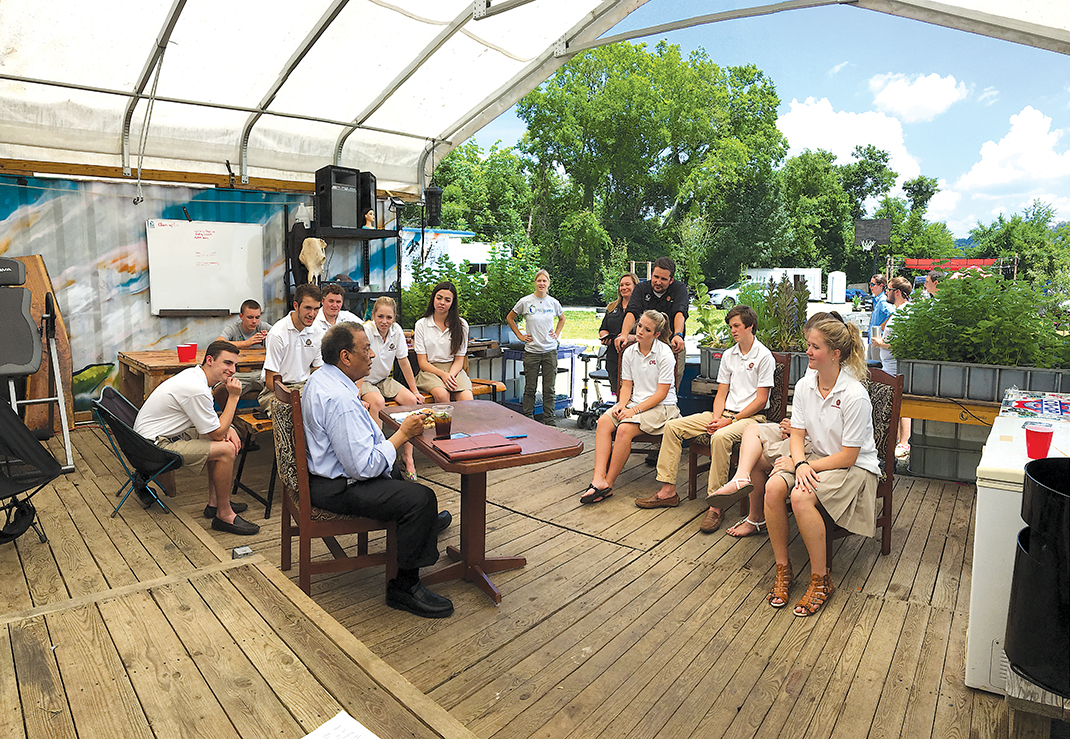
 Ambassador Young talks with students from Christian Heritage School.
Aquaponics Fast Facts
» Aquaponics is known as a “closed loop system,” meaning everything is recycled – even waste. » Fish waste fertilizes the plants and the plants’ roots purify the water to return to the fish. » Aquaponics uses 90 percent less water than traditional soil farms and a fraction of the electricity. In fact, several HATponics systems are powered by sun and wind.» When using aquaponics, you can produce as much food on 1/3 of an acre than you can on 10 acres with traditional farming, Cox says.
It was a hot June afternoon at HATponics, an aquaponics farm in Rossville, Georgia. Ambassador Andrew Young looked at the plate of food set before him: blackened catfish and a green salad prepared from food harvested just 25 yards from his seat in the shade.
“Hey y’all, we prayin’!” he called to the group.
Even though Young, 85, is a former Atlanta mayor, the first African-American appointed ambassador to the United Nations, and a prominent Civil Rights leader, he’s never far from his roots as a minister in a Southern farming community. In fact, his agrarian background is what ultimately led him to HATponics, which he has partnered with on several sustainable agriculture projects through his namesake nonprofit, The Andrew J. Young Foundation.
“Ryan is one of the brightest and most decent people I’ve met,” Young says of HATponics CEO and founder Ryan Cox. “He’s a disciplined scholar and a brilliant guy. I think it’s just a matter of time before this catches hold and becomes a worldwide effort.”