
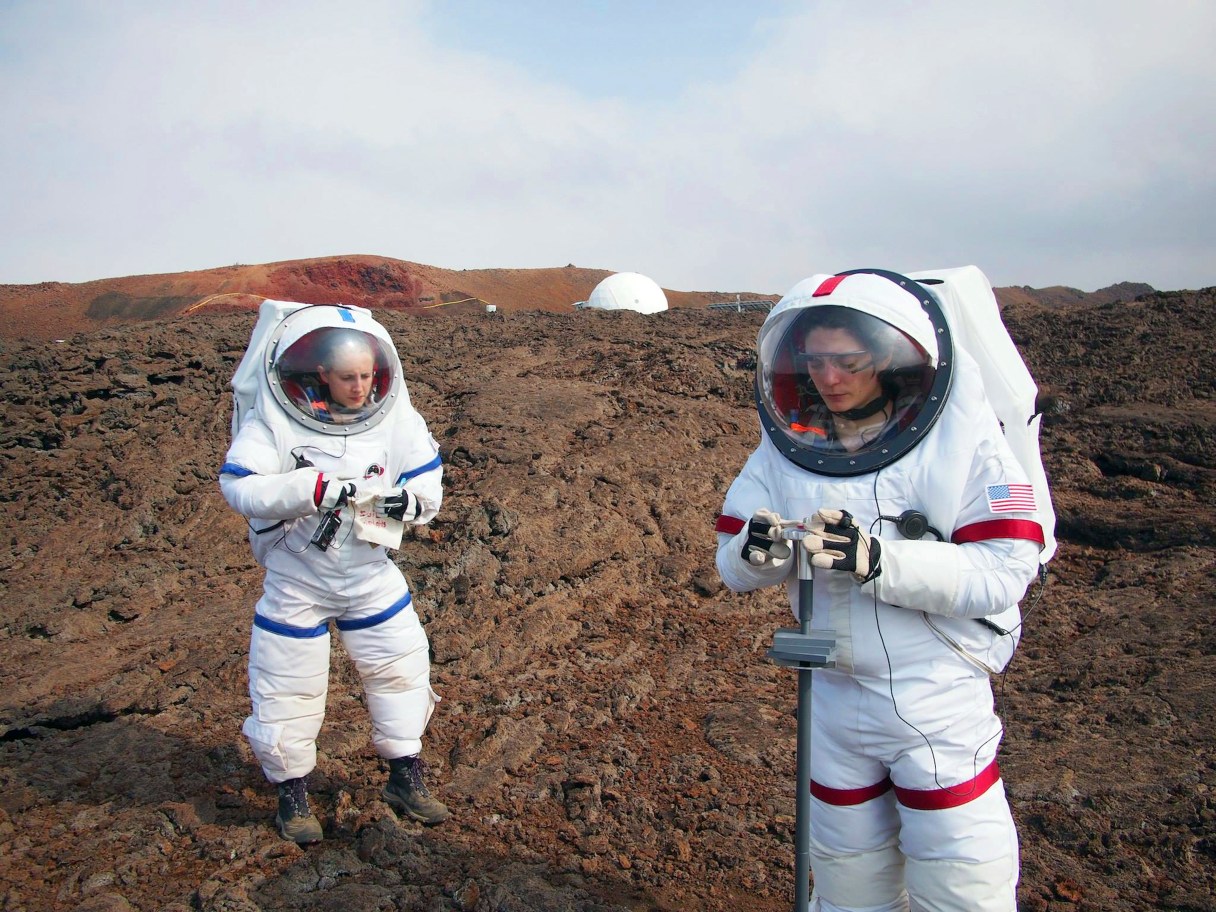
HONOLULU (AP) – A group of NASA-funded researchers are poised to enter an isolated geodesic dome on a Hawaii volcano to study human behavior for long-term space exploration, including a planned voyage to Mars.
The six crew members head into their new home Thursday on the Big Island’s Mauna Loa volcano for an eight-month stay. There will be no physical human contact with the outside world, a 20-minute delay in communications to simulate the time it takes for messages to reach earth from Mars and the team will be required to wear space suits whenever they leave the compound.
The study will assess the psychological difficulties associated with living in isolated and confined conditions far away from home. The University of Hawaii operates the facility called Hawaii Space Exploration Analog and Simulation, or HI-SEAS.
“We’re hoping to figure out how best to select individual astronauts, how to compose a crew and how to support that crew on long-duration space missions,” said principal investigator Kim Binstead, a University of Hawaii science professor. The study’s goal, she said, is to “reduce the barriers to a human journey to Mars.”
There are a number of other Mars simulation projects around the world, but the Hawaii project has been receiving federal funding for several years and is unique, the university says, because of its accessibility, consistent weather and realistic Mars-like geography.