
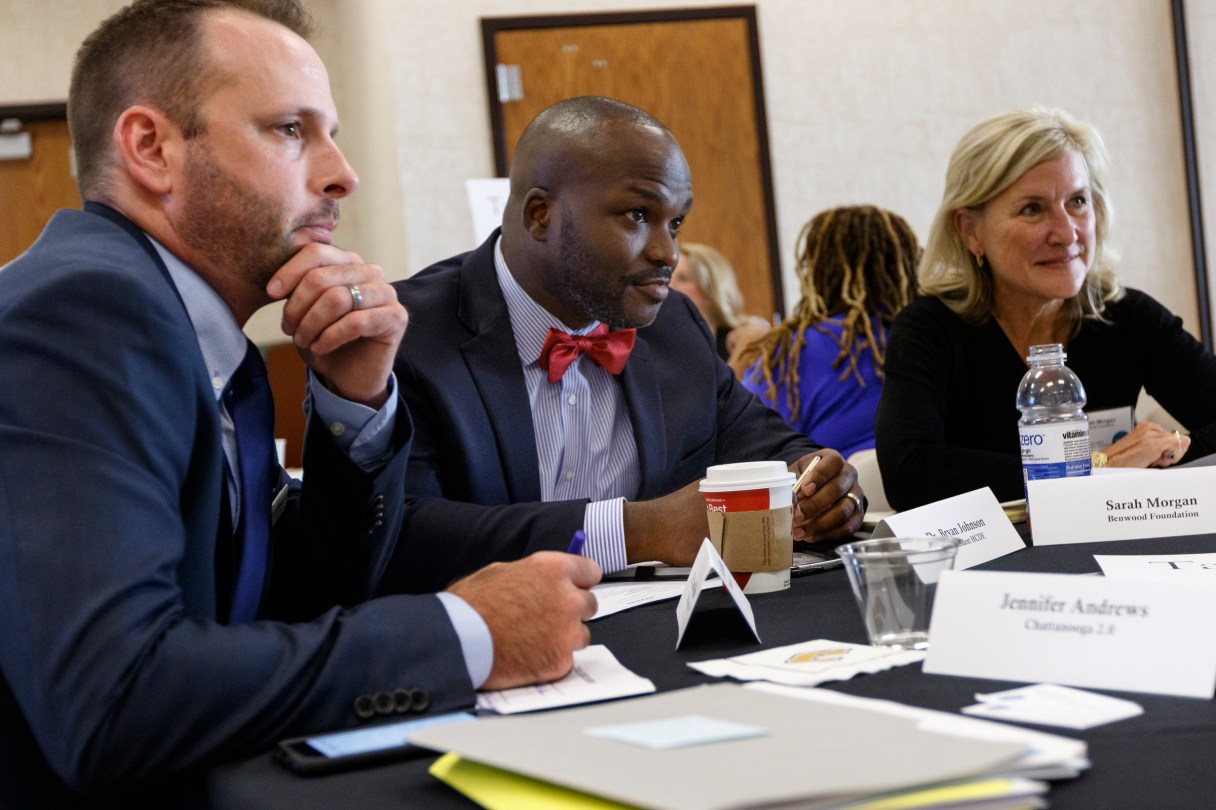
We’ve heard a lot recently about the Chattanooga 2.0 initiative, an inspired and optimistic project that bodes well for the future of our community. The lofty goal is “Build the smartest community in the South.” That is commendable, but the big question is: Where do we begin?
The answer lies in transforming the way we approach public education. Creating the “smartest community” doesn’t necessarily translate into a community with the most kids attending college. Author George Orwell once observed, “There are some ideas so absurd that only an intellectual could believe them.” Surely such an absurdity is the idea embraced by many politicians and educators that every child should attend college – as if a baccalaureate program is the magic elixir that provides wealth, happiness and fulfillment.
I recently spent a morning with Todd Jackson, the principal of Sequoyah High School, Hamilton County’s only vocational high school. He pointed out there is a lot of vocational education in Hamilton County, not only at Sequoyah but at every high school. Sequoyah is unique because it is the only secondary education facility that has the tools and shop space to teach vocational skills such as automotive collision repair, automotive maintenance and repair, computer technologies, cosmetology, machine tool technology, residential and commercial construction, residential wiring and electricity, and welding. These are great programs that offer promising careers, and more could be added.
Yet, like Sequoyah High School, vocational education remains more an afterthought than mainstream. In fact, the Hamilton County Education Department website states that vocational education “is based on student interest and business participation and varies from school to school.” In other words, vocational education is poorly planned and managed. Are the managers of Chattanooga 2.0 to sit back and hope that “student interest” aligns with the 10,000 jobs opening in the automotive and advanced industries coming over the next few years to our community?
For instance, if a child wants to attend Sequoyah, he or she must apply, interview and be accepted. Only 400 students attend, and the only transportation is from six bus routes in the county. Since school hours are 9 a.m. to 4 p.m., transportation is difficult for many low-income families when the primary provider is working during school hours. Perhaps this accounts for the lack of racial diversity at Sequoyah. The student body is comprised of only 4 percent black and 4percent Hispanic.
Furthermore, vocational education is often in direct conflict with federal and state mandates. Even if a student has no desire or documented intellectual ability to perform at a college academic level, he or she must take math through algebra II, biology and either physics or chemistry along with related grade-level courses in English and history. Jackson points out there is precious little time for a student to do more than scratch the surface in vocational subjects.
Fortunately, the current U.S. president and his administration are attuned to the problems in our educational system. There is a powerful movement within the Department of Education under its new secretary, Betsy DeVos, to reverse the trend for federally mandated educational templates. Instead, they want to send money and authority back to the states and allow educators at the state level to plan curricula and courses that best suit students’ needs. The timing is perfect for Hamilton County Schools to prepare our children for future opportunities.
Students can begin their education in high school to fill those positions, but not if they are are held back by antiquated public education – a system designed to fill academic squares but not provide an education that leads to careers with dignity and fulfillment for responsible citizens. Those changes are critical if we truly intend to “build the smartest community in the South.”
Roger Smith, a local author, is a frequent contributor to the Times Free Press.