
Monday, November 9, 2026Nov 9

North Korea says missile test puts ‘entire’ US in range

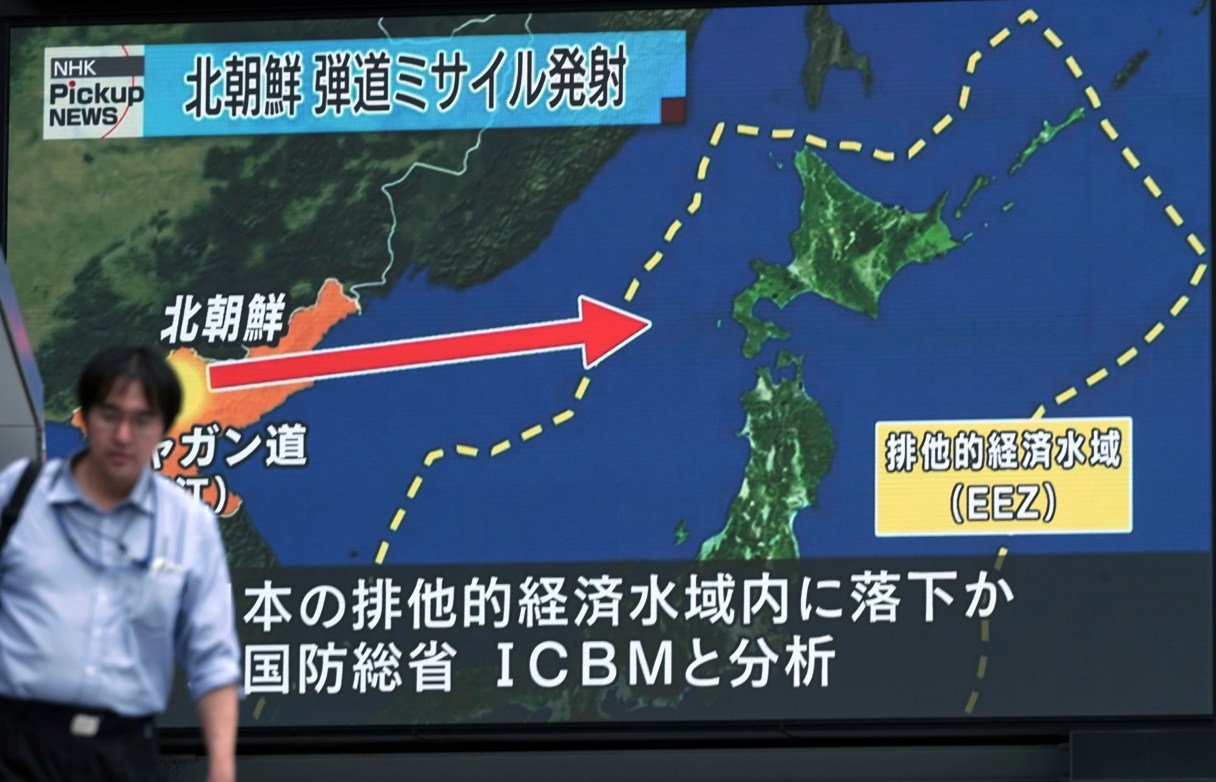
A man walks in front of a public TV screen broadcasting news of North Korea's test-firing of its second intercontinental ballistic missile, in Tokyo Saturday, July 29, 2017. North Korea on Friday test-fired its second intercontinental ballistic missile, which flew longer and higher than the first according to its wary neighbors, leading analysts to conclude that a wide swath of the U.S., including Los Angeles and Chicago, is now within range of Pyongyang's weapons. The ticker above reads: "North Korea fired ICBM missile." (AP Photo/Eugene Hoshiko)
A man walks in front of a public TV screen broadcasting news of North Korea's test-firing of its second intercontinental ballistic missile, in Tokyo Saturday, July 29, 2017. North Korea on Friday test-fired its second intercontinental ballistic missile, which flew longer and higher than the first according to its wary neighbors, leading analysts to conclude that a wide swath of the U.S., including Los Angeles and Chicago, is now within range of Pyongyang's weapons. The ticker above reads: "North Korea fired ICBM missile." (AP Photo/Eugene Hoshiko) A man walks in front of a public TV screen broadcasting news of North Korea's test-firing of its second intercontinental ballistic missile, in Tokyo Saturday, July 29, 2017. North Korea on Friday test-fired its second intercontinental ballistic missile, which flew longer and higher than the first according to its wary neighbors, leading analysts to conclude that a wide swath of the U.S., including Los Angeles and Chicago, is now within range of Pyongyang's weapons. The ticker above reads: "North Korea fired ICBM missile." (AP Photo/Eugene Hoshiko)

PYONGYANG, North Korea (AP) – North Korean leader Kim Jong Un said Saturday the second flight test of an intercontinental ballistic missile demonstrated his country can hit the U.S. mainland, hours after the launch left analysts concluding that a wide swath of the United States, including Los Angeles and Chicago, is now in range of North Korean weapons.

The Korean Central News Agency said that Kim expressed “great satisfaction” after the Hwasong-14 missile reached a maximum height of 3,725 kilometers (2,314 miles) and traveled 998 kilometers (620 miles) before accurately landing in waters off Japan. The agency said that the test was aimed at confirming the maximum range and other technical aspects of the missile it says was capable of delivering a “large-sized, heavy nuclear warhead.”

Analysts had estimated that the North’s first ICBM on July 4 could have reached Alaska, and said that the latest missile appeared to extend that range significantly.

Immediately after the launch, U.S. and South Korean forces conducted live-fire exercises. South Korean Defense Minister Song Young-moo called for the deployment of strategic U.S. military assets – which usually means stealth bombers and aircraft carriers – as well as additional launchers of an advanced U.S. anti-missile system.

Japanese government spokesman Yoshihide Suga said the missile, launched late Friday night, flew for about 45 minutes – about five minutes longer than the first. The missile was launched on very high trajectory, which limited the distance it traveled, and landed west of Japan’s island of Hokkaido.