
Find reactions from political leaders at the end of this article.
—
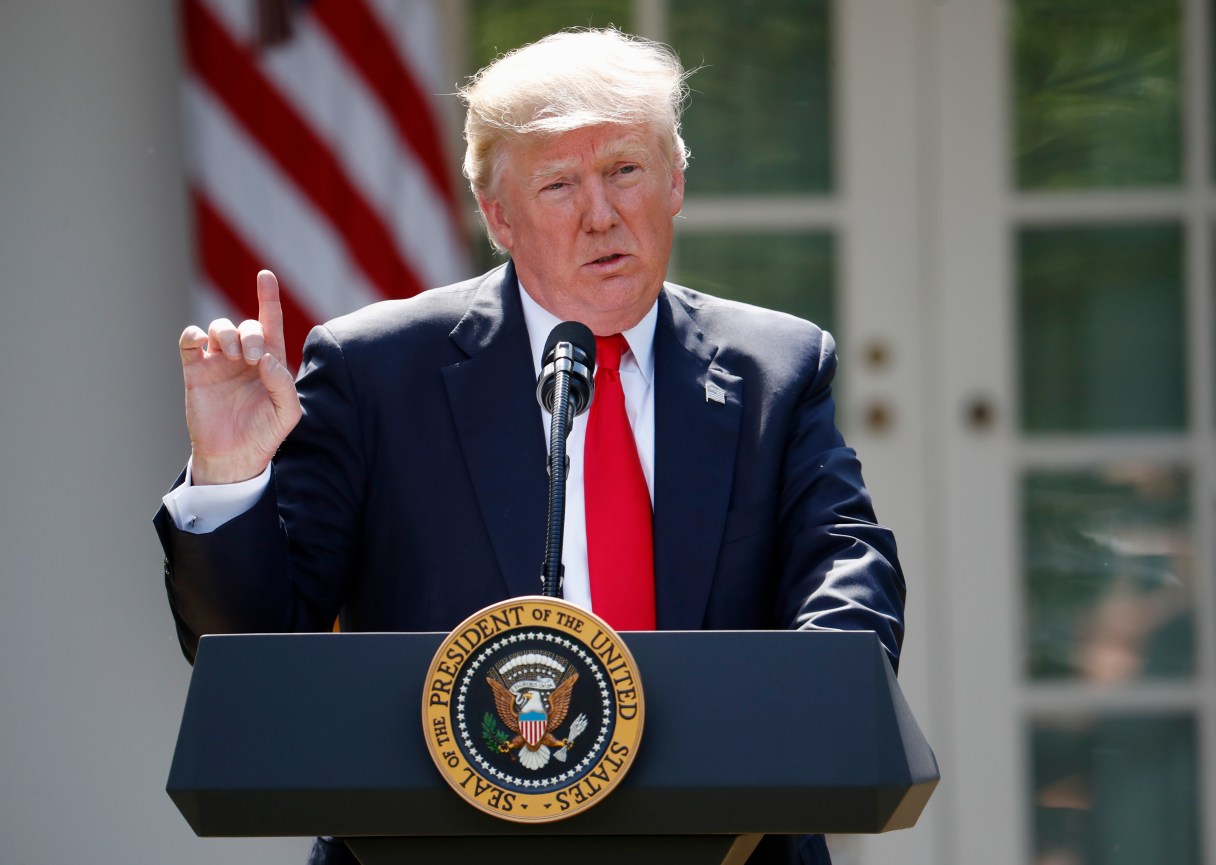
UPDATE: WASHINGTON – President Donald Trump declared Thursday he was withdrawing the U.S. from the landmark Paris climate agreement, striking a major blow to worldwide efforts to combat climate change and distancing the country from many allies abroad. He said the U.S. would try to re-enter but only if it can get more favorable terms.
Framing his decision as “a reassertion of America’s sovereignty,” he said, “I was elected to represent the citizens of Pittsburgh, not Paris.” His decision ended weeks of speculation, some of it fueled by Trump himself and his Cabinet members.
Under former President Barack Obama, the U.S. had agreed under the accord to reduce polluting emissions by about 1.6 billion tons by 2025. But the targets were voluntary, meaning the U.S. and the nearly 200 other nations in the agreement could alter their commitments.
Trump said that he would begin negotiations to re-enter the agreement or establish “an entirely new transaction” to get a better deal for the U.S. But he suggested re-entry was hardly a priority. “If we can, great. If we can’t, that’s fine,” he said.
By abandoning the world’s chief effort to slow the tide of planetary warming, Trump was fulfilling a top campaign pledge. But he was also breaking from many of America’s staunchest allies, who have expressed alarm about the decision. Several of his top aides have opposed the action, too, as has his daughter and adviser, Ivanka Trump.
Scientists say Earth is likely to reach more dangerous levels of warming sooner as a result of the president’s decision because America contributes so much to rising temperatures. Calculations suggest withdrawal could result in emissions of up to 3 billion tons of additional carbon dioxide in the air a year – enough to melt ice sheets faster, raise seas higher and trigger more extreme weather.
Trump’s decision marked “a sad day for the global community,” said Miguel Arias Canete, climate action commissioner for the European Union.
At home in America, the U.S. Conference of Mayors said it strongly opposed the decision and said mayors will continue efforts to reduce greenhouse gas emissions blamed for global warming. The group’s vice president, New Orleans Mayor Mitch Landrieu said the action “is shortsighted and will be devastating to Americans in the long run.” In fact, he said, sea level rise caused by unchecked climate change could mean that cities like his “will cease to exist.”
Trump, however, argued the agreement had disadvantaged the U.S. “to the exclusive benefit of other countries,” leaving American businesses and taxpayers to absorb the cost.
“This agreement is less about the climate and more about other countries gaining a financial advantage over the United States,” he said, claiming that other countries have laughed at the U.S. for agreeing to the terms.”
Investors seemed pleased, with stock prices, already up for the day, bumping higher as he spoke. The Dow Jones industrial average rising 135 points for the day
As for the mechanics of withdrawal, international treaties have a four-year cooling off period from the time they go into effect. That means it could take another three-and-half years for the U.S. to formally withdraw, though Trump promised to stop implementation immediately.
Major U.S. allies, business leaders and even the Pope had urged the U.S. to remain in the deal. The decision drew immediately backlash from climate activists and many business leaders.
The U.S. is the world’s second-largest emitter of carbon, following only China. Beijing, however, has reaffirmed its commitment to meeting its targets under the Paris accord, recently canceling construction of about 100 coal-fired power plants and investing billions in massive wind and solar projects.
White House aides have been divided on the question of staying or leaving the accord and had been deliberating on “caveats in the language” as late as Wednesday, one official said. But Trump’s statement was clear and direct.
So was opposition from environmental groups, as expected.
“Generations from now, Americans will look back at Donald Trump’s decision to leave the Paris Agreement as one of the most ignorant and dangerous actions ever taken by any President,” Sierra Club executive director Michael Brune said in a statement.
—
ORIGINAL STORY: WASHINGTON – President Donald Trump will announce Thursday that the United States will withdraw from the Paris global climate pact, according to a White House official, congressional officials and others briefed by the White House.
Trump is to make the announcement from the Rose Garden Thursday afternoon.
“He’s pulling out. It’s official,” said Stephen Moore, an economist who worked for Trump’s campaign and participated in an administration conference call. “They’re going to withdraw U.S. participation in the treaty.”
White House talking points obtained by The Associated Press say that the Paris accord “is a BAD deal for Americans” and that the president’s action would keep “his campaign promise to put American workers first.”
“The Accord,” the document goes on to say, “was negotiated poorly by the Obama Administration and signed out of desperation.”
“The U.S. is already leading the world in energy production and doesn’t need a bad deal that will harm American workers,” it reads.
The White House had signaled that withdrawal was likely, but Trump has been known to change his mind at the last minute on such major decisions.
Abandoning the pact was one of Trump’s principal campaign pledges, but America’s allies have expressed alarm about the likely consequences. Top White House aides have been divided. Aides have been deliberating on “caveats in the language,” one official said.
The White House invited representatives from several groups that support withdrawing from the Paris accord, including staff from the Heritage Foundation, a conservative think tank with close ties to the administration, and Myron Ebell, director of the Center for Energy and Environment at the Competitive Enterprise Institute, a libertarian think tank that gets financial support from the fossil fuel industry.
Trump had several potential options. Some of his aides have been searching for a middle ground in an effort to thread the needle between his base of supporters who oppose the deal for fear it will hamper U.S. economic growth and those warning that a U.S. exit would deal a blow to the fight against global warming as well as to worldwide U.S. leadership.
Under the agreement, the U.S. had agreed to reduce the country’s pollution emissions to 26 percent to 28 percent of 2005 levels by 2025 – about 1.6 billion tons. Countries are permitted under the treaty to change their goals and there is no punishment for missing targets.
Pulling out of the agreement outright would take three-and-a-half years under the standard cooling-off period for new international treaties.
Abandoning the Paris pact would isolate the U.S. from a raft of international allies who spent years negotiating the 2015 agreement to fight global warming and pollution by reducing carbon emissions in nearly 200 nations. While traveling abroad last week, Trump was repeatedly pressed to stay in the deal by European leaders and the pope. Withdrawing would leave the United States aligned only with Russia among the world’s industrialized economies.
American corporate leaders have also appealed to the businessman-turned-president to stay in the pact. They include Apple, Google and Walmart. Even fossil fuel companies such as Exxon Mobil, BP and Shell say the United States should abide by the deal.
In a Berlin speech, Chinese Premier Li Keqiang said that fighting climate change is a “global consensus” and an “international responsibility.”
“China in recent years has stayed true to its commitment,” said Li, speaking in Berlin Wednesday.
Trump met Wednesday with Secretary of State Rex Tillerson, who has favored remaining in the agreement. Chief strategist Steve Bannon supports an exit, as does Environmental Protection Agency Administrator Scott Pruitt.
Trump’s chief economic adviser, Gary Cohn, has discussed the possibility of changing the U.S. carbon reduction targets instead of pulling out of the deal completely. Senior adviser Jared Kushner generally thinks the deal is bad but still would like to see if emissions targets can be changed.
Trump’s influential daughter Ivanka Trump’s preference is to stay, but she has made it a priority to establish a review process so her father would hear from all sides, said a senior administration official. Like the other officials, that person was not authorized to describe the private discussions by name and spoke only on condition of anonymity.
Interior Secretary Ryan Zinke said Wednesday in Alaska that he had “yet to read what the actual Paris Agreement is,” and would have to read it before weighing in.
Scientists say Earth is likely to reach more dangerous levels of warming sooner if the U.S. retreats from its pledge because America contributes so much to rising temperatures. Calculations suggest withdrawal could result in emissions of up to 3 billion tons of additional carbon dioxide in the air a year – enough to melt ice sheets faster, raise seas higher and trigger more extreme weather.
What political leaders are saying
“I appreciated the opportunity to talk with President Trump and his team several times this week about his decision on the Paris climate agreement. The substantive requirements of the agreement are, in fact, non-binding. On the other hand, legitimate concerns have been raised about the likelihood of domestic interest groups using the agreement to file lawsuits in an effort to halt the repeal of regulations which, while being litigated, would stifle economic growth here at home. I appreciate the president’s desire to renegotiate an agreement that is more in line with what is achievable in a manner that promotes an increase in the standard of living of American citizens and protects our environment. I stand ready to work with him toward that end.”- U.S. Sen. Bob Corker, R-Tenn., chairman of the Senate Foreign Relations Committee”The United States is one of the strongest countries in the world in our commitment to high environmental standards across all industries, including power production. Unfortunately, the Paris climate deal was yet another regulatory overreach by the Obama administration and should have been put forward for the advice and consent of the Senate. I will continue to work on commonsense approaches to energy production and the environment.”- U.S. Sen. Johnny Isakson, R-Ga., member of the Senate Committee on Foreign Relations”Removing the United States from the Paris Agreement is a reckless and indefensible action. It undermines America’s standing in the world and threatens to damage humanity’s ability to solve the climate crisis in time. But make no mistake: if President Trump won’t lead, the American people will. Civic leaders, mayors, governors, CEOs, investors and the majority of the business community will take up this challenge. We are in the middle of a clean energy revolution that no single person or group can stop. President Trump’s decision is profoundly in conflict with what the majority of Americans want from our president; but no matter what he does, we will ensure that our inevitable transition to a clean energy economy continues.”- Al Gore, former U.S. vice president “President Trump promised that he would put America first and he has rightly determined that the Paris accord was not in the best interests of the United States. In addition to costing our economy trillions of dollars and millions of jobs, the accord also represented a willful and voluntary ceding of our national sovereignty. The agreement would have had negligible impact on world temperatures, especially since other countries and major world economies were not being held to the same stringent standards as the United States. “The Earth’s climate has been changing since the planet was formed – on this there is no disagreement. At USDA, we rely on sound science and we remain firmly committed to digging ever deeper into research to develop better methods of agricultural production in that changing climate. Floods, droughts, and natural disasters are a fact of life for farmers, ranchers, and foresters. They have persevered in the past, and they will adapt in the future – with the assistance of the scientists and experts at USDA. To be effective, our research and programs need to be focused on finding solutions and providing state-of-the-art technologies to improve management decisions on farm and on forest lands.”- Statement of Agriculture Secretary Sonny Perdue