
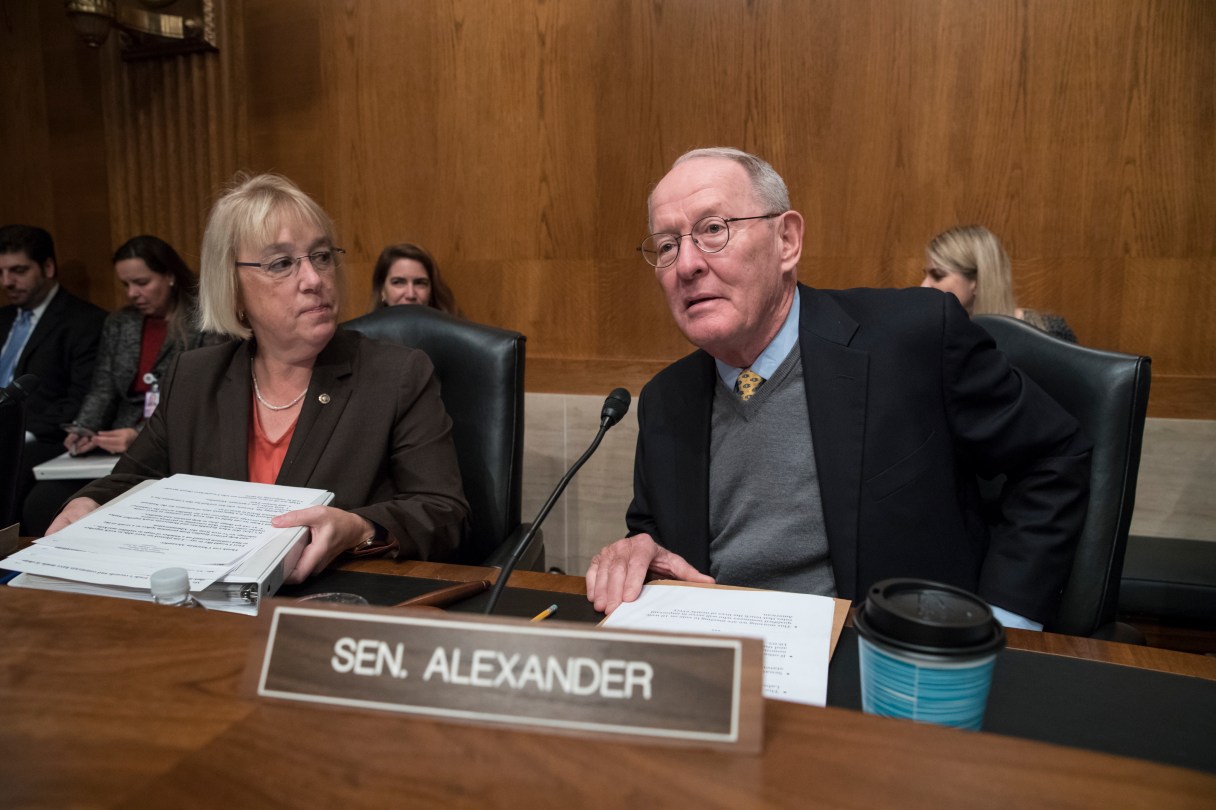

For those people who are sure President Donald Trump would never want or sign anything short of complete repeal of the Affordable Care Act (ACA), we offer you Sen. Lamar Alexander, R-Tenn.
“Three weeks ago,” he said in a video news release, “I was having dinner with Honey, my wife, and President Trump called. He said we need to get a short-term, bipartisan health insurance bill to make sure Americans aren’t hurt between now and the time we repeal and replace Obamacare, and he said he wants to make sure it doesn’t bail out insurance companies.”
Alexander, chairman of the Senate’s Health, Education, Labor and Pensions Committee, already was working on such a bill to stabilize the ACA insurance marketplaces with the ranking Democratic member, Sen. Patty Murray, D-Wash. For months, he had been publicly concerned about the high annual ACA premium increases in Tennessee – 176 percent in the last four years – and the collapsing marketplace.
Last week, he introduced the Bipartisan Health Care Stabilization Act of 2017, and on Wednesday he announced on the Senate floor that the nonpartisan Congressional Budget Office (CBO) and the staff of the Joint Committee on Taxation said the bill, which is sponsored by 12 Republicans and 12 Democrats, would do what Trump told him he wanted it to do – benefit taxpayers and consumers with two years of cost-sharing payments and not benefit insurance companies.
The CBO said the bill would reduce the deficit during the 2018-2027 period by $3.8 billion and that federal costs for subsidies for plans purchased through ACA marketplaces would shrink by about $1.1 billion over the same period.
Trump, being Trump, initially signaled his support after the bill’s introduction, then reversed course a day later and said it contained “bailouts” he could never support. However, since the positive CBO scoring, he has not commented.
Alexander, in a news release, said “the ball is in the hands of the White House,” which had “made some suggestions” on the bill. Nevertheless, he said it “sounds like something that might become law before the end of the year.”
However, Senate Majority Leader Mitch McConnell, R-Ky., said he doesn’t want to bring up the bill for discussion on the Senate floor until he hears from Trump on what he’s looking for. And Speaker of the House Paul Ryan, R-Wis., said his body isn’t likely to debate health care again until 2018.
Frankly, because of their lack of success earlier this year on previous health care bills, none of them want to bring up the Alexander-Murray bill unless it both has the president’s approval and can pass. That’s the bottom line, and it’s understandable.
But the bill does what Trump allegedly wants and even offers a new, cheaper insurance plan (with higher deductibles) for people over the age of 29 who want coverage that would prevent a medical catastrophe from leading to financial ruin.
Republicans are unlikely to propose anything more substantial on health care in 2017, and probably not in 2018, an election year.
Indeed, the drain-the-swamp crowd that believed a replacement for the ACA might be crafted and passed quickly never had a clue. Ways of repealing it, or defunding it, were available, but what came next was never going to be child’s play.
The GOP doesn’t have a bulletproof, 60-member majority in the Senate, and any plan that repealed but didn’t replace was going to be a public relations nightmare and inhumane besides. We can say with certainty the ACA was bad legislation, but Americans who bought into the pig in a poke don’t deserve to be left with fewer options or no health care coverage at all.
That’s generally what drove Alexander to work on the bill in the first place. Like most Republicans, he wants to get rid of the ACA but feels duty-bound not to leave any of his constituents worse than they were before the 2010 legislation.
Trump, senators and House members should recognize this kind of bipartisan agreement – a bridge of sorts to what we hope will be a new and better health care plan – is real progress, is not easily hammered out, and is the type of legislation people should expect of their lawmakers.
Yes, with a Republican president, House and Senate, it would be nice to think, in Trump’s campaign words, “we’re going to win so much, you’re going to be so sick and tired of winning.” But his saying the words wasn’t going to make it happen, and even electing him wasn’t going to make it happen.
We’re sorry, it just wasn’t. And with an opposition party embarrassed over its election loss and a national media united against him, the job is doubly hard.
Which is all more reason Alexander’s bridge legislation is worthy of close consideration and passage before the end of the year.