
Thursday, November 12, 2026Nov 12

Spy museum’s newest: ax used on Trotsky, parts of Powers’ U2

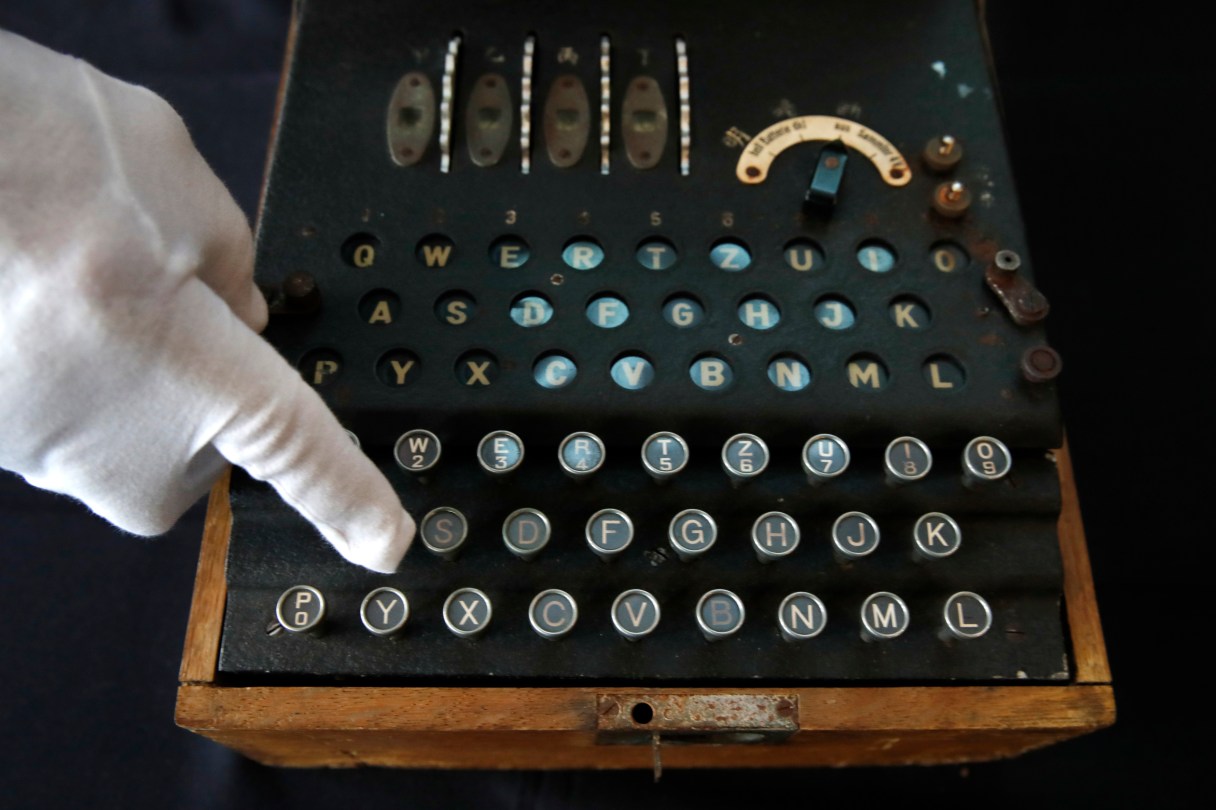
H. Keith Melton points to a key on an Enigma Machine with four rotors and a some Japanese characters that was used in World War II to encode messages, Wednesday, Sept. 13, 2017, in Washington. The machine is one of the many items that he is donating to the International Spy Museum from his collection of spy objects. (AP Photo/Jacquelyn Martin)
H. Keith Melton points to a key on an Enigma Machine with four rotors and a some Japanese characters that was used in World War II to encode messages, Wednesday, Sept. 13, 2017, in Washington. The machine is one of the many items that he is donating to the International Spy Museum from his collection of spy objects. (AP Photo/Jacquelyn Martin) H. Keith Melton points to a key on an Enigma Machine with four rotors and a some Japanese characters that was used in World War II to encode messages, Wednesday, Sept. 13, 2017, in Washington. The machine is one of the many items that he is donating to the International Spy Museum from his collection of spy objects. (AP Photo/Jacquelyn Martin)

WASHINGTON (AP) – H. Keith Melton spent 40 years looking for the ice-climbing ax used in the bloody assassination of Russian revolutionary Leon Trotsky. It had been sitting under a bed in Mexico City for decades.

Much easier was acquiring a mangled, basketball-size chunk of Gary Powers’ U2 spy plane shot down over the Soviet Union in 1960. It was a gift from a Soviet official.

The items are part of the world’s largest private collection of spy artifacts. Melton, a wealthy businessman from Boca Raton, Florida, is donating all of it to the International Spy Museum in Washington.

The museum announced Wednesday that more than 5,000 items Melton amassed during four decades of crisscrossing the globe will be the cornerstone of a new, larger facility slated to open next year in the nation’s capital.

It is a “magnificent gesture,” gushed Peter Earnest, the museum’s founding director, crediting Melton’s donation with tripling the museum’s current holdings of roughly 2,000 items.