
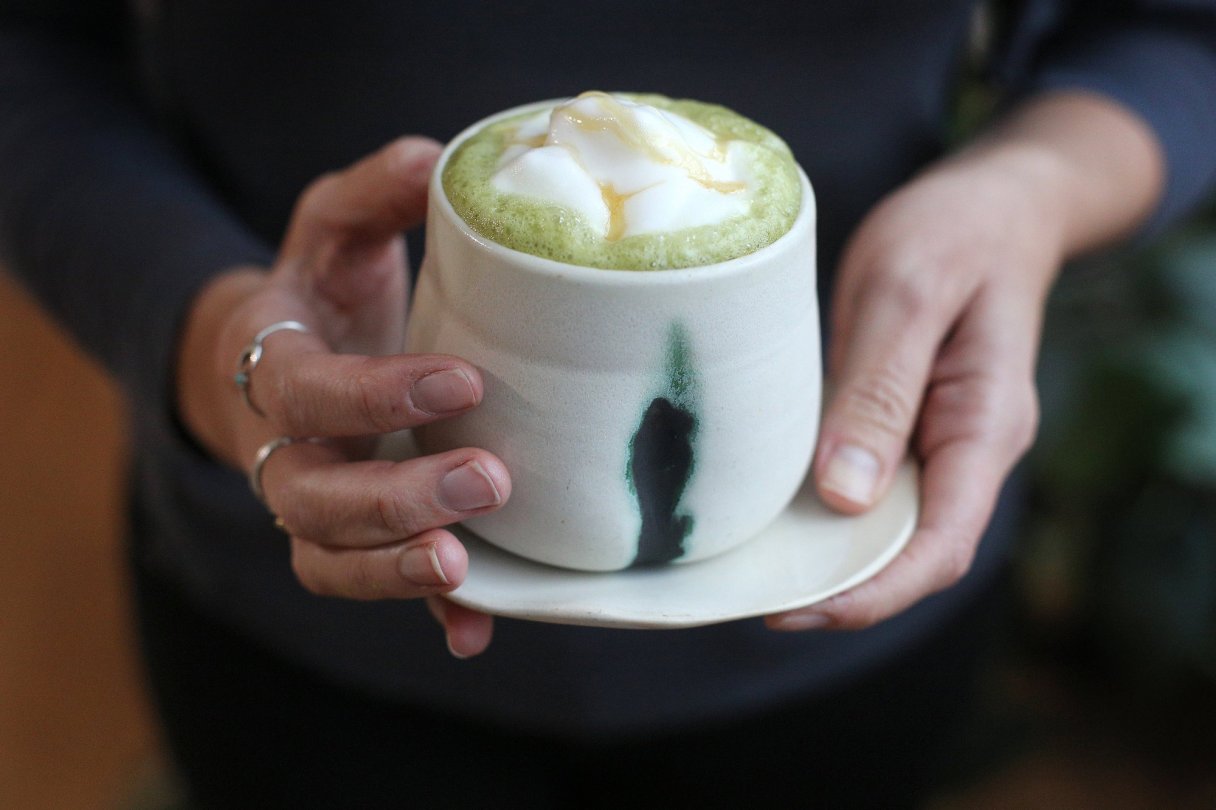
The list of Japanese contributions to American pop culture is long and varied: Godzilla, Pokemon, origami, sushi.
Now, meet matcha.
Matcha (pronounced MA-cha) is a fine, powdered green tea that has graduated from monastic uses by Buddhist monks more than a thousand years ago in Japan to an increasingly common food and beverage flavoring in America.
It’s not just the taste that proponents are sold on. Like kale and blueberries, green tea is considered a nutritional superfood, rich in antioxidants and other compounds that give it an apparent ability to protect against chronic conditions such as heart disease, diabetes and cancer. Research also suggests, says Healthline.com, that it may be an effective tool for weight loss.
“It’s definitely had a lot of buzz around it as of late as far as the health properties,” says Hillary Libby, owner of Wildflower Tea & Apothecary on Market Street.
Open since August 2016, Wildflower deals exclusively in teas, herbs and plant remedies.
“There’s probably a hundred or so varieties that we serve here in the tea shop or sell to take home,” Libby says, adding, “Matcha is definitely a favorite.”
One reason for matcha’s supercharged reputation is how it’s processed. It comes in powdered form, ground from the entire leaf, so it retains 100 percent of the nutrients. That, says MatchaSource.com, gives matcha powdered green tea 137 times more antioxidants than regularly brewed green tea.
MADE IN THE SHADE
Matcha is derived from the same plant that all true teas come from: camellia sinensis, says BreakawayMatcha.com. The plant’s leaves can be made into green tea, which is unfermented tea that is simply steamed and dried; oolong tea, in which the leaves partially ferment; and black tea, which is fully fermented.
“Matcha is a true green tea,” says the website, “but its growth style, harvest and production style are markedly different from those of other green teas, let alone from those of oolong and black teas.”
Premium matcha is harvested just once a year, typically in May, and always by hand. About six weeks before harvest, the tea fields are covered with straw or black vinyl sheets. The coverings gradually shade the plants and decrease photosynthesis. The highest-grade matcha is grown in near darkness by the time harvest rolls around, according to BreakawayMatcha. As a result of the decreased light, the tea leaves produce increasing amounts of chlorophyll and amino acids. The increased amino acids give matcha its intense flavor profile.
“I would call it grassy. Very, very grassy,” says Libby. “Very vividly green – it tastes that way.”
TWISTS ON TRADITION
For centuries, matcha was used in traditional Japanese tea ceremonies. Today, the concentrated powder is added to everything from lattes to chocolate to bourbon, or simply made into tea – just add water.
“We use it daily for green tea lattes and hot or cold or frozen Frappuccino,” says Kimberly Shepherd, manager of the Rock City Starbucks, who describes matcha’s flavor as earthy.
“Some people like the taste,” she says. “Some drink it because it’s supposed to boost metabolism and burn calories.”
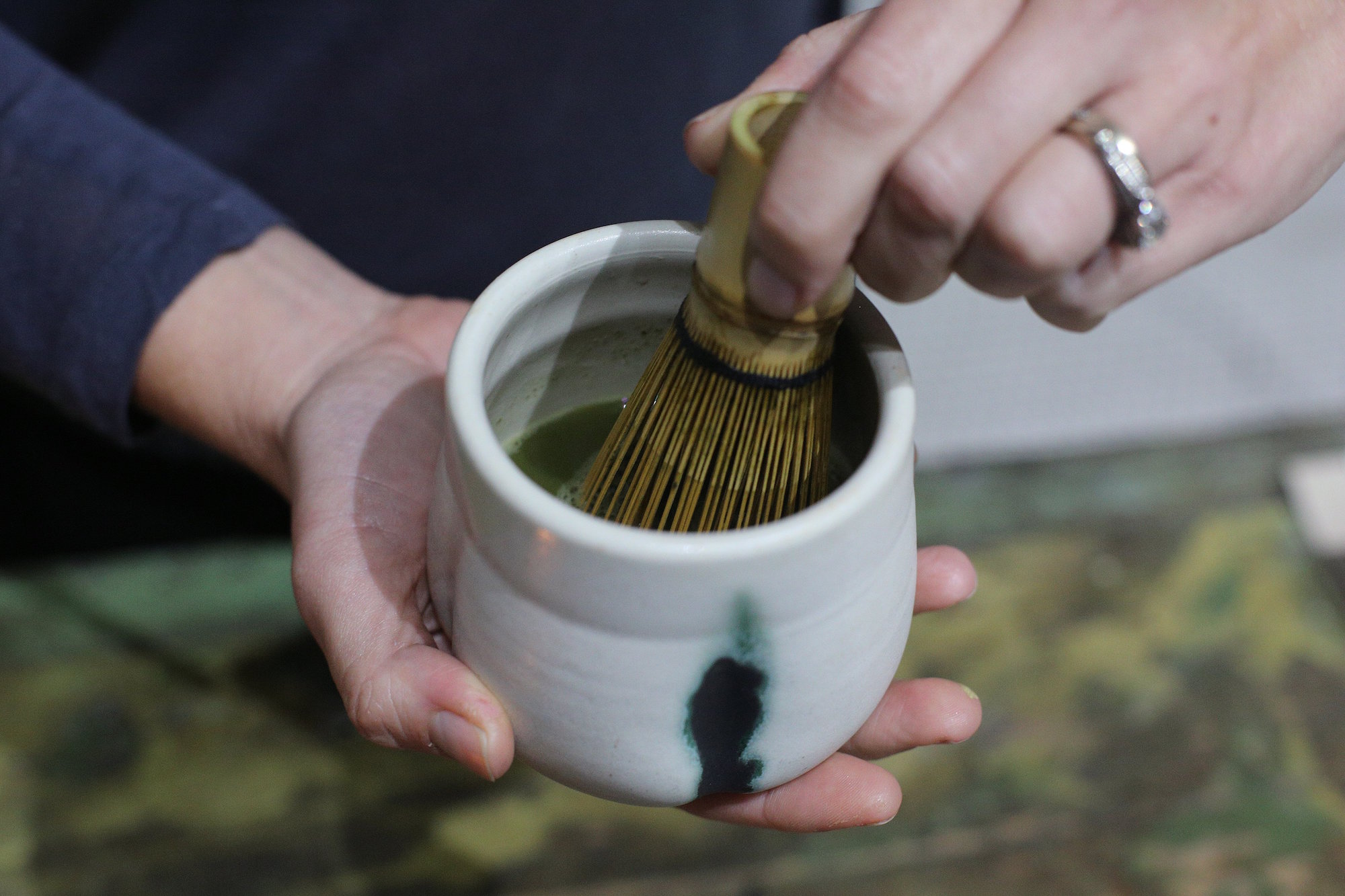 Hillary Libby uses a traditional bamboo whisk to stir matcha in a cup made especially for the tea made by Annie Hanks Ceramics.
The Local Juicery & Kitchen, an East Main Street shop that touts its raw, organic juices as equal parts art and medicine, offers Matcha Mylk among its 30 cold-pressed juices. It’s made with fresh almond milk and matcha green tea. The menu boasts of its high level of antioxidants and ability to improve cholesterol and burn calories.
Libby says some of Wildflower’s customers drink straight matcha and water. “That’s pretty hardcore to me,” says Libby, who prefers hers slightly sweetened.
“My favorite way to drink it is in a matcha latte with almond milk and local honey,” she says. “It’s probably my favorite afternoon pick-me-up when I want something energizing.”
Wildflower’s sit-down customers also get the benefit of tea cups specially made for matcha and the culturally significant bamboo whisk.
“We try to do it as traditional as possible,” Libby says. “We use the special matcha whisk and serve it in special cups handmade for us by Annie Hanks Ceramics. There’s a lot of intentionality behind it. We do try to make it an experience when you come in here.”
TRUE TO TRADITION
Etsuko Lammon, a native of Japan who has lived in Chattanooga for 22 years, often serves as a translator when delegations from Chattanooga’s sister city, Tono, Japan, visit. She also promotes more-casual cultural exchanges by leading traditional tea ceremonies around town – especially when her parents make the 24-hour trip from their home in Sapporo, Japan.
“My parents happen to be tea masters who studied tea ceremony for 40 years,” she says. “Every time when they visit here, I plan some tea ceremony.”
Traditional ceremonies are imbued with formality. In her presentations, Lammon covers much of the cultural expectations, which include bows to the host and other guests, traditional greetings, and the particular placement of bowls and utensils. She has held these “Way of the Tea” ceremonies at the Hunter Museum of American Art, Alexian Village, the Chattanooga Public Library, University of Tennessee at Chattanooga and Creative Discovery Museum, among other sites.
Lammon says the growing interest in matcha in America has even renewed interest in the tea in Japan.
“Matcha was not so popular among regular Japanese,” she says. “But matcha latte or matcha ice cream’s reimportation from America made lots of Japanese people pay attention to matcha. Nowadays, Japanese use matcha in drinks or sweets more than enjoy it as a tea ceremony.”