
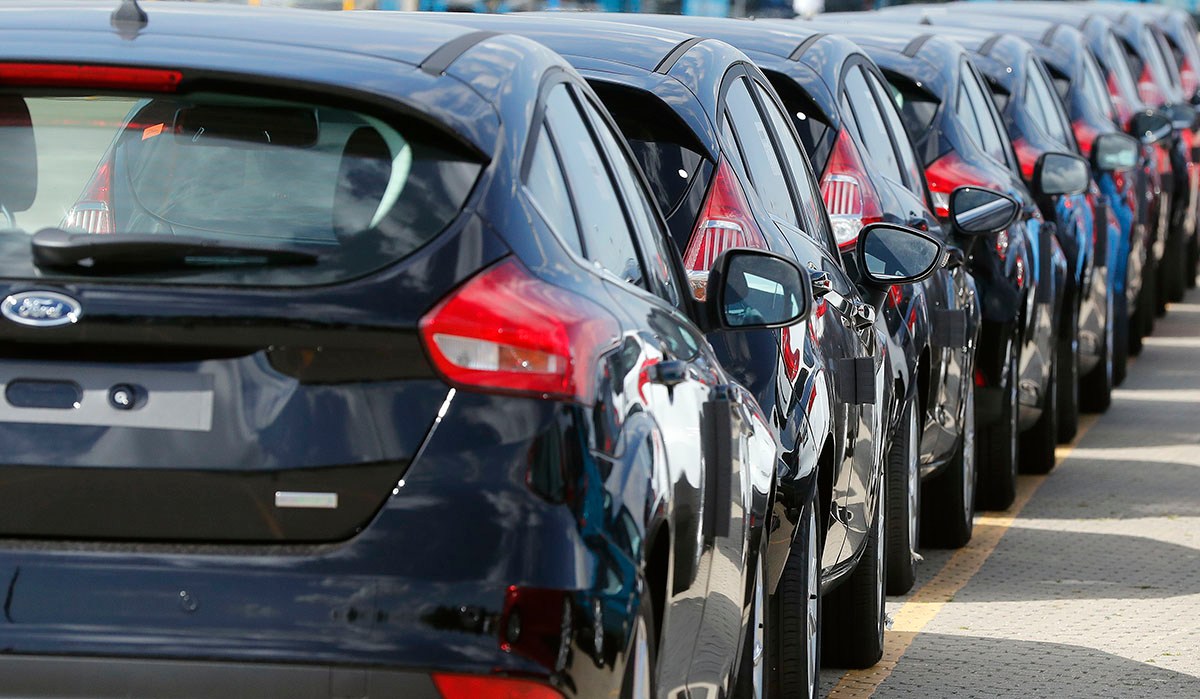
Trade war, higher prices to cut auto maker profits
All of Detroit’s Big 3 automakers issued downward revisions on Wednesday in their financial forecasts for the year. The moves, made as the companies announced second-quarter earnings, sent their shares down sharply.
General Motors said a decline in its quarterly income largely reflected rising commodity and materials prices. Ford and Fiat Chrysler singled out difficulties in their operations in China, and both said they were undertaking aggressive efforts to regain momentum.
The reference to commodities prices signaled that the Trump administration’s tariffs and trade policies were already hurting auto company profits and might yet worsen the situation, said Efraim Levy, a stock analyst at CFRA Research.
“It’s been a bad day for auto stocks,” he said. “Commodities and tariffs and their interrelationship are weighing. It’s the big picture that’s hitting the outlook.”
President Donald Trump has imposed tariffs on imported steel and aluminum, moves that raise costs for automakers, who are major purchasers of those metals.
GM and Fiat Chrysler both reported their earnings before the market opened. GM shares ended the day off 4.6 percent, and Fiat Chrysler was down 11.8 percent.
Ford’s announcement came after the close of trading, and its shares were off about 4 percent in extended trading.
GM said its pretax profit fell 13.3 percent to $3.2 billion, with its North American operations feeling a significant hit. The automaker said it was also affected by economic turmoil in South America and unfavorable exchange rates related to the Brazilian and Argentine currencies.
On a conference call, Mary Barra, the GM chief executive, said, “I think it’s in everyone’s best interest to have a strong U.S. auto industry, a big provider of quality jobs.” The company, she added, is “making sure we spend a lot of time with the administration” so that decisions “aren’t made that have unintended consequences.”
While its North American business was strong in the quarter, Ford said, it was a “particularly challenging period” elsewhere, and the company “is focused on China and taking urgent action to address underperformance.”
Fiat Chrysler also said it had suffered a decline in earnings because of trouble in China, despite a rise in North American profits. The company also reduced its revenue outlook for the year.
Covenant Transport profits jump in quarter
Covenant Transportation Group, Inc.boosted its second quarter profits nearly seven-fold from a year ago and beat analysts forecasts for the spring period as freight volumes, rates and utilization all improved for the Chattanooga-based trucking firm.
Covenant said it earned $10 million, or 54 cents per share, on revenues of $196.3 million. In the same period a year earlier, Covenant earned $1.5 million, or 8 cents per share, on revenues of $145.6 million. The results were 2 cents per share better than the average estimate among analysts who follow Covenant.
Covenant Transport CEO David Parker said he expects the improvement in trucking volumes and utilization to continue in the second half of 2018 and the company’s $83 million purchase of the Greeneville, Tenn.-based Landair Transport Inc. – the biggest acquisition in Covenant’s 32-year history – should add to earnings in the balance of the year.
“From an earnings perspective, we expect our consolidated operating ratio for the third quarter to be similar to our consolidated operating ratio for the second quarter, but with the addition of revenue from Landair’s operations,” Parker said. “For the fourth quarter, we expect to remain a major participant in the holiday peak shipping season and anticipate our consolidated operating ratio and consolidated earnings per diluted share to improve compared with the fourth quarter of 2017.”
Facebook’s growth slows after scandals
Facebook may not be bulletproof after all.
For months, the social network has weathered a series of scandals – including Russian misuse of the platform to interfere in the 2016 U.S. presidential campaign and the harvesting of user data through the political consulting firm Cambridge Analytica – with hardly any effect to its business. Facebook continued to post healthy double-digit increases in revenue and profit.
But on Wednesday, it showed some of the first signs of wear and tear from the months of scrutiny.
The Silicon Valley company reported a 42 percent increase in revenue and a 31 percent jump in profits for its second quarter. But the quarterly revenue of $13.2 billion missed Wall Street estimates of $13.4 billion. In addition, Facebook said its daily active users rose 1.4 percent to 1.47 billion, compared with 3.4 percent growth in the previous quarter.
The results sent Facebook’s stock down more than 7.5 percent in after-hours trading.
“It should not be surprising that there was some impact from Cambridge Analytica,” said Brian Wieser, an analyst at Pivotal Research. “To explain that there is a couple million people who chose not to continue using Facebook is unsurprising.”
Visa profit jumps by spending boost
Payment processing giant Visa said Wednesday that its fiscal third-quarter profits rose an adjusted 36 percent from a year ago, helped by an 11 percent increase in the amount people spent on its namesake network worldwide.
Visa reported a profit of $2.33 billion, up from $2.06 billion in the same period a year earlier. Excluding a $600 million one-time charge related to a lawsuit Visa is defending, the company’s net income was $2.79 billion, or $1.20 a share. That beats the $1.09 per-share estimate analysts had been expecting according to FactSet.
Consumers spent $2.101 trillion on Visa’s network worldwide last quarter, up 11.1 percent from a year earlier. Visa earns a small fee for every dollar spent using credit or debit cards on its Visa network.
“Our third quarter results reflect continued strength across all of our key business drivers and healthy economic fundamentals across the world,” said Visa Chief Executive Officer Alfred Kelly.
Total revenues were $5.24 billion up from $4.57 billion a year earlier.