
Thursday, October 29, 2026Oct 29

This story is free to read.

Pam’s Points: Let’s elect Summit the supercomputer president

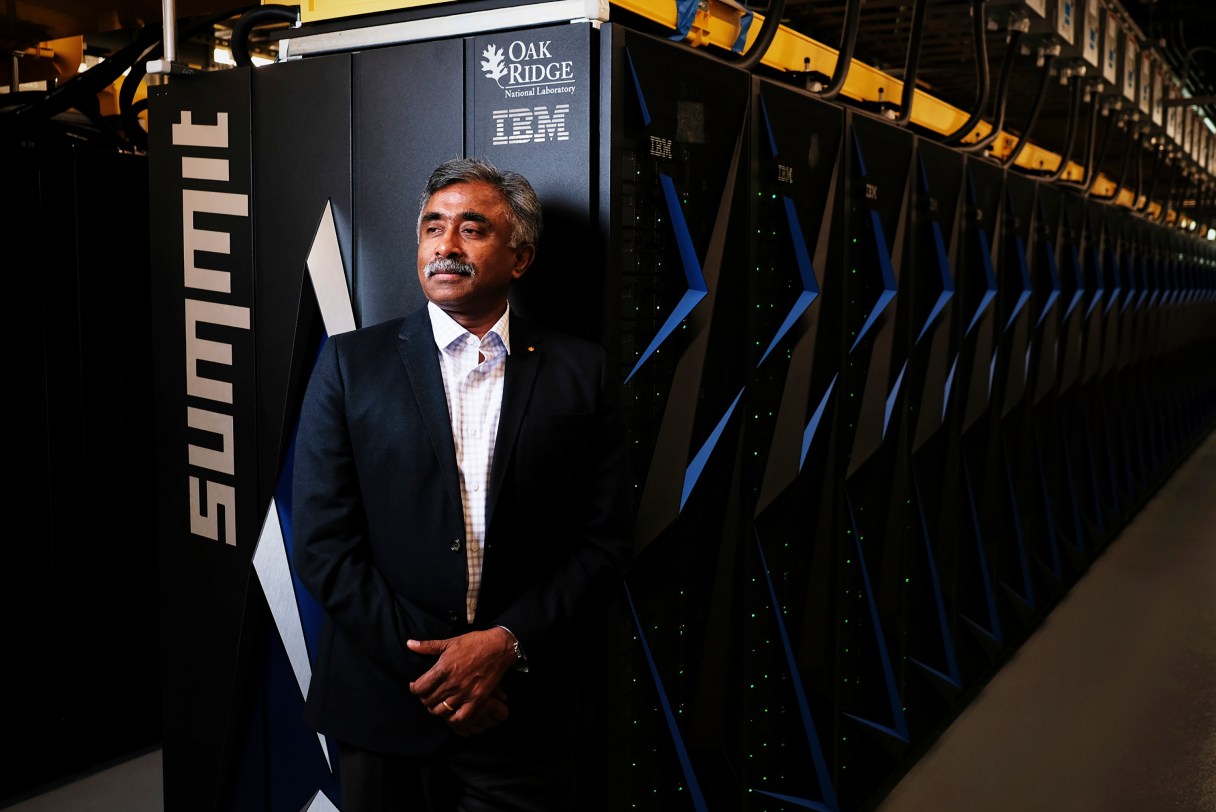
Thomas Zacharia, director of the Oak Ridge National Laboratory, with Summit, the world's fastest supercomputer, in Oak Ridge, Tenn. last week. Summit can do mathematical calculations at the rate of 200 quadrillion per second, or 200 petaflops. If a person did one calculation a second, she would have to live for more than 63 billion years to match what the machine can do in a second. (Shawn Poynter/The New York Times)
Thomas Zacharia, director of the Oak Ridge National Laboratory, with Summit, the world's fastest supercomputer, in Oak Ridge, Tenn. last week. Summit can do mathematical calculations at the rate of 200 quadrillion per second, or 200 petaflops. If a person did one calculation a second, she would have to live for more than 63 billion years to match what the machine can do in a second. (Shawn Poynter/The New York Times) Thomas Zacharia, director of the Oak Ridge National Laboratory, with Summit, the world's fastest supercomputer, in Oak Ridge, Tenn. last week. Summit can do mathematical calculations at the rate of 200 quadrillion per second, or 200 petaflops. If a person did one calculation a second, she would have to live for more than 63 billion years to match what the machine can do in a second. (Shawn Poynter/The New York Times)

Made in Tennessee

America won bragging rights in the newest race to build the world’s fastest supercomputer, The New York Times wrote Friday.

Actually, to be more accurate, the Oak Ridge National Laboratory right here in the Volunteer State won those bragging rights. And they named the new fastest-ever computer – the one that beat out China’s five-year champion – Summit.

Well, of course.

Summit, which cost $200 million to build, is not just fast – it is also at the forefront of a new generation of supercomputers that are adding artificial intelligence and the ability to handle vast amounts of data to traditional supercomputer technology. Their smarts and their speeds will tackle the most daunting computing challenges in science, industry and national security. Already they do things like simulate nuclear tests, predict climate trends, find oil deposits and crack encryption codes.