

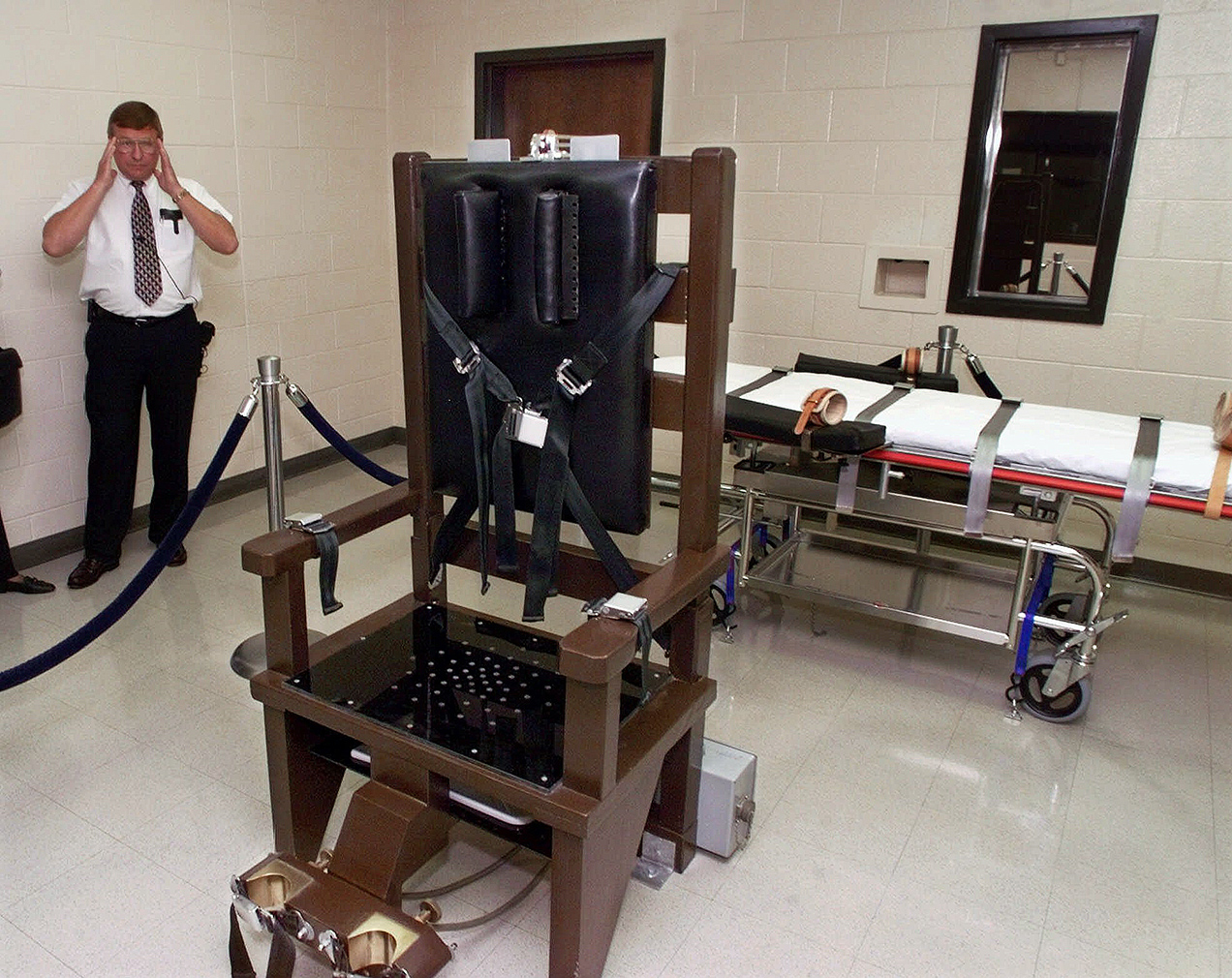
 In this Oct. 13, 1999, file photo, Ricky Bell, then the warden at Riverbend Maximum Security Institution in Nashville, Tenn., gives a tour of the prison’s execution chamber. Attorneys for Tennessee death row inmate Edmund Zagorski on Wednesday, Oct. 10, 2018, asked a federal court to force the state to use the electric chair to execute him, rather than lethal injection. The court battle over his Thursday execution played out over a solemn background in which prison staff and volunteers said the death of the well liked inmate will leave an impact. (AP Photo/Mark Humphrey, File)
NASHVILLE, Tenn. (AP) – A man sentenced to die for a 1980s double murder was scheduled Thursday evening to become Tennessee’s first inmate since 2007 to be put to death in the electric chair and the first nationwide in a half decade using that method.
With hours remaining until his planned 7 p.m. CDT execution, Edmund Zagorski awaited a response from the U.S. Supreme Court for a request for a stay, his attorneys arguing it was unconstitutional to force him to choose between the electric chair and lethal injection. The state came close to administering a chemical injection to the 63-year-old inmate three weeks ago, but that execution was stopped by the governor when Zagorski exercised his right to request the electric chair.
Zagorski was condemned to die for his convictions in the April 1983 slayings of two men who had been shot and had their throats slit when they sought to buy marijuana from him in a drug deal-turned-robbery. He was set to be put to death at a maximum-security prison in Nashville.
Nationwide, only 14 other people have been put to death in the electric chair since 2000, the most recent being in Virginia in 2013. In Tennessee, condemned inmates whose crimes occurred before 1999 can choose the electric chair – one of six states that allow such a choice.
Zagorski’s attorneys argued the inmate believed death by electrocution in the chair would be a quicker and less painful way to die than by an injection though they contend both methods are unconstitutional.