
Thursday, November 12, 2026Nov 12

Chinese researcher claims first gene-edited babies

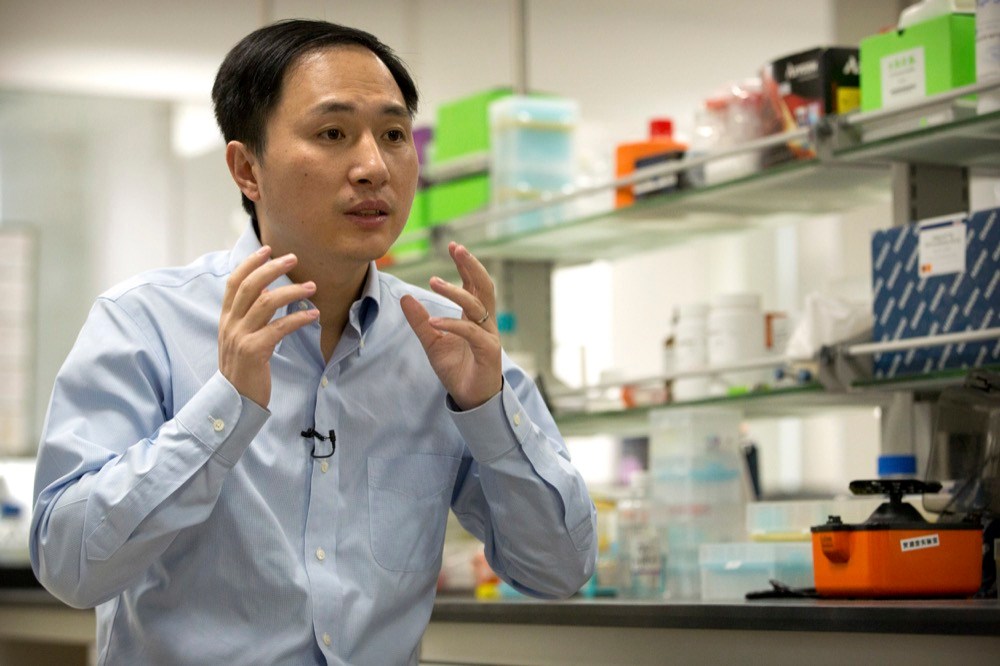
In this Oct. 10, 2018 photo, He Jiankui speaks during an interview at a laboratory in Shenzhen in southern China's Guangdong province. Chinese scientist He claims he helped make world's first genetically edited babies: twin girls whose DNA he said he altered. He revealed it Monday, Nov. 26, in Hong Kong to one of the organizers of an international conference on gene editing. (AP Photo/Mark Schiefelbein)
In this Oct. 10, 2018 photo, He Jiankui speaks during an interview at a laboratory in Shenzhen in southern China's Guangdong province. Chinese scientist He claims he helped make world's first genetically edited babies: twin girls whose DNA he said he altered. He revealed it Monday, Nov. 26, in Hong Kong to one of the organizers of an international conference on gene editing. (AP Photo/Mark Schiefelbein) In this Oct. 10, 2018 photo, He Jiankui speaks during an interview at a laboratory in Shenzhen in southern China's Guangdong province. Chinese scientist He claims he helped make world's first genetically edited babies: twin girls whose DNA he said he altered. He revealed it Monday, Nov. 26, in Hong Kong to one of the organizers of an international conference on gene editing. (AP Photo/Mark Schiefelbein)

HONG KONG (AP) – A Chinese researcher claims that he helped make the world’s first genetically edited babies – twin girls born this month whose DNA he said he altered with a powerful new tool capable of rewriting the very blueprint of life.

If true, it would be a profound leap of science and ethics.

A U.S. scientist said he took part in the work in China, but this kind of gene editing is banned in the United States because the DNA changes can pass to future generations and it risks harming other genes.

Many mainstream scientists think it’s too unsafe to try, and some denounced the Chinese report as human experimentation.

The researcher, He Jiankui of Shenzhen, said he altered embryos for seven couples during fertility treatments, with one pregnancy resulting thus far. He said his goal was not to cure or prevent an inherited disease, but to try to bestow a trait that few people naturally have – an ability to resist possible future infection with HIV, the AIDS virus.