
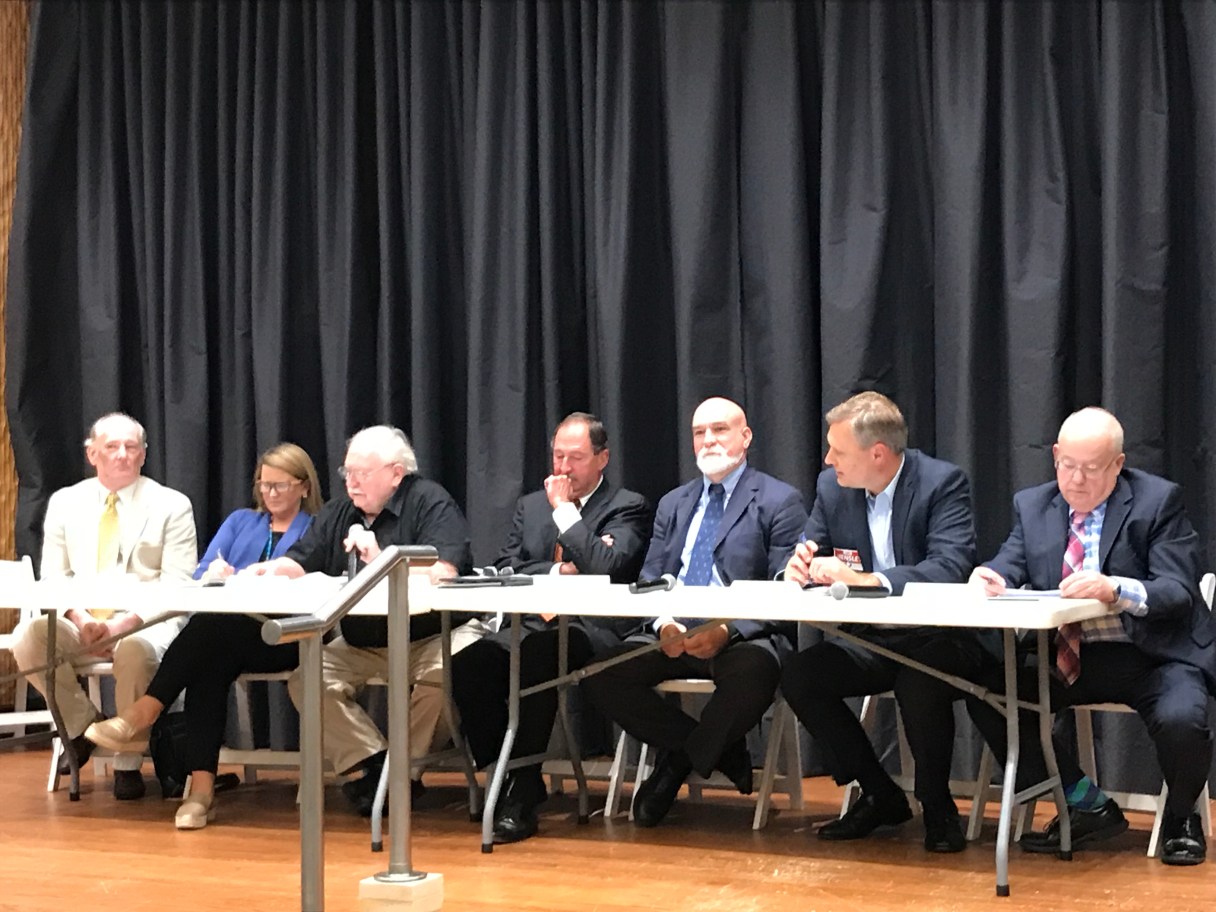

Early voting started Wednesday, Oct. 17. To help residents make informed decisions at the polls, Alexian Village hosted a forum for Signal Mountain Town Council candidates Oct. 11.
All seven candidates attended: Joe Durek, Rob Hensley, Dan Landrum, Bill Lusk, Dun Monroe, Susannah Murdock and Rick Saputa. Three will be elected.
Moderator Dudley Meadows handed out numbers to the candidates, who were asked to introduce themselves beginning with No. 1, and the person who followed each was asked to state one thing the previous candidate had mentioned with which they personally disagreed.
This was meant to be the crux of the forum. Instead, candidates chose to simply introduce themselves in the order of their numbers, beginning with Monroe.
Monroe said he coached baseball on the mountain for 12 years and belongs to Signal Mountain Methodist Church. He’s been going to the majority of Signal Mountain Town Council meetings for the past 11-12 years, he said.
“I don’t want to see a progressive mountain,” said Monroe, when Meadows asked what he planned to do for residents. “I’m definitely conservative in spending financially. I’m not a fan of going out and borrowing millions of dollars and putting it on the taxpayers’ backs.”
“It’s a terrible idea to establish an independent school district up here,” Monroe added, referring to an ad-hoc group spearheaded by fellow candidate Hensley that proposed splitting away from Hamilton County Schools.
Murdock, a Shepherd Forest resident, said she moved to Signal Mountain at age 1 and was happy to move back with her husband, who also grew up there, and their two children, 12 and 15. Local politics began to attract her attention when a zoning change was proposed on Taft Highway, she said. Last August and again this year, The Keith Corporation attempted to rezone low-density residential property abutting commercial property on Taft to accommodate a Food City store.
Murdock said she was previously unaware that The Keith Corp. had purchased the Signal Crossing and Signal Plaza properties on both sides of the highway from the longtime owners, and that the North Carolina-based development company had also purchased the abutting low-density residential property behind one of the parcels. Several in the audience murmured in agreement that they were also unaware.
“It was very concerning to me,” said Murdock. “I didn’t feel like the citizenry of Signal Mountain had been told what their plans were.”
She feels the town needs to strengthen its zoning ordinances and that citizens should help drive strategic planning for development in the town, and said she’d like to involve the Regional Planning Agency in the process as well.
Saputa said he feels Signal Mountain has an interesting demographic, composed of people with a long history in the community and new residents who, like himself, came to enjoy its small-town atmosphere. He said he considered himself a member of the silent majority until he started attending town council meetings and the issues “started looking like a soap opera.” The sitting council and how they conducted themselves are what inspired him to run, said Saputa.
“What’s said in one meeting isn’t necessarily the same thing that’s said in the next,” he said, and many in the audience nodded in agreement.
Saputa said he also supports maintaining as little government as possible with as little taxes as possible.
Durek, who freelances for the Signal Mountain Mirror, said he moved to the mountain five years ago to be close to his godsons. He said he advocates for more transparency on the council, and noted that the town’s website has had no new meeting notes posted since May 2018 and no council report on the state of the town since 2014.
Durek said he wants to work toward getting a second road built going into Signal Mountain Middle/High School, as well as look into the town’s budget. He worked on the budgets for the U.S. Secretary of Defense during the Carter and Reagan administrations, he added.
Hensley said he has four children, two of whom attend Signal Mountain High School. He said he grew up in Red Bank, attended the U.S. Air Force Academy and served as an intelligence officer for the Air Force for 10 years.
Landrum, the incumbent, said he’s lived on the mountain for 20 years, and the benefits his family has experienced from living there are what caused him to get involved in local government. He noted that he has been filming and sharing council meetings since he joined the council in 2014, and also started a community forum group to allow citizens an opportunity to interact with councilmembers.
“Government can’t know what you’re passionate about unless you actually meet with people,” he said, adding that he hopes that in the future other counclmembers will want to be involved, as he had intended when he started the group.
Lusk, a former councilman and mayor of the town, said he’s lived on the mountain for 50 years and spent 38 years in the transportation logistics business. During his time on the town council from 2006-2016, six years of which were spent as mayor, he said he saw an improvement in highway development and the town’s relationship with the Tennessee Department of Transportation. Lusk helped push for the installation of the town’s sole traffic light, he said.
Addressing current officials’ ongoing discussion about whether to sell the town’s water system, Lusk said he feels the system is not in terrible shape.
“If we sell it, it’s likely gone forever, especially if we sell it to a private company that’s solely motivated by profit,” he said.
Lusk also said he’s proud of the conservation easement secured during his tenure to protect the town’s parks, adding that he’d like to improve access to the town’s recreational facilities and potentially lease access to existing town fields to others.
He’d also like to reduce the town’s debt and add a new road going down the mountain, he said.
Email Emily Crisman at ecrisman@timesfreepress.com.