
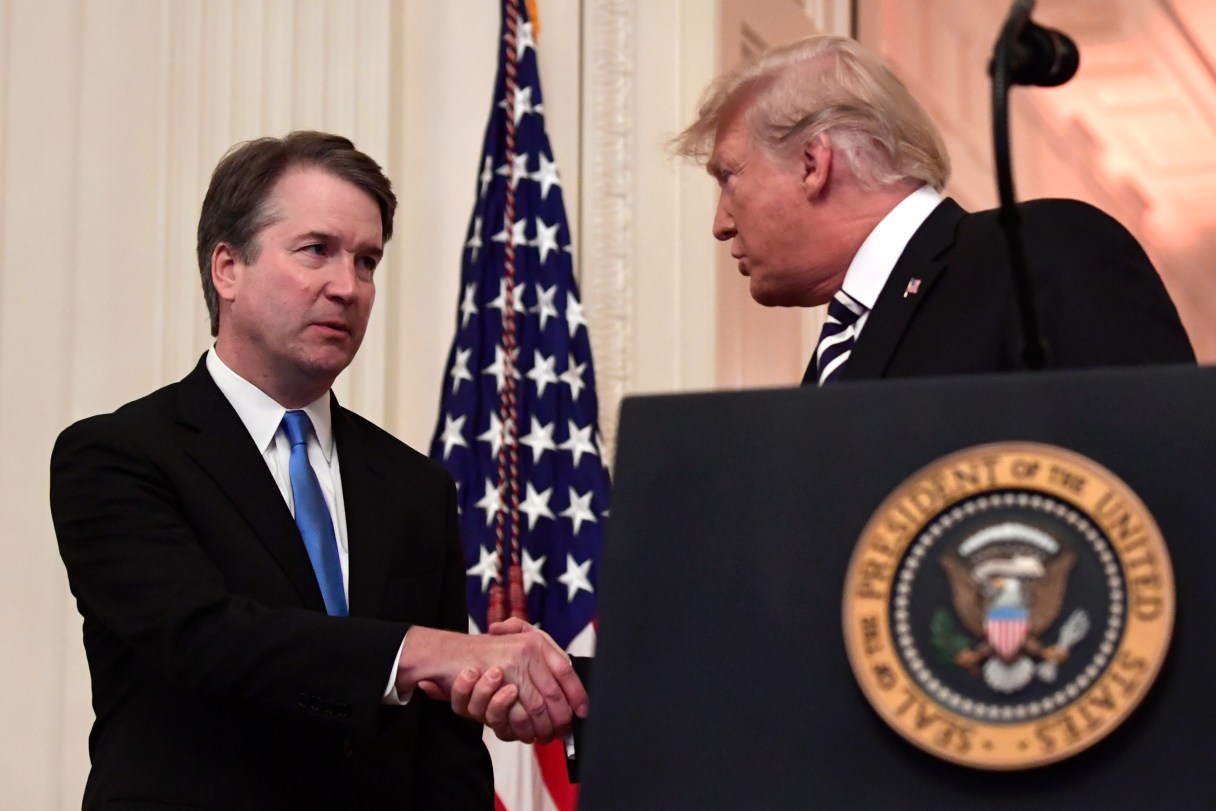
The confirmation of Justice Brett Kavanaugh brings to the Supreme Court a fifth conservative, and the reconfigured court is about to raise the curtain on a new age. The “30 years war” for the court, begun with the rejection of Robert Bork’s nomination, has been won.
Chief Justice John Roberts Jr. and Justices Clarence Thomas, Samuel Alito Jr., Neil Gorsuch and Kavanaugh compose a natural, stable and hopefully predictable coalition. Yet liberals should not fear an age of “activism,” but rather look forward to the end of the madcap judicial imperialism that began with the arrival of Chief Justice Earl Warren and on which the curtain has hopefully come down with the retirement of Justice Anthony Kennedy.
For six decades the court has been assigning to itself an ever larger and more powerful role in the nation’s life. It has gone from being the umpire of disputes – the metaphor popularized by Roberts in his confirmation hearing – to a role more closely resembling that of a commissioner of a major sports league. Commissioners such as the National Football League’s Roger Goodell and the National Basketball Association’s Adam Silver are less arbitrators of disputes than czars of their domains. And that is what the court has morphed into: the commissioner of the United States Politics League. This must end.
To be sure, the court did need to act as “commissioner” when the promise of the 14th Amendment had been systemically ignored by Jim Crow. The court itself had blessed the monstrosity of segregation and needed to reverse its terrible error. The ruling in Brown v. Board of Education, though itself a magnificent decision, unfortunately triggered a sort of intoxication among the then-serving and subsequently confirmed justices. Collectively, they began to fashion for themselves a role far greater than that imagined in the founding era. The court wanted and took for itself power.
Once the court became the commissioner of our national life, with final say over any issue or dispute it maneuvered before it, it was bound to become a battlefield. The battle for the court has been fierce, and scarring.