
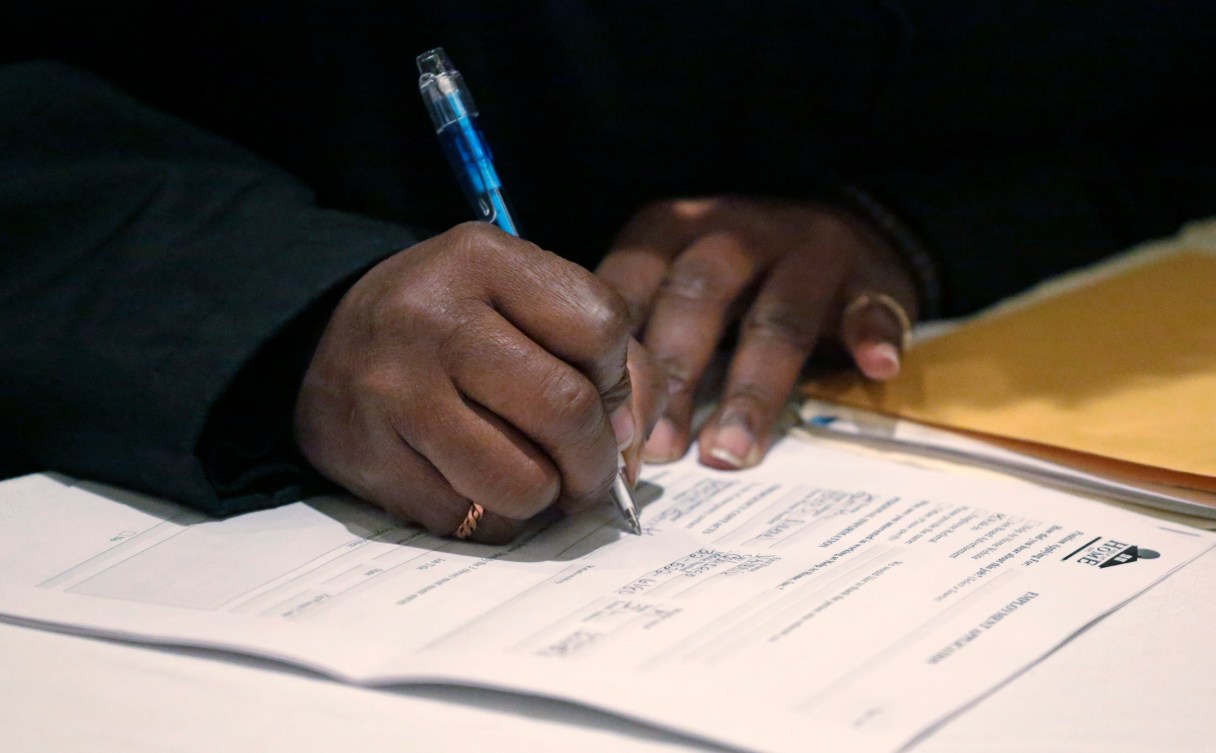
The fewest people in nearly 50 years sought unemployment benefits last week, a sign of a strong job market and an unusually low level of layoffs.
Yet the decline in applications for jobless aid isn’t due solely to a tight employment picture. Many states have imposed stricter rules on their unemployment insurance programs – from making it harder to qualify to reducing the duration of benefits to cutting payouts.
The combined effect has been to reduce the number of unemployed people who apply for and receive aid, economists say. Nationwide, just 30% of people out of work now receive unemployment insurance, down from about 40% before the Great Recession.
The historically low level of people seeking aid “tells us we have a strong labor market, and that we’ve made policy changes that mean fewer people can qualify for benefits,” said Martha Gimbel, research director at job listings website Indeed.
Weekly applications for unemployment benefits dropped 8,000 to a seasonally adjusted 196,000 last week, the Labor Department said Thursday . That is the lowest level since 1969.
IPO offering values Uber at $100 billion
Uber, the ride-hailing service that has upended transportation around the world, took a major step toward the largest initial public offering in years when it officially unveiled its finances in a prospectus Thursday.
The offering, which could value Uber at around $100 billion, is expected to reverberate through global financial markets and to solidify the company’s position as one of the most consequential technology firms of the past decade. The share sale would be the biggest since the Alibaba Group of China began trading on the New York Stock Exchange in 2014 and would peg Uber’s value at more than four times that of United Airlines’ parent and double that of FedEx.
But the prospectus for Uber’s offering renewed questions about how sustainable the company’s business actually is. It said in the filing that it had lost $1.8 billion in 2018, excluding certain transactions, on revenue of $11.3 billion. And the prospectus also showed that Uber’s rocket-ship trajectory for revenue growth was beginning to slow.
The company’s archrival in North America, Lyft, went public last month at a valuation of $24 billion. But Lyft, which is also deeply unprofitable, fell below its offering price in its second day of trading as investors questioned whether it could make money.
Mortgage rates rise; 30-year at 4.12%
U.S. long-term mortgage rates rose moderately this week, remaining at historically low levels that can lure potential purchasers in the spring home buying season.
Mortgage buyer Freddie Mac said Thursday the average rate on the 30-year, fixed-rate mortgage increased to 4.12% from 4.08% last week. Two weeks ago, the benchmark loan rate marked its steepest weekly drop in a decade, from 4.28%.
The average rate on the 30-year loan stood at 4.42% a year ago.
The average rate this week for 15-year, fixed-rate home loans rose to 3.60% from 3.56%.
Boeing makes 96 tests for airliner
Boeing’s CEO says crews have made 96 flights to test a software update for its troubled 737 Max jet and will make more in coming weeks as the company attempts to convince regulators to let the plane fly again.
Dennis Muilenburg also said Thursday that the company has met with pilots and airline officials in the U.S. and abroad, holding flight-simulator sessions to demonstrate the software changes.
The Federal Aviation Administration, which will consider whether the plane can resume flying in the U.S., plans to meet Friday with safety officials and pilots from American, Southwest and United, the three U.S. carriers that were using the Max jet.
An FAA spokesman said the agency wants to hear from the airlines and pilots before deciding what Boeing must do before the plane is allowed to fly.