
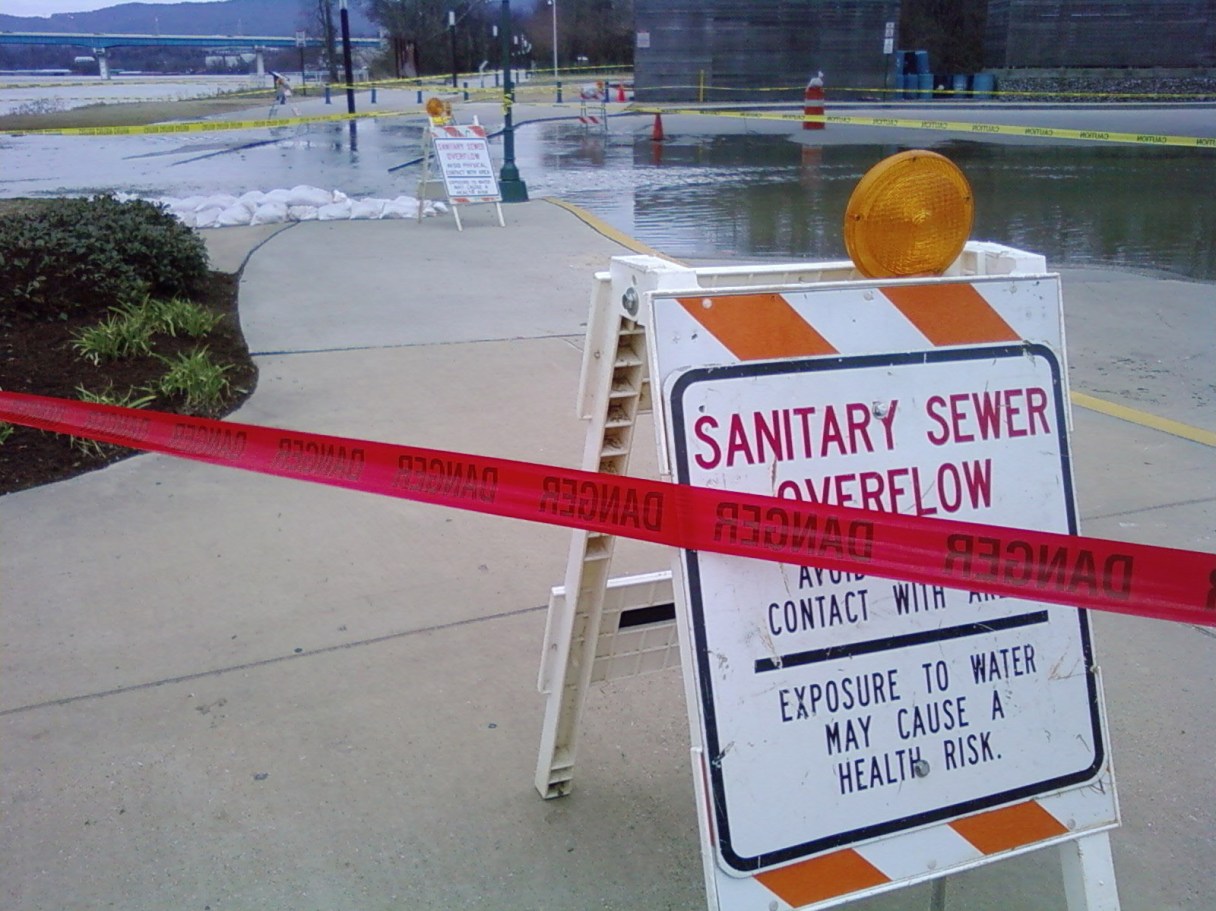
SSDD. To clean this up a bit, we’ll define that urban dictionary acronym as “same stuff, different day.” And that’s where Hamilton County commissioners found themselves on Wednesday – talking yet again about sewage treatment and its infrastructure in our 576-square-mile county.
Voting down a sewage treatment plant in Ooltewah last month made the commissioners heroes in the Mahan Gap community, but it didn’t solve the problem one commissioner said can cost Hamilton County millions in penalties and lost growth opportunities.
“The EPA is breathing down our necks, there’s $248 million in repairs needed [by the Hamilton County Water and Wastewater Treatment Authority], and somebody sooner or later is going to have to deal with that,” Commissioner Warren Mackey said at the commission’s first meeting of 2019. “We should think ahead.”
Indeed. And “we” should have been thinking ahead some years ago. But the characterization of that cost as penalties or fines is wrong. And wrongheaded. When the Hamilton County Water and Wastewater Treatment Authority eventually signs a consent degree with the U.S. Environmental Protection Agency for years of consistently violating the nation’s Clean Water Act, that anticipated $248 million hammer will pay not just for needed repairs but also necessary future treatment expansions so the county’s population, neighborhoods and businesses can continue to grow.
We’re playing catch-up, now, and catch-up is always expensive growth, rather than smartly planned growth.
That’s especially true of stinky, dangerous sewage. When we’re talking about a community-sized flushing – let alone a county-sized flushing – the mess just doesn’t disappear by itself. And it won’t roll downhill or into some “away” hole for free.
Commissioners voted 6-3 last month not to grant a special permit for the WWTA to build a sewage treatment plant at 7800 Mahan Gap Road. WWTA’s contention (on its website and in various meetings) for needing the 10-million to 20-million gallon-a-day plant was that Chattanooga’s Moccasin Bend Wastewater Treatment Plant was at capacity.
That’s just not true.
The Moccasin Bend plant, designed to be a regional plant, has a treatment capacity of 140 million gallons per day. It now treats, on average, 65 million gallons a day, leaving plenty of room for what WWTA wanted to send to Mahan Gap. Even during wet-weather events, the city can pump an additional 90 million gallons a day through its wet weather storage system, creating a total wet weather capacity at Moccasin Bend of 230 million gallons a day.
Just the wet-weather storage system alone – a series of eight cavernous underground tanks most Chattanoogans don’t even know exist – cost about $50 million. Begun in the 1990s, it was part of Chattanooga’s effort to defray its own dreaded federal consent decree with EPA. But the city’s $50 million was a lot of bang for the buck, considering that WWTA’s very small proposed plant was to cost about $45 million.
Our county – also under the gun from EPA even in the 1990s – didn’t do so much planning. Instead, in 1994 it created a separate authority, WWTA, and thrust the planning duty off on it. WWTA’s mission was to repair and extend sewerage lines in small local cities and the rural areas of the county. Those lines would carry waste to Moccasin Bend, and the city utility would charge the smaller feeder cities, as well as the WWTA, for the amount of waste fed into the treatment plant.
But with a few exceptions, the county and WWTA didn’t really stick to the plan. After all, that wastewater stubbornly refused to disappear down a hole for free, and any real solution was expensive and complicated and required political will to raise rates or increase taxes or both. By 2007, County Commission Chairman Larry Henry and treatment authority Chairman Henry Hoss said the county would be served best by “complete consolidation” of the city’s and county’s sewage treatment systems.
Henry and Hoss wanted Collegedale and Chattanooga to join the WWTA. But who would control that consolidation was the sticking point. Then-Chattanooga Mayor Ron Littlefield basically said no thanks, but maybe in the future – along with other “metro service” ideas.
That brings us here – back at square one with the ball in the county commission’s court. The Moccasin Bend plant can handle nearly twice the waste it now treats, but the county and WWTA continue to violate Clean Water Act standards regularly. Because of that, communities all over the county – think Signal Mountain – are under development moratoriums. If more homes and businesses can’t be built, the county’s tax base can’t grow without more and more tax increases.
As of Wednesday night, Tennessee American Water Co. confirmed that it is interested in buying WWTA, and according to WWTA board chairman Mike Moon, a private utility out of Pennsylvania also has called him about a possible sale.
One thing is certain. The county and WWTA haven’t served us well. Combined services might. So might private companies.
Whatever the answer, commissioners, just remember two things: Stuff always flows downhill. And making sure it does so safely is never free. Please, finally, do your homework.