
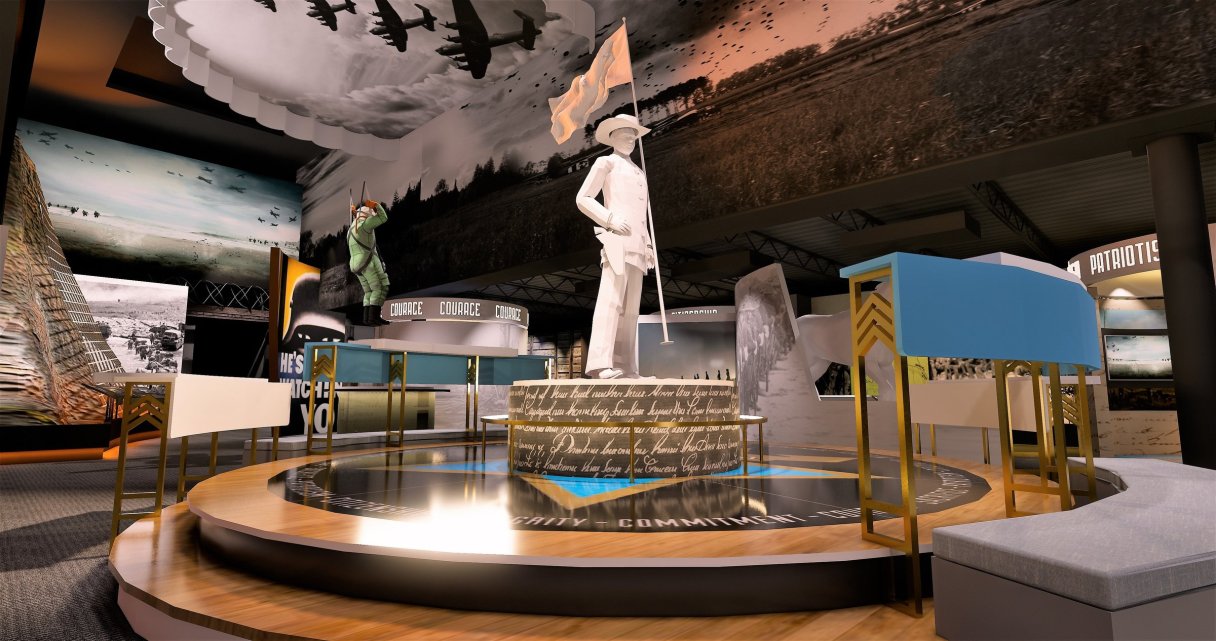
The Charles H. Coolidge National Medal of Honor Heritage Center is not about things. It’s about people. And character.
The heritage center – now slated to open in downtown Chattanooga in February 2020, will honor the tradition, culture and values of Medal of Honor recipients and teach character through Chattanooga’s and Tennessee’s own rich heritage of them – from Charles H. Coolidge and Desmond Doss to Mary Walker and Andrews’ Raiders.
You could say the the story of the Medal of Honor, America’s highest award for combat heroism, began in Chattanooga in 1863 when the Union’s Andrews’ Raiders boarded a train here called the General, bound for Marietta, Georgia. They hijacked the train and turned it back northward with a plan to destroy railroad tracks, burn bridges and cut telegraph wires behind them as they returned to Union lines near Chattanooga. The goal was to isolate our city from the Confederates to the south as Union forces prepared to attack and take control of Chattanooga’s rail hub.
Though bold, the Great Locomotive Chase, as the maneuver came to be known, was unsuccessful. But when the Union finally did prevail, 19 members of Andrews’ Raiders received the first Medals of Honor.
Mary Walker, the only female Medal of Honor recipient, was an abolitionist and an 1855 graduate of Syracuse Medical College who wanted to join the Union Army as a surgeon but wasn’t allowed because she was a woman. Because of her credentials, she didn’t want to be a nurse, either, so she chose to volunteer for the Union Army. As the war wore on and Chattanooga came to be called the biggest medical disaster of the Civil War, the Army decided to accept her medical credentials and send her here.
She was captured in April 1864 by the South and held as a prisoner of war for about four months. She and other Union doctors were eventually exchanged in a prisoner-of-war swap for Confederate medical officers. According to the National Library of Medicine, sources say Walker had been captured intentionally so she could spy for the North, but there is little evidence to support that claim, according to Army.mil.
In November 1865, having left government service for good, Walker was awarded the Medal of Honor by President Andrew Johnson, even though she was a civilian who had never been a commissioned officer in military service. That civilian status is why Walker’s medal was rescinded in 1917. But the feisty Walker refused to return the medal, and continued to wear it until she died two years later. In 1977, President Jimmy Carter restored the honor in her name, thanks to efforts made by her family.
George Jordan, a Williamson County, Tennessee, native, was a black Buffalo Soldier in the U.S. Army who received America’s highest military award for his actions in the Indian Wars of the West.
His citation reads: “While commanding a detachment of 25 men at Fort Tularosa, N. Mex., [he] repulsed a force of more than 100 Indians,” and later at Carrizo Canyon with 19 men, “he stubbornly held his ground in an extremely exposed position and gallantly forced back a much superior number of the enemy, preventing them from surrounding the command.”
Desmond Doss of Rising Fawn, Georgia, was 26 when, serving as a U.S. Army corporal and combat medic with an infantry company in World War II, he saved 75 men in the Battle of Okinawa and became the only conscientious objector to receive the Medal of Honor. His life has been the subject of books, a documentary titled “The Conscientious Objector,” and the 2016 film “Hacksaw Ridge.”
Then, there’s Charles Coolidge of Signal Mountain.
“I’m sorry, Mac, you’ve got to come and get me.” That was the reply that the then-23-year-old Coolidge, a bookbinder by trade, shouted in reply to a German commander’s order to surrender in France during World War II. Then Coolidge, who had by attrition become the platoon’s senior officer, advanced on two German tanks with a bazooka that failed. Tossing it aside, he grabbed all the hand grenades he could carry and crawled forward, throwing and inflicting heavy casualties.
But more tanks were coming, and seeing that eventually the enemy would overrun them, Coolidge “displaying great coolness and courage, directed and conducted an orderly withdrawal, being himself the last to leave the position,” according to his Medal of Honor citation.
More than 74 years later, Coolidge is Tennessee’s only living Medal of Honor recipient. It is for him that the planned heritage center in the former city visitor center beside the Tennessee Aquarium is named.
Those are real stories of real people, real character, real valor. Retired Maj. Gen. Bill Raines, chairman of the center, hopes to see them highlighted – along with a couple of dozen others among the nation’s 3,500 or so Medal of Honor recipients – to teach character, both in the museum and in our schools.
In the Chattanooga area, “we are the stewards of hallowed ground where 33 Medals of Honor were awarded – from the blood-soaked fields of Chickamauga to Missionary Ridge to the stirring site of the Battle Above the Clouds,” according to the center’s web site at mohm.org.
This is a worthy endeavor whose time finally has come.