
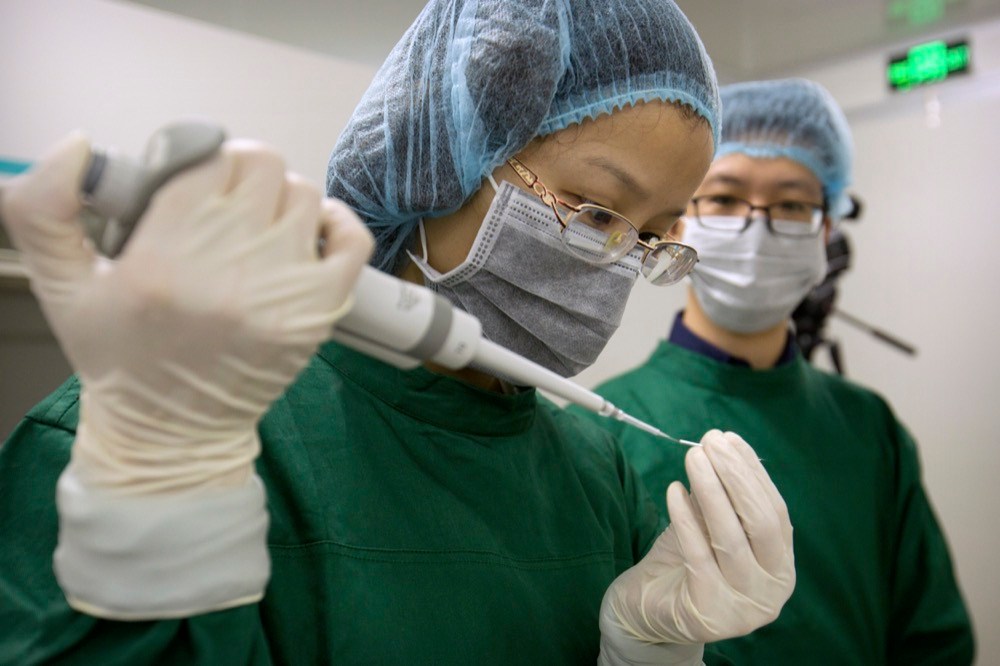
Chinese authorities confirmed last week that a scientist there is responsible for the first “gene editing” of human babies.
I don’t understand the deep science here, but I take it that by altering a baby’s DNA scientists believe they can prevent bad health outcomes.
 Mark Kennedy
But will this “gene editing” have unintended consequence? Could it even create a demand for designer babies, genetically altered to have more-desirable traits?
In the China case, a rogue, fame-seeking scientist is said to have “genetically altered the DNA of twin girls at conception” last year to help them resist infection with the AIDS virus. Reports are that the twins’ father had tested positive at some point for HIV/AIDS.
It’s bothersome that scientists are messing around with the building blocks of human existence in unborn babies. This China story feels like the opening act of a science-fiction movie.
The Associated Press reports that gene editing for the purpose of human reproduction is banned in the United States and much of Europe. Few scientists in the Western world, it seems, are ready ethically to proceed down that slippery slope.
Good.
But let’s say that some birth defects could be eliminated by manipulating a child’s DNA. Wouldn’t that be worth a shot? Or imagine that a third person’s DNA could be added to the baby-making recipe, making a child immune to some hereditary disease. Wouldn’t that be a good thing?
OK, maybe.
For the sake of discussion, let’s say parents 100 years from now will have the option to acquire made-to-order babies. Imagine if they could manipulate a child’s hair color, height and temperament, as easily they could, say, order a cheeseburger – hold the pickles – at McDonald’s.
I’m suddenly getting this image of a would-be father touching a pencil to the tip of his tongue then scribbling, “Doctor, please make our baby a left-handed relief pitcher with high-level math skills and a winning smile.”
If you don’t already have kids, the idea of perfect children may sound appealing. In fact, I remember thinking – even praying – obsessively about the health of our unborn children. If you do have children, of course, you know that their imperfections are sometimes their most endearing traits. They are certainly inseparable from the child’s personality. Faults are what make us human.
Our younger son, now 12, had a minor breathing issue when he was born. For the first day or so he panted fitfully instead of taking full, deep breaths. His attending doctor, sensing there was nothing really wrong, diagnosed him as just a “quirky” baby.
The diagnosis stuck as an inside-the-family joke. Even now, when he does something silly, our 12-year-old will excuse himself by saying, “I’m just a quirky kid, I guess.”
View other columns by Mark Kennedy
All this is theoretical now. But the time will come when altering an unborn child’s gender, appearance, intelligence or disease becomes possible.
It seems easy now to just say “don’t do it.” But it will be hard to convince future parents to maintain that restraint once the genie (pardon the pun) is out of the bottle.
Still, doesn’t a baby have the right to be born imperfect?
Might designer babies do damage to the gene pool?
Could reproductive technology lead to the end of individualism as we know it?
These are all questions that need answers. And the time to debate them is now, before fringe scientists decide to take matters into their own hands.
Contact Mark Kennedy at mkennedy@timesfreepress.com or 423-757-6645.