

Think you’d like to leave your 9-to-5 job and make a living hosting your own YouTube channel?
“You definitely can,” says Jarrod Alonge, a 25-year-old Chattanooga musician/producer/creative with more than 220,000 YouTube subscribers who tune into his videos about misheard song lyrics and song parodies.
“We are not savants. A lot of people say that they can do it, but they don’t. The reason I’m doing it [making a living online] is because I’m actually doing it,” Alonge says.
Of course, much of this depends on your definition of “making a living.” It also depends on how you set up your ad structure, whether people actually watch the ads, and whether you do endorsements. But, a rough estimate would be between $10,000 and $12,000 per year per 100,000 subscribers, according to online research.
Alonge says he is making enough to afford renting a place on Tremont Street and to have the occasional meal out – though it could all end in an instant should a change occur in how sites like YouTube operate.
He has a Plan B, if things should end: “My fallback is medical school.”
Alonge does have friends making good livings on social media, but “they have millions of subscribers,” he says.
YouTube’s “Partner Program” gives creators the opportunity to earn money on their content. Once a channel reaches 4,000 watch hours in the previous 12 months and 1,000 subscribers, the owner can apply to be part of the program, according to information provided by YouTube. Though YouTube didn’t specify the exact number of channels out there that fit this bill (some estimate around 500,000), it did say the number of channels earning five figures annually grew more than 50 percent last year, while channels earning six figures a year grew by more than 40 percent.
Alonge says he was originally planning to come out of college and go into medical school, but the fun little sketch videos he and his friends started posting started getting enough viewers to pay him money. “My senior year, I was making a decent amount on the side,” he says.
 Patty Walters, Matt Hamilton, Alex McFarland and Jarrod Alonge, from left, on set during filming.
Then, record labels, bands and producers started contacting Alonge about working with him, and he decided to take a gap year. He did a stint over two summers shooting videos on the Vans Warped Tour – the largest traveling music festival in the United States – and “since then I’ve fallen into all of these things.”
He now produces his videos for YouTube, produces for others and records his own music, which he puts on Spotify. He is also creating his own media company.
 Jarrod Alonge performs and creates videos for hit YouTube channel.
We spoke to Alonge about the ins and outs of making a living creating videos or other content for social media. We also spoke with PJ and Thomas McKay, a married Cleveland, Tennessee, couple who host a lifestyle channel called “PJ and Thomas,” and Darren, the host of “Mustie1,” a how-to channel popular with fans who want to learn how to repair a small engine, among other things. (Darren asked that we not use his last name because his recent celebrity status gets more than a few uninvited visitors to his New Hampshire shop.)
Each is quick to point out that it’s not as simple as just coming up with an idea and then collecting a paycheck. There is a lot to consider and it takes time. Lots of time.
“It’s all day long,” says Thomas. The couple’s videos feature a variety of topics including home renovations, cooking, travel and lifestyle tips, as well as some YouTube couples challenges. For the last several weeks, they have been doing a YouTube Live video every evening where people from around the world can ask questions and post comments live.
Those don’t take as much time to edit as the couple’s recorded videos, but they do take time. But the real time consumer is having to constantly monitor their phones for comments and questions and just promoting their work in general. If PJ, 32, and Thomas, 27, are contracted by a company looking for them to promote a product, there is additional sharing and work to do across all platforms.
They actually have an agent in Los Angeles who finds and vets those endorsement deals for them. She works out things like how long the McKays are obligated to use only that product, plus endorsement wording, etc., ahead of time. PJ says income from their social media work represents about 80 percent of their income, with real estate, remodeling work and house flipping bringing in the remainder.
 Thomas McKay, left, and PJ McKay relax on the set of “PJ and Thomas.” The two post videos dealing with home improvement, lifestyle and cooking topics on several social media sites.
“One downside of social media is that when you are getting paid to work on Facebook, Instagram and Twitter – and people our age are usually on those sites anyway – but we are literally on there all day responding to comments or questions or promoting our videos,” PJ says.
He also says relying on a system that can change at a moment’s notice can be worrisome.
“It’s kind of scary because with making so much money on social media, it’s hard to rely on it.”
 Thomas McKay gives PJ McKay and lift during the filming of one of the “PJ and Thomas” online video shoots.
The two now have more than 40,000 YouTube followers and more than 200,000 Instagram followers, and say they plan to ride this wave out until something new comes along. They started posting videos on social media in 2015 and shot a pilot called “Down to the Studs” for HGTV. Today, they prefer the freedom and control they have producing their own online videos.
“We actually enjoy this better, because when you are filming for TV you lose a lot of the control and storyline, and with this we have full control, and we actually make more money than you do filming a TV [show],” Thomas says.
“They [TV] set it up so you have to be in season three, four or five before you make any money.”
Darren, 54, makes his living via his “Mustie1” channel, as well as through selling the equipment he refurbishes. The most popular videos are segments he calls “Will it run?” and center around things like lawnmowers, weed eaters, chainsaws, boat motors and generators he finds at yard sales. It appears he can fix almost anything. Some of his videos register a million views or more, and one he did a year ago about a VW bus that had been parked in a field for 31 years has 6.6 million views to date.
Darren has a true skill for getting things to work again, but he also has a talent for making the viewer feel like they are literally looking over his shoulder. He does that by talking to the camera as if it were a single person. It’s a gimmick that works, but one he says is not easy.
“When I’m working on something, all of my focus is on what I’m doing, but I have to be worried about what the camera can see and did the camera catch it? Am I speaking properly? Is the lighting good? Is this the best angle? All of this is going on in your mind while you are making the video and you are pretending that none of that is an issue. And then, all the sudden the battery light is flashing and you hurry to get it done before the camera shuts off.”
A lifelong tinkerer and professional mechanic for much of his life, he says he has always loved taking things apart and putting them back together, and wants to give viewers the sense that they are spending a Saturday morning in his New Hampshire workshop “figuring stuff out.”
“When I was a kid, there were mentors that you liked, and I always enjoyed hanging out in a garage with someone and being over their shoulder and learning things. The camaraderie of guys doing guy things.
“It was fun being in a garage on a Saturday or Sunday, and I try to emulate that same feeling,” Darren says.
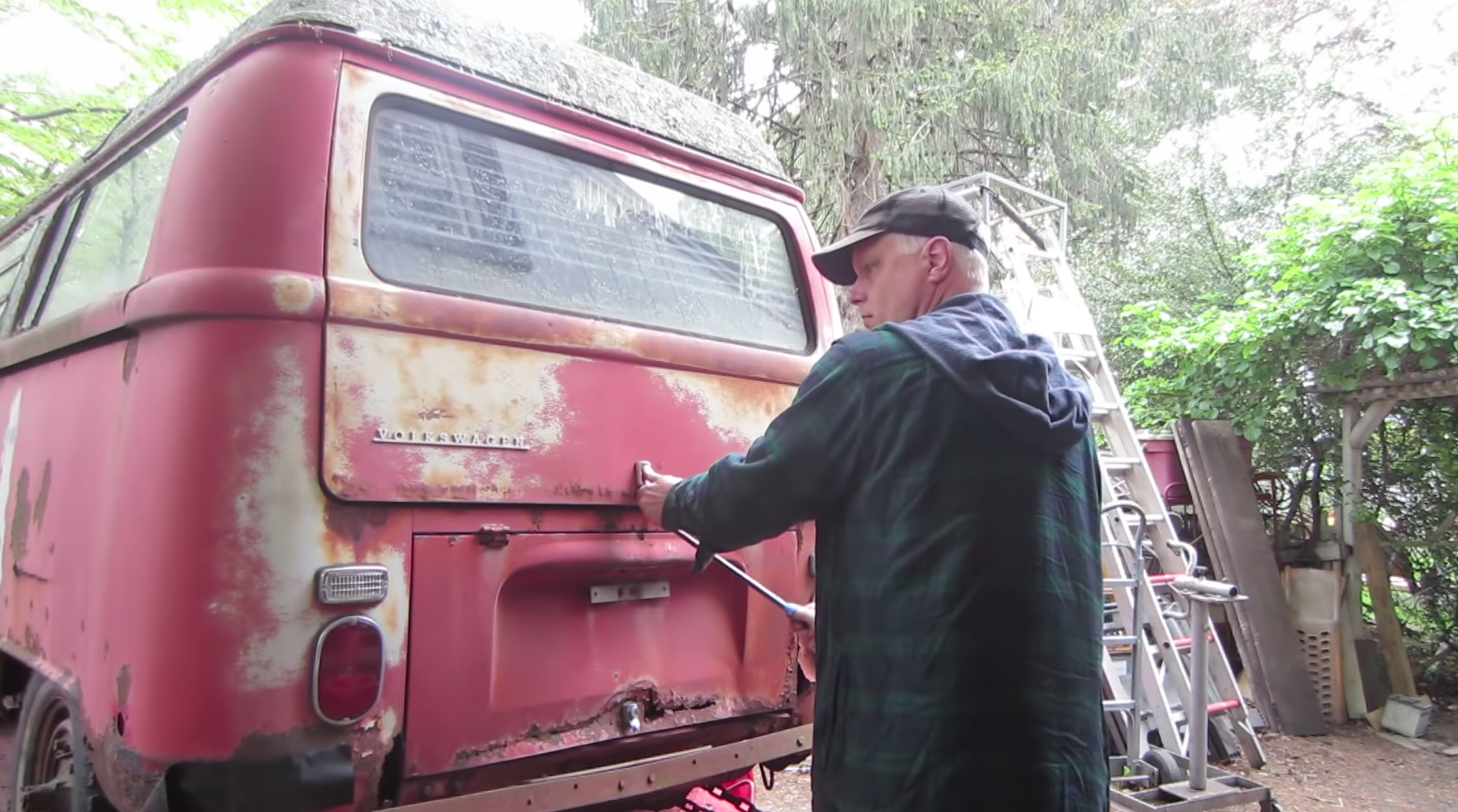 Darren makes a living via his “Mustie1” YouTube channel.
He started hanging out on YouTube in 2007 with a bunch of like-minded people informally known as the YouTube Garage Gang. They shared how-to tips and tricks and even had T-shirts made up, but there was no money to be made back then, however.
YouTube didn’t offer that option until around 2012, and even then Darren says it wasn’t until after a serious back injury sidelined him from working that he put more effort into his videos as a possible money-making endeavor.
“I no longer need to pursue a job to make an income to support myself,” he says, “but I have a backup in case I need it. They can shut you off at any time and there is no warning. They can change the way they go and they can decide you are no longer what they want for their audience.
“I have a welding fabrication trailer that is mobile as a backup.”
Darren says he pretty much avoids the endorsement deals, “because that’s when the lawyers show up.” Late into negotiations with one broadcast show, he says it became apparent they would essentially “own me” for a while, so he passed. He doesn’t mention “Adpocalypse” by name as another deterrent, but Alonge does. It’s the name given to a trend that started on YouTube in 2017 with advertisers questioning placement of their ads on certain videos they contend include hate speech or inappropriate behavior.
YouTube uses an algorithm to place ads and another to monitor content. Alonge says it’s a non-human approach that often gets it wrong, and that some videos and producers then get blocked.
“I’ve had videos blocked for being controversial even though they weren’t, and it takes so long to get them reinstated,” he says.
Alonge makes most of his money by having people download his music through Spotify, and like the McKays, uses Facebook, Twitter and Instagram to send people there.
“The model now is to get people to see the videos and link to Spotify, and that is the majority of my revenue,” Alonge says.
All four say they will ride the current setup until something different, or better, comes along.
“I think we are looking at it like a stepping stone,” says Thomas.
“We know it has a shelf life.”