
Hamilton County’s propensity for missing opportunities never ceases to amaze.
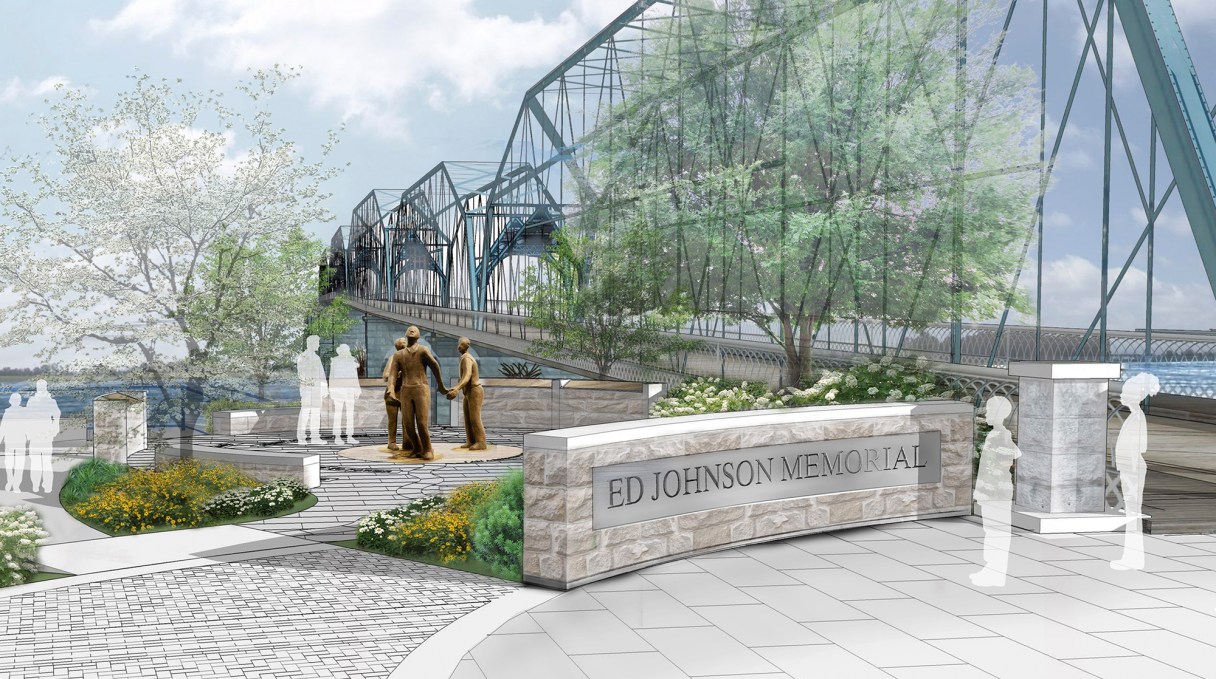
This time, Hamilton County commissioners are split on whether to use $100,000 in taxpayer dollars to help fund a memorial honoring Ed Johnson, a black man who was lynched from the Walnut Street Bridge in 1906.
But our commissioners, come Wednesday, absolutely should find a way to fund this – either with the general fund or with tourism taxes – and here’s why:
The Johnson Project, underway since 2017 with a local committee leading the effort to raise the last $100,000 of about a half million dollars, is not just about an innocent man killed by mob rule, but also our city’s African-American and civil rights history.
The memorial, planned for construction at the south side to the Walnut Street Bridge, will tell the story of Johnson, his two attorneys and a Supreme Court case.
Johnson was wrongly accused of raping a white woman, convicted in court despite a lack of credible evidence and sentenced to hang. His black attorneys, Noah Parden and Styles Hutchens, took the case to the U.S. Supreme Court, which granted a stay of execution. But an angry Chattanooga mob stormed the jail and lynched Johnson on the bridge. A newspaper account from the time quoted Johnson as saying just before he was killed, “I’m ready to die, but I never done it.”
Johnson is one of four victims who were hung on the bridge in years past. The memorial also would honor them.
Oh, and did we mention that this memorial – not to put a commercial money maker note on it, but, yes, to do just that – would add to our city’s increasingly rich tourism economy?
We talk a lot about Chattanooga’s Civil War history, its American Indian history and its industrial history. But we also have a wealth of African-American and civil rights history here – and that’s something that is just beginning to be explored and exploited, locally and nationally.
In 2017, U.S. Sen. Lamar Alexander, R-Tenn., co-sponsored bipartisan legislation to establish the African-American Civil Rights Network. Facilitated by the National Park Service, the network would form preservation and interpretation partnerships with existing federal, state, local and privately owned sites found to be significant to the civil rights struggle. President Trump signed the bill into law in early 2018, and last August, then-Secretary of Interior Ryan Zinke designated the Mississippi home of slain civil rights leader Medgar Evers as an official African-American Civil Rights Network site. The Park Service plans eventually to post online guidelines for site nominations.
Already, Tennessee has 10 tourism stops along the newly launched U.S. Civil Rights Trail – all in the cities of Memphis, Nashville and Clinton (home of the first desegregated public high school in the South).
But wait a minute! Chattanooga played a starring, albeit tragic, role in the largest migration of people in U.S. history – the slave trade.
Between 1800 and 1860, Southerners sold more than one million enslaved African-Americans, and Chattanooga – first with the Browns Ferry Federal Road and later with our rail lines – was the confluence of that billion-dollar industry and those million broken lives.
Chris Barr, a Chickamauga and Chattanooga National Military Park ranger who is researching our city’s African-American history, says there were at least two slave markets in Chattanooga, both on Market Street near the rail depot. Published news accounts from 1858 put the average number of “forced emigration of colored Americans of African descent through Chattanooga” at 600 to 800 a week.
Barr notes that equates to 3,000 a month or 36,000 a year. Using other research, he estimates that, conservatively, $2 million worth of enslaved “property” passed through Chattanooga each month – $24 million a year, in the 1860s.
“Chattanoogans may not have been buying many slaves [we weren’t plantation territory]. Chattanoogans may not have owned many slaves. But they surely profited from the institution,” he has noted in a park-sponsored history walks. “Chattanoogans owned the rail lines in the city and saw profits from the increased numbers of trains. Chattanoogans worked in the hotels putting up slave traders. Chattanoogans worked in the insurance firms insuring this $24 million worth of valuable property. Chattanoogans worked in the markets selling provisions to the slave traders. Chattanoogans worked in the shops repairing the trains and rail lines. Chattanoogans worked in the two slave exchanges on Market Street.”
And, in an era before income taxes, city governments taxed economic activity, and Barr’s research found that Chattanooga taxed slave traders $500 a year. So it’s more than fair to say that Chattanooga’s works projects and infrastructure were built in part with taxed blood money from the economic engine of slavery.
Instead of whitewashing these and other cultural stains in our city by pretending they don’t exist, why don’t we do what’s right and honor them – teaching a new unity along the way?
Other than a handful of plaques and the Bessie Smith Cultural Center, we currently make little of the artifacts of Chattanooga’s African-American and civil rights history.
Let’s not miss yet another opportunity to heal our city – and pocket some tourist dollars while we’re at it.