
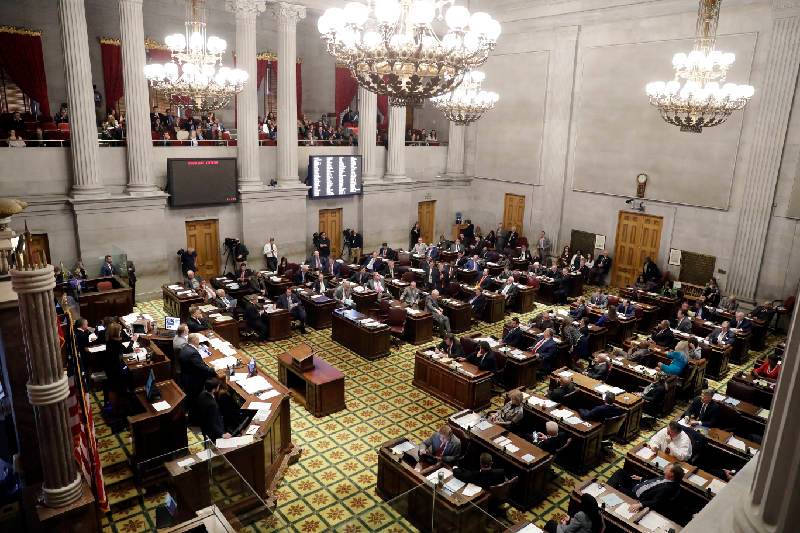
NASHVILLE – The Tennessee House on Thursday overwhelmingly passed legislation barring state or local governments from taking “discriminatory action” against companies over owners’ employee pay, health and anti-discrimination policies when they seek public contracts or economic incentives.
Critics charge the bill is a “license to discriminate.”
Passage of the measure reignites a controversy going back at least eight years. The head of the Tennessee Equality Project called the bill a “clear swipe at the LGBTQ community since we are not already protected by federal and state law in employment, housing and public accommodations.”
The measure, sponsored by Rep. Jason Zachary, R-Knoxville, was approved by the GOP-led House on a 68-22 vote following a sometimes-spirited and occasionally confusing debate.
“This is the pro-active, business protection bill,” Zachary told the GOP-dominated chamber.
But House Democratic Caucus Chairman Mike Stewart of Nashville later told reporters “If you think that bill is designed to protect people’s civil rights, I’m the king of Bavaria. Every oppressive law like that has been defended as an effort to help the people it oppresses. This is an old playbook.”
A similar measure passed the Senate in 2017 only to lose traction in the House.
But this time around, Zachary and bill proponents appear to have at least a temporary problem in the upper chamber.
Sen. Todd Gardenhire, R-Chattanooga, the bill’s sponsor in the upper chamber, said in a Times Free Press interview that he doesn’t plan to press the legislation and is now looking to hand the bill off to someone else instead.
“I’m not going to be carrying it,” said Gardenhire, who noted he agreed to introduce it on the last day before bill filing deadlines as a favor. Gardenhire said he has “concerns” about the language of the measure, declining to delve into specifics.
Under the bill, local governments and state agencies would be barred from taking “discriminatory action” against businesses if they have internal polices that are already in compliance with existing state and federal laws and regulations in four areas. They are:
* Anti-discrimination policies.
* Health insurance policies and what coverage is or isn’t provided.
* Family leave policies.
* Minimum wage policies.
During debate, Zachary said the bill “ensures that Tennessee continues to treat businesses the way we’ve done for the last eight years that has led to record low unemployment, record wages. This ensures that we continue to look at businesses the same way.”
He said neither Republican Gov. Bill Lee nor any state department had “flagged” the bill, which is the executive branch’s method of showing opposition to pending legislation.
Moreover, Zachary said, “most of the business entities, whether it’s the homebuilders, the engineers that have come to our offices this year and offered support of this legislation, they see this as pro-active legislation that protects businesses. There’s been no opposition from within the state on this legislation.”
There is an amendment in the bill, however, that specifically excludes the Tennessee Department of Economic and Community from provisions that would apparently interfere with the state’s standard practice on large economic incentive packages to lure major employers.
The state routinely offers tens of millions of dollars to major companies in grants and other incentives based on their commitment to pay high, set average wages to employees.
Chris Sanders of the Tennessee Equality Project said the bill is one of several measures that he’s dubbed the “slate of hate” in the General Assembly.
Describing Zachary as “clever” in speaking publicly about the bill, Sanders said, “I think he really avoids talking about specifics and how it ties the hands of city governments.”
Rep. Yusuf Hakeem, D-Chattanooga, a former Chattanooga city councilman, voted against the bill. He said he agreed with an argument Stewart made on the House floor about where the state Revenue Department stood on the bill.
“Second from that, there is a concern about the LGBT community about what the bill would mean to them. And I think we’ve seen around the country where a business can sort of take things upon themselves and create some problems,” Hakeem said.
But a major force behind the bill, David Fowler, a former Republican state senator from Signal Mountain and president of the Christian conservative Family Action Council of Tennessee, said he doesn’t see what the fuss is all about.
Fowler accused cities, especially Nashville, of trying to circumvent a 2011 bill he pressed that became state law. It prohibits cities from trying to enact social and pay policies through ordinances, he said.
He pointed to a fairly recent executive order signed by Nashville Mayor David Briley. It affirmed the inclusion of LGBTQ-owned businesses “as a recognized category for Metro procurement.”
In a news release, the mayor’s office said it was part of Briley’s mission “to have Metro Government reflect the diversity of Nashville in its hiring practices, contracting and economic development opportunities, and through the delivery of equitable programs, services, and policies.”
“What we’re forgetting here is an attempt by one city, if not others, to flout and to circumvent the clear intent of the law passed in 2011,” Fowler said. “You can’t do it by ordinance. The basic policy was already set.”
He charged that “by saying we can’t legally make you do it, but we will give you ‘preferences’ and give you ‘opportunities’ is to circumvent the clear intent of the law.”
If Nashville wants to change the law, let them come and ask the legislature to do it, Fowler said.
The GOP-controlled General Assembly has shown little hesitation in barring cities’ efforts to enact measures on any number of fronts.
Fowler said the intent of the bill is to keep government leaders, be it from a progressive or a conservative perspective, from overreaching. As an example, he pointed to conservative Rhea County’s commission once attempting to ban members of the LGBTQ community from living there.
Contact Andy Sher at asher@timesfreepress.com or 615-255-0550. Follow him on Twitter @AndySher1.